SightingCold War
Soviet Air Defence UAP Contact — Chișinău, Moldavian SSR, 1978
c. 1978
Chișinău, Moldavian SSR, USSR
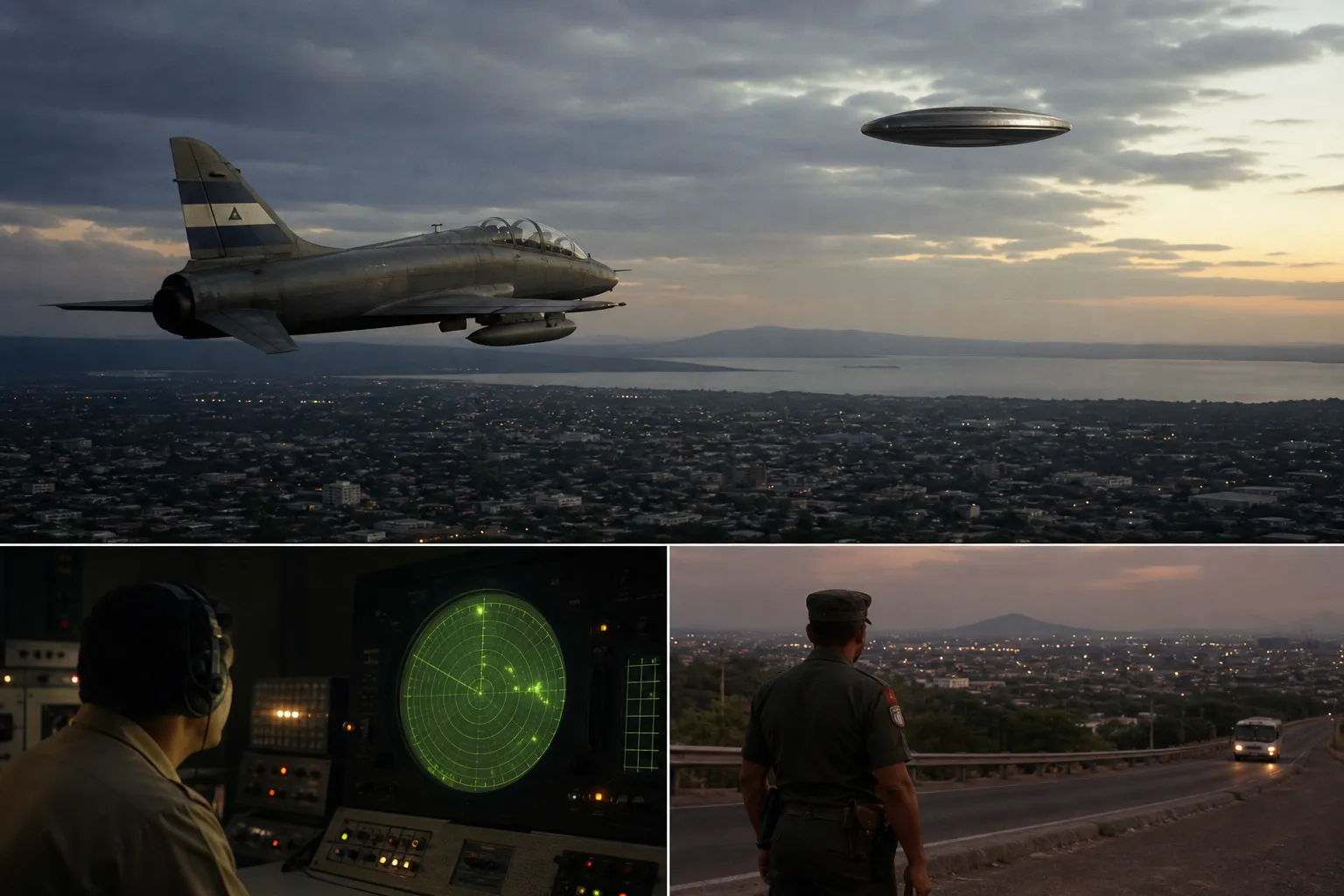
AI-rendered impression — A Soviet police officer in Chișinău, Moldavian SSR, observing a large luminous sphere hovering silently over the city outskirts as Soviet radar operators simultaneously track the object, 1978 — UAP Archive / openai (gpt-image-1)
Credibility Assessment
Moderate
Military WitnessMultiple WitnessesRadar CorroboratedLaw EnforcementOfficial Report
Event Description
Observed Shape
Orb
Craft morphology

Non-Human Intelligence (NHI)
Reported Entities
No NHI encounter documented for this event.
The Moldavian Soviet Socialist Republic occupied a distinctive position along the western frontier of the USSR in 1978. Bordering Romania — itself a Warsaw Pact member but one with an unusually independent foreign policy under Nicolae Ceaușescu — the Moldavian SSR was covered by Soviet Air Defence Forces radar installations specifically tasked with monitoring the sensitive western air corridor. Chișinău, the capital, sat within radar range of Romanian and indirectly of NATO territory. The year 1978 was particularly significant in Soviet UAP documentation: the SETKA investigation programme was formalized that year under the joint oversight of the Soviet Academy of Sciences and the Ministry of Defence, and a wave of high-quality reports from across the western USSR entered the programme's collection almost immediately.
The primary witnesses included Soviet Air Defence Forces radar operators at a PVO installation serving the Chișinău military district, who tracked the object on radar. A Chișinău city police officer on patrol — a law enforcement professional with formal training in observation and reporting — made an independent visual sighting at street level. Additionally, night-shift workers at a factory complex on the outskirts of the capital observed the object from the factory yard, providing a third independent witness group. The combination of military radar personnel, a sworn law enforcement officer, and factory workers represents three independent witness categories with no communication between them during the event.
The object appeared as a large, luminous sphere or ovoid, distinctly brighter than any navigation lighting or flare. The police officer described it as approximately 20–30 metres in apparent diameter at its closest approach, silent, and hovering at low altitude for several minutes before ascending rapidly and departing at high speed. The factory workers, observing from a slightly different angle, confirmed the spherical shape and the sudden high-speed departure. Radar operators tracked the object as a solid return that appeared at altitude, descended to a low hover, then departed vertically at a rate of climb no aircraft in their recognition inventory could achieve.
The vertical departure at a rate of climb exceeding any known aircraft — including the fastest Soviet interceptors of 1978 — is the primary flight performance anomaly. The object's ability to hover silently at low altitude without any visible propulsion mechanism ruled out all known aircraft. Its size, as estimated by multiple independent witnesses, exceeded any known balloon or weather instrument. The corroboration between the radar track and the independent visual observations from three separate locations established the object as a genuine physical phenomenon.
Radar contact by Soviet PVO operators is the primary instrument record. The radar return was consistent with a solid, large-scale physical object. The police officer's patrol vehicle radio reportedly experienced interference during the closest approach of the object — a pattern consistent with other documented Soviet UAP cases from the 1978–1980 period. No permanent damage to equipment is recorded.
The case was reported through PVO channels and also through civilian party structures to the SETKA investigation programme coordinator at the Ministry of Defence. The SETKA programme, which collected thousands of military UAP reports between 1978 and 1990, assigned this case a classification number in its registry. Soviet researchers including Vladimir Ajaja (USSR Academy of Sciences) cited western border-region cases in their summary analyses. The case was not publicly disclosed during the Soviet era.
Standard Soviet military classification protocols applied. Personnel who filed reports were bound by military or state security secrecy obligations. The proximity of the Moldavian SSR to the Romanian border added an additional layer of sensitivity — any acknowledgment of unidentified aerial phenomena over this region had potential diplomatic and intelligence implications. No specific disinformation narrative was deployed; suppression took the form of classification and non-disclosure.
The Chișinău 1978 case is significant because it represents the intersection of three independent witness categories — military radar, law enforcement, and civilian — in a single event, which is among the most robust evidence configurations available. The case's entry into the SETKA programme means it was evaluated by Soviet scientists and military analysts using systematic methodological criteria, not merely filed and forgotten. The Moldavian SSR's border position made the Soviet Air Defence radar coverage in the region exceptionally dense, lending additional weight to the radar confirmation. Post-Soviet Moldova's partial access to former Soviet classified archives has made some of these records available to researchers for the first time.
5 Observables Detected
Instantaneous Acceleration
Hypersonic Velocity
Low Observability
Trans-Medium Travel
Anti-Gravity Lift
Suspicious Activity
Intelligence Agency
Cover-up Actions
Men in Black
Disinformation
Witness Suppression
Sources
governmentSETKA programme registry — Soviet Ministry of Defence UAP case files, 1978 (western SSR series)
mediaVladimir Ajaja (USSR Academy of Sciences) — published Soviet UAP case summaries, 1980s (samizdat/post-Soviet release)
mediaPaul Stonehill & Philip Mantle, 'Russia's UFO Files' (1997) — documents western Soviet republic UAP cases from SETKA