
Credibility Audit
3 factors- Military Witness+3
- Multiple Witnesses+2
- Official Report+1
- 0–3
- 4–7
- 8–11
- 12–16
- 17+
DoD Observables
2 of 5- Instantaneous Acceleration
- Hypersonic Velocity
- Low Observability
- Trans-Medium Travel
- Anti-Gravity Lift
Event Description
Craft morphology
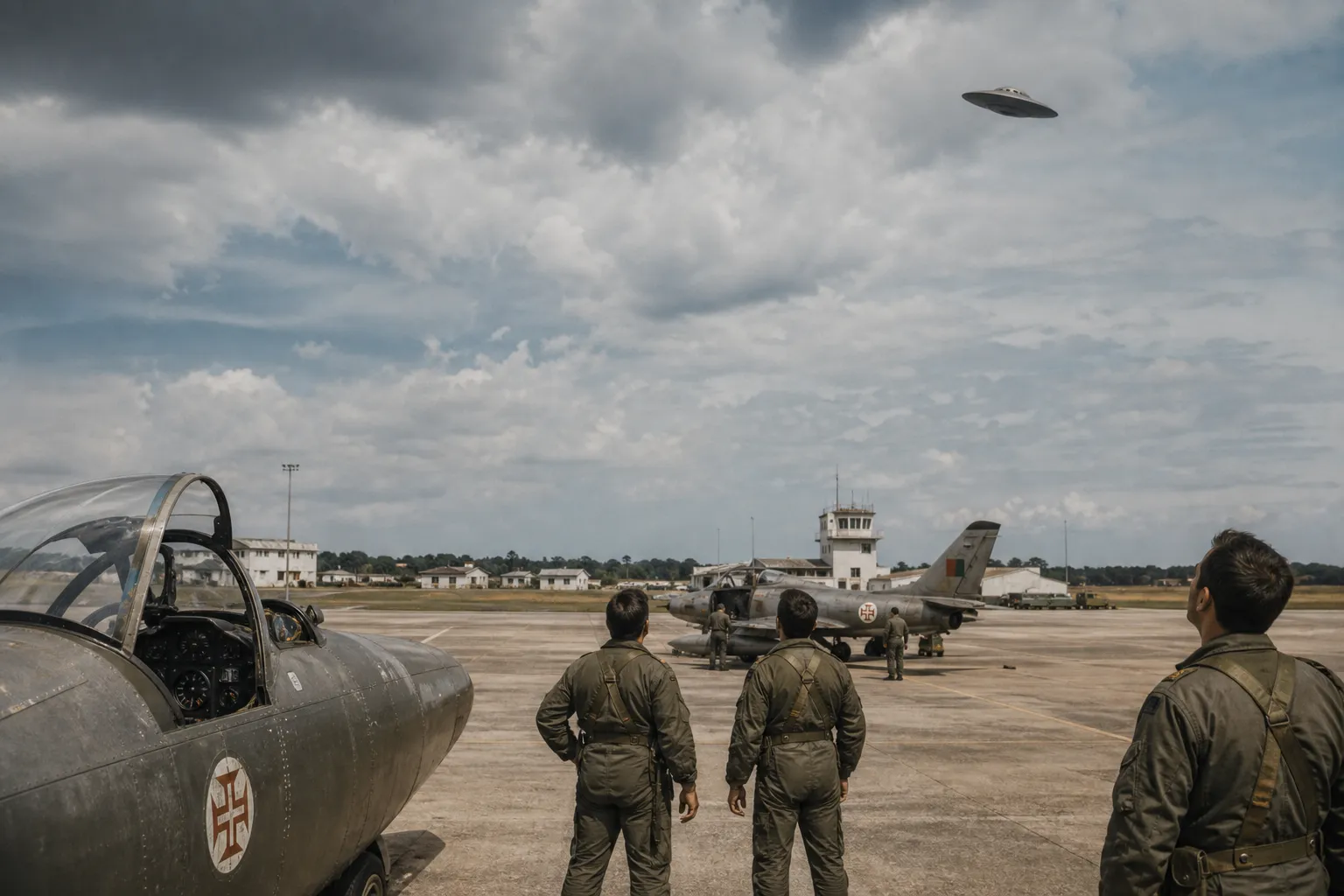
In early 1974, Mozambique was still a Portuguese colonial territory — the Estado Novo regime's African province in the final phase of its existence. The Força Aérea Portuguesa (Portuguese Air Force, FAP) maintained air assets at Beira's La Buonone airfield as part of the counterinsurgency campaign against FRELIMO. Portuguese military pilots in Mozambique were operational combat veterans flying Fiat G.91 ground attack jets and Alouette III helicopters in active operations. The political crisis that would culminate in the April 1974 Carnation Revolution in Lisbon — just months after this sighting — was building rapidly; the military's attention was divided between the colonial wars and the domestic political situation. Against this backdrop of heightened surveillance and military professionalism, a UAP report from Portuguese Air Force pilots carried institutional weight.
Portuguese Air Force combat pilots — officers with active operational experience in the counterinsurgency theatre — were the primary witnesses. These were professional military aviators trained to the highest FAP standards of the period, experienced in aircraft recognition and atmospheric phenomena assessment from actual combat flying hours over the Mozambican bush. Multiple pilots observed the object simultaneously, providing independent corroboration. The report was filed through FAP channels and entered the Portuguese Air Force's classified UFO file, which was maintained alongside the more famous Cape Verde and metropolitan Portugal UFO reports of the same era.
The object was described as a disc shape with a metallic, highly reflective surface observed in daylight. It appeared in the airspace near Beira at medium altitude and executed a series of sharp directional changes before accelerating rapidly away. Pilots described the object as much larger than any drone or balloon of the period, with no visible propulsion system. Its maneuvers — sharp angular changes without any deceleration or banking — were physically impossible for any known aircraft. No sound was reported.
The disc shape, metallic surface, sharp-angle maneuverability without deceleration, and silent operation were the primary anomalies. Portuguese pilots in Mozambique were acutely aware of potential South African reconnaissance aircraft and FRELIMO surface-to-air threats; unidentified objects were taken seriously. The object's behavior — controlled, purposeful, and dramatically exceeding known aircraft performance — ruled out all known adversary aircraft.
No radar tracking is documented for this specific event. The primary evidence is the multi-pilot visual observation. The FAP's Mozambique airfields did not maintain comprehensive radar coverage of the broader Beira area.
The report was submitted through FAP channels. Portugal's military UFO files from the colonial period were partially declassified in the 1990s as part of broader archival openness following democratization. The declassified Portuguese Air Force files include reports from the African theatre alongside reports from metropolitan Portugal and the Azores. The Beira 1974 sighting is referenced in Portuguese UAP research literature.
Portugal's Estado Novo regime and its successor democratic government both maintained standard military classification for UFO reports. The classification of colonial-era military files was lifted progressively after 1974. No specific disinformation effort is documented for this case.
The Mozambique 1974 case is significant for its timing — Portuguese military pilots at the peak of the colonial crisis, months before the political transformation that would end Portuguese Africa, reporting an anomalous object that exceeded their considerable operational experience. Combat pilots are among the most credible UAP witnesses available, precisely because their professional training requires distinguishing genuine threats from misidentifications in high-stakes operational conditions. The case contributes to the documented African UAP record from the period of the liberation wars, when military aviation activity across the continent was at historically high levels.
Sources
- governmentPortuguese Air Force declassified UFO files — Força Aérea Portuguesa archive, African theatre reports, 1970s
- mediaJoaquim Fernandes & Fina d'Armada — Portuguese UAP research, colonial-era military cases
- mediaCynthia Hind, 'UFOs Over Africa' (1982) — Portuguese colonial military cases, Mozambique chapter