
Credibility Audit
5 factors- Military Witness+3
- Pilot Witness+3
- Radar Corroborated+3
- Official Report+1
- Historical Document+1
- 0–3
- 4–7
- 8–11
- 12–16
- 17+
DoD Observables
2 of 5- Instantaneous Acceleration
- Hypersonic Velocity
- Low Observability
- Trans-Medium Travel
- Anti-Gravity Lift
Event Description
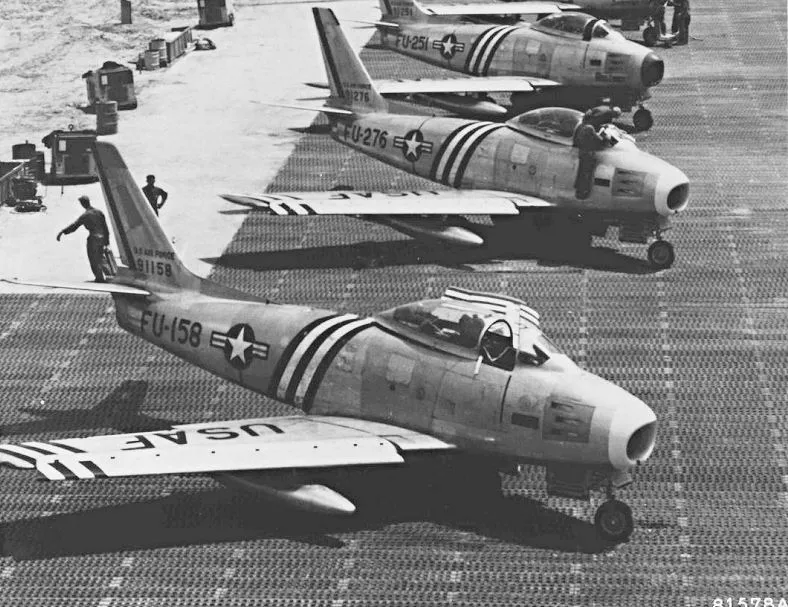
On the morning of March 12, 1954, at approximately 09:35 local time, USAF 1st Lieutenant Robert Johnson was scrambled in a North American F-86 Sabre jet fighter from Nouasseur Air Force Base in French Morocco — the same facility serving as a Strategic Air Command staging hub on the edge of Cold War geopolitics. What followed was a 30-second pursuit that Project Blue Book would log as case number 2937 and classify as unexplained.
Johnson reported closing on an object that appeared, at a distance, to be approximately the size of a fighter aircraft. It bore no identifying markings, no external fuel tanks, and produced no contrails or exhaust trails — the defining visual signatures of any jet-powered aircraft of that era. Despite pushing his F-86 to speeds in excess of 530 miles per hour, Johnson could not close the gap. The object then accelerated northward and disappeared from view. The entire observation lasted roughly 30 seconds.
The March 12 incident did not occur in isolation. Blue Book records and the NICAP case file note that "a number of unidentified objects have been reported in this area, both visually and by radar" during the seven days preceding Johnson's scramble. The opening event of this cluster occurred on March 5, 1954, when crews aboard USAF KC-97 aerial tanker aircraft reported an unidentified object or light making deliberate passes at their aircraft, with a second object observed flying straight and level. Tanker crew sightings in airspace they routinely occupied, followed one week later by a fighter pilot being unable to intercept a craft of apparent fighter-plane dimensions — the Blue Book file treats these as part of a coherent regional wave, not isolated noise.
Project Blue Book rated this case with a credibility score of 5, its highest tier. Within the Blue Book system, that designation was applied when the witness was considered unimpeachable — a trained military aviator in the act of operating the aircraft — and when the reported performance exceeded anything attributable to known technology or natural phenomena. Case #2937 received that rating. Blue Book's investigators could offer no conventional explanation.
The significance of the Nouasseur case rests on several converging factors. The primary witness was a commissioned USAF officer, an active-duty fighter pilot, flying a front-line aircraft, performing a documented scramble. He was not a bystander: he was the designated intercept asset, trained to identify and close on aerial targets. His report of an object that outran his F-86 while displaying none of the physical characteristics of a jet or propeller aircraft — no tanks, no contrails — is a technical observation, not an impression. The 7-day multi-platform pattern of radar and visual contacts at the same base adds corroborative depth that a single-witness event cannot provide. For North Africa, where UAP documentation from this era is sparse, the Nouasseur cluster represents one of the most rigorously documented Cold War-era cases on record.