SightingMedieval
Nuremberg Chronicle — Fiery Sphere Over Central Europe
c. 1034 AD
Central Europe, Holy Roman Empire
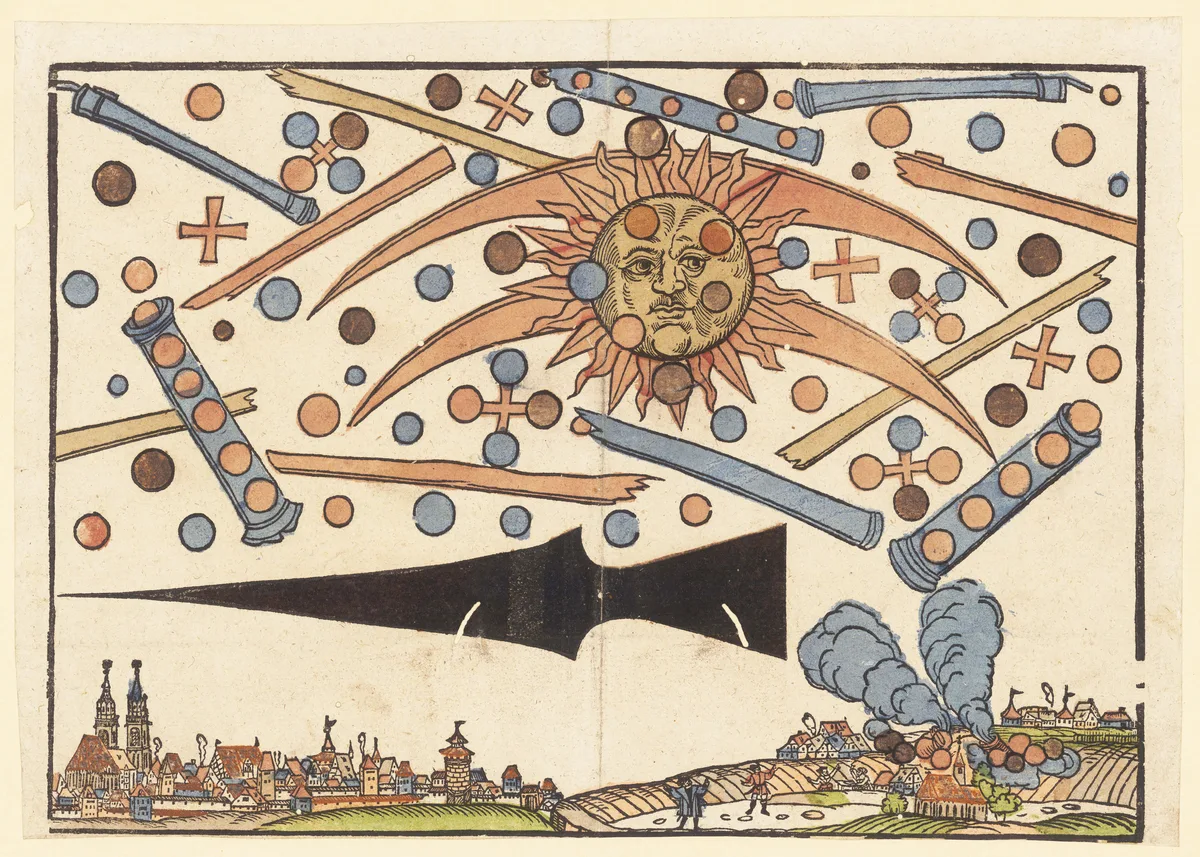
The 1561 Nuremberg celestial phenomenon — a hand-colored broadsheet depicting spheres, cylinders, and crosses engaged in aerial battle over the city, one of the most detailed surviving illustrations of a medieval mass UAP event — Public Domain Image Archive / 16th century Germany
Credibility Assessment
Low
Historical Document
Event Description
Observed Shape
Sphere
Craft morphology

Non-Human Intelligence (NHI)
Reported Entities
No NHI encounter documented for this event.
The Liber Chronicarum — the Nuremberg Chronicle — was compiled by the physician and humanist Hartmann Schedel and published in 1493 by Anton Koberger using Gutenberg-press technology. It was one of the most ambitious publishing projects of the incunable era, drawing on Roman, medieval, and regional chronicles to create a comprehensive history of the world. Among the entries preserved in this authoritative source is an account from the year 1034: a 'fiery sphere' that moved in a straight course from south to east, then veered toward the setting sun.
The directional change is what elevates this account beyond ordinary meteor or atmospheric phenomenon. A natural meteoric body follows a ballistic trajectory determined by gravitational and atmospheric forces. An abrupt course change toward the setting sun — orthogonal to the original flight path — is not consistent with any known natural aerial phenomenon. Jacques Vallée, the French-American astronomer and computer scientist who systematically catalogued pre-modern UAP accounts in Passport to Magonia (1969), cited this entry as one of the earliest definitively dated medieval European UAP records. Vallée's methodology specifically sought accounts where the behavioral description ruled out conventional natural explanation.
The Nuremberg Chronicle survived in hundreds of copies — approximately 1,400 Latin and 700 German editions — distributed across the libraries and monasteries of the Holy Roman Empire. Schedel drew on multiple contemporaneous regional chronicles for his historical entries, meaning the 1034 account was not a lone record but a compilation of multiple independent primary sources. The event occurred during the reign of Holy Roman Emperor Conrad II, in a region where literate clergy and court chroniclers maintained detailed records.
The year 1034 sits within a broader medieval period that produced an unusually high number of documented aerial anomalies. Ecclesiastical record-keepers, whose chronicles were organized around the concept of divine omens and portents, applied detailed observational standards to aerial events because such events were considered prophetically significant. This cultural framework, while not scientific in the modern sense, created an incentive for accurate, detailed documentation — events that could be easily explained as birds or weather were not worth recording. The fiery sphere accounts that survived the medieval documentary filter represent observations sufficiently anomalous that multiple observers and chroniclers considered them remarkable.
The 1034 Nuremberg Chronicle entry belongs to a class of pre-Arnold UAP records that stretch back to antiquity — Alexander the Great's accounts of shining shields over his armies in 329 BC, the 218 BC Roman senatorial records of specters in the sky documented by Livy, and the Tulli Papyrus from Egypt circa 1440 BC. Together they form a documentary thread suggesting the phenomenon is neither modern nor culturally bounded.
5 Observables Detected
Instantaneous Acceleration
Hypersonic Velocity
Low Observability
Trans-Medium Travel
Anti-Gravity Lift
Suspicious Activity
Intelligence Agency
Cover-up Actions
Men in Black
Disinformation
Witness Suppression