
Credibility Audit
6 factors- Military Witness+3
- Radar Corroborated+3
- Pilot Witness+3
- Multiple Witnesses+2
- Historical Document+1
- Official Report+1
- 0–3
- 4–7
- 8–11
- 12–16
- 17+
DoD Observables
0 of 5- Instantaneous Acceleration
- Hypersonic Velocity
- Low Observability
- Trans-Medium Travel
- Anti-Gravity Lift
Event Description
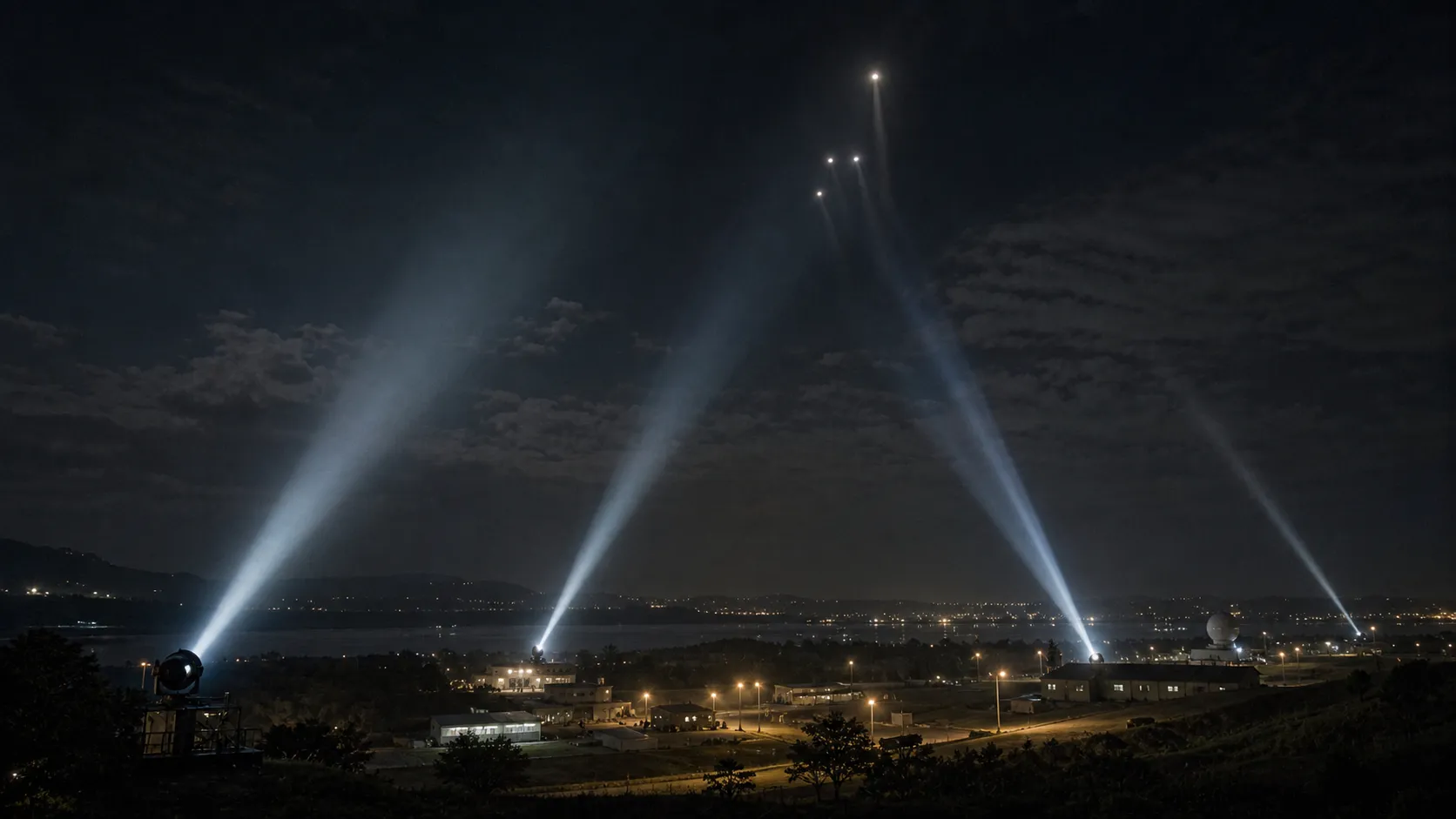
During the night of March 9 into the early hours of March 10, 1958, the radar operators and military personnel at U.S. Army and Air Force installations in the Panama Canal Zone encountered a sustained series of anomalous aerial tracks that resisted all conventional explanation. The Canal Zone — the narrow strip of American-administered territory flanking the Panama Canal — was among the most heavily instrumented military installations in the Western Hemisphere during the Cold War, ringed by radar systems protecting the canal from potential air attack. The objects tracked that night were not subtle or ambiguous: they appeared as strong, discrete returns on multiple independent radar systems, occasionally hovered, then accelerated to speeds approximating 1,000 miles per hour as intercept aircraft approached. Ground personnel at Fort Clayton illuminated the night sky with searchlights, making visual contact with the targets — and watching them ascend from 2,000 to 10,000 feet in seconds. The event was formally investigated, documented, and retained in Project Blue Book records as an unexplained case.
The witnesses comprised three distinct categories, each with significant institutional credentials. First, military radar operators at multiple Canal Zone installations — trained technicians responsible for air defense of a strategic national asset — detected and tracked the objects using search and tracking radar equipment. Their reports are institutional records, logged as part of operational duty and subject to chain-of-command review. Second, ground personnel at Fort Clayton observed the objects visually when searchlights were brought to bear, providing direct human confirmation of the radar returns. Third, a commercial aviation witness: the pilot of a Pan American DC-6 airliner transiting the area independently reported observing an object in the same airspace, describing it as appearing larger than his own aircraft and traveling in a southeasterly direction. The three-category witness structure — military radar operators, military ground visual observers, and an independent commercial airline pilot — provides a cross-corroborating evidentiary base that is difficult to dismiss.
The radar returns were described by operators as strong and clearly distinct from weather clutter — not ambiguous targets but confident tracks. The objects' movements were characterized as erratic and evasive, with general trajectories showing triangular patterns of track. At various points the objects hovered in place before executing rapid accelerations. When Fort Clayton personnel directed military searchlights at the sky, the objects responded: within seconds of illumination, they ascended from approximately 2,000 feet to approximately 10,000 feet — a vertical climb rate that overwhelmed the tracking radar's slew rate, causing the lock to break. Separate from the military observations, the Pan American DC-6 pilot reported an object appearing larger than a transport aircraft traveling southeastward through the canal zone airspace. The correlation between radar tracks and independent commercial pilot sighting provides simultaneous multi-platform corroboration.
The principal anomaly is the response to searchlight illumination: a deliberate, rapid evasive ascent from 2,000 to 10,000 feet within seconds of the searchlight being directed at the object. No conventional aircraft of 1958 — military or civilian — was capable of that rate of climb from that altitude, and no aircraft would respond to a searchlight by immediately climbing vertically. This behavior is consistent with active sensor awareness and evasive action, which carries significant implications for the nature of the object. Secondary anomalies include the acceleration to approximately 1,000 mph as intercept aircraft approached — a speed in excess of any U.S. Air Force aircraft operationally deployed in the Canal Zone in 1958 — and the erratic, triangular track patterns that do not conform to any known aircraft's flight behavior.
The primary instrument record is the multi-system radar tracking data from Canal Zone installations. The tracking radar's inability to maintain lock during the objects' ascent from 2,000 to 10,000 feet represents both a radar performance limit and indirect evidence of an extraordinary climb rate. No electromagnetic effects on other systems were documented in available open-source records. Intercept aircraft dispatched to locate the objects visually found nothing — consistent with the objects having departed the area at high speed before aircraft could reach their last known position. The combination of strong positive radar returns followed by radar lock-break during rapid ascent, and then clean intercept miss, is a pattern consistent with objects capable of velocities and accelerations beyond 1958 military aircraft capabilities.
The U.S. Air Force formally investigated the incident through Project Blue Book, the official USAF program for evaluating UAP reports. Fort Clayton's incident was filed as an official report and retained in the Blue Book archive, which was declassified and transferred to the National Archives. The report's survival in the declassified Blue Book records — rather than being dismissed and destroyed — indicates it met the threshold for formal documentation as a genuine unknown. No official explanation was ever assigned; the case was classified as unexplained. The presence of multiple independent radar systems, a commercial aviation witness, and the specific detail of searchlight-triggered rapid ascent distinguished this report from ambiguous single-source sightings.
No specific suppression actions beyond standard military classification have been documented for this case. The information was held within Project Blue Book classified files from 1958 until the Blue Book records were declassified and transferred to the National Archives. The Canal Zone's strategic importance meant that any discussion of air defense radar anomalies would have been treated as sensitive; personnel involved in radar operations would have been bound by standard security protocols. The Internet Archive subsequently digitized and preserved the declassified Blue Book file on this incident, making it publicly accessible.
The Panama Canal Zone 1958 incident is among the most geopolitically significant UAP events in Latin American history by virtue of its location: the Canal Zone was then one of the United States' most strategically important overseas military installations, and its air defense radar network represented a serious military capability. An unexplained radar-visual incident at this location — one that prompted scrambling of intercept aircraft and produced a multi-system radar record — is not a marginal event. The case satisfies the most rigorous evidentiary standards: multiple independent radar systems, ground visual confirmation by military personnel, independent corroboration by a commercial airline pilot, object behavior suggesting evasive response to illumination, and speeds exceeding 1958 military aircraft capabilities. Its retention in Project Blue Book as an unexplained case reflects the USAF investigators' own inability to assign a conventional explanation.