SightingCold War
General Maltsev's Official UAP Statement
Mar 21, 1990
Pereslavl-Zalesskiy, Moscow Oblast, Russia
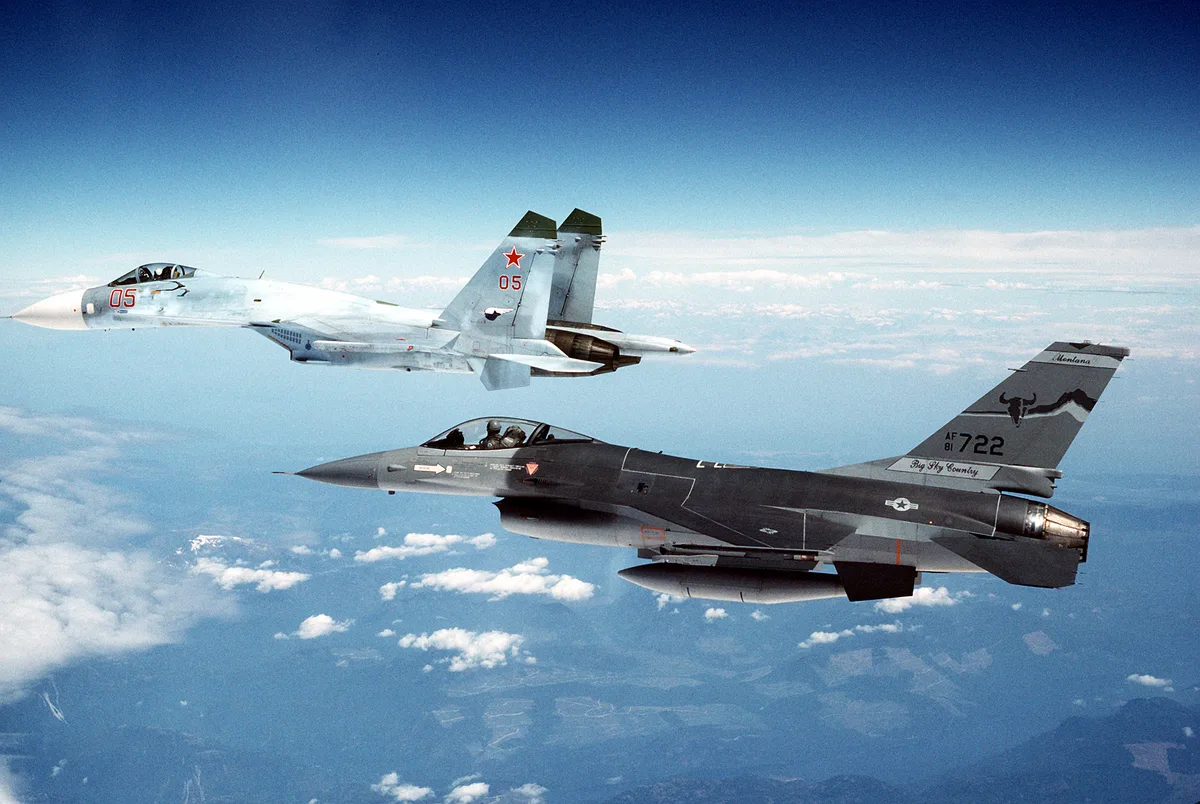
Soviet Su-27 alongside a NATO F-16 — General Maltsev commanded the air defense forces whose radar systems tracked the UAP he described in his 1990 official statement — US DoD / Public Domain
Credibility Assessment
High
Military WitnessPilot WitnessRadar CorroboratedMultiple WitnessesGovt. AcknowledgmentOfficial Report
Event Description
Observed Shape
Orb
Craft morphology

Non-Human Intelligence (NHI)
Reported Entities
No NHI encounter documented for this event.
In April 1990, Soviet Air Defense Forces General Igor Maltsev — Chief of Staff of the Soviet Air Defense Forces and a four-star officer with direct authority over the Soviet Union's entire military aerospace surveillance network — issued a formal public statement confirming that Soviet military personnel had repeatedly tracked unidentified aerial objects displaying capabilities beyond any known technology. The statement was published in the Soviet newspaper Rabochaya Tribuna and rapidly disseminated internationally.
Maltsev described objects tracked by Soviet air defense radar at altitudes ranging from 100 to 7,000 meters, performing maneuvers that included: sustained motionless hovering, right-angle direction changes at high speed, and acceleration from a stationary position to velocities exceeding the performance envelope of any aircraft in any nation's inventory — what would later be termed hypersonic velocity and instantaneous acceleration in the Pentagon's own UAP observables framework. He stated explicitly that the characteristics were observed consistently across multiple independent radar stations and by multiple trained personnel, ruling out equipment malfunction, localized anomalies, or individual misidentification.
Maltsev's statement represented the most senior official Soviet military acknowledgment of the UAP phenomenon in the Cold War period. It coincided with the broader glasnost era of increased Soviet transparency, but went substantially beyond what political openness required — it was a direct military assessment that anomalous aerial objects were a real, documented, and unexplained phenomenon, made by an officer whose position gave him access to the entire classified record of Soviet air defense observations.
The Soviet Union had maintained its own classified UAP investigation program since at least the early 1970s, reportedly designated SETKA, which had compiled thousands of military observation reports from air defense installations across the Soviet Union and Warsaw Pact territory. Maltsev's 1990 statement effectively opened a window on that classified record, confirming that Soviet defense scientists and officers had been grappling with the same observed phenomenon as their American counterparts across the same decades — a convergence of institutional experience that argues against any nation-specific or culturally specific explanation.
5 Observables Detected
Instantaneous Acceleration
Hypersonic Velocity
Low Observability
Trans-Medium Travel
Anti-Gravity Lift
Suspicious Activity
Intelligence Agency
Cover-up Actions
Men in Black
Disinformation
Witness Suppression