SightingCold War
Shevchenko Airport Radar Intercept — Kazakhstan, 1977
August 14, 1977
Shevchenko (Aktau), Kazakh SSR (USSR)
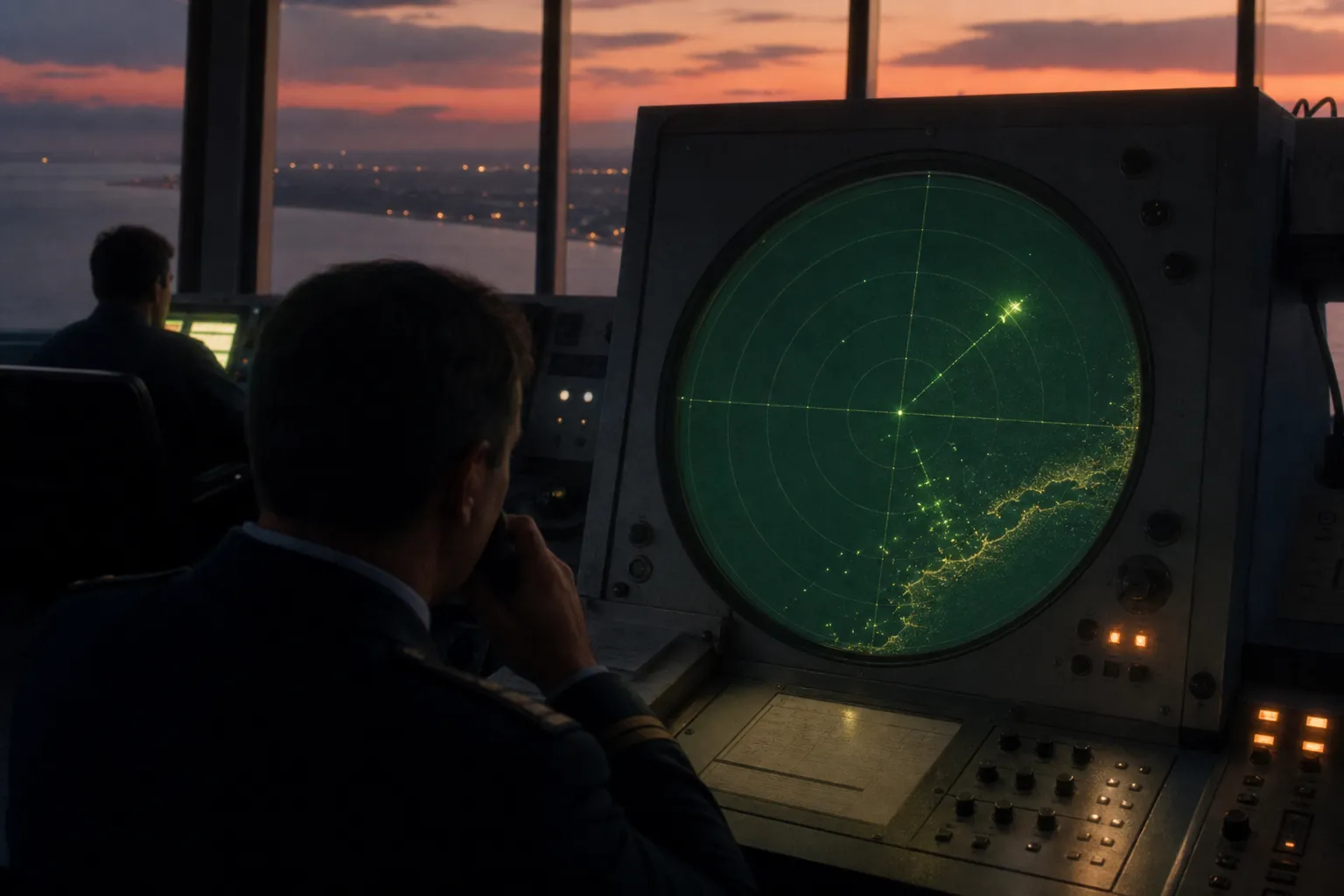
AI-rendered impression — Soviet-era civil airport radar scope displaying an anomalous contact over the Caspian coastline of Kazakhstan at dusk, August 1977 — UAP Archive / openai (gpt-image-1)
Credibility Assessment
Moderate
Military WitnessMultiple WitnessesHistorical DocumentOfficial Report
Event Description
On the evening of August 14, 1977, between 20:00 and 20:30 local time, Raisa Gopachenko, the duty air traffic controller at Shevchenko Airport on the eastern shore of the Caspian Sea in Kazakhstan's Mangyshlak Oblast, detected an anomalous radar return. The contact appeared abruptly over the town of Aksu, roughly northeast of the airport, without any corresponding flight plan, ATC clearance, or advance notice from any civil or military aviation authority. It would become one of only a handful of Central Asian cases formally documented by the Soviet state's classified UFO research apparatus, designated SETKA Report No. 44 — a designation that placed it among the most officially acknowledged anomalous aerial cases from Kazakhstan.
Two aviation professionals observed the incident in an operational capacity. Raisa Gopachenko was the duty air traffic controller at Shevchenko Airport, working a radar scope in a professional civil aviation environment. Her colleague Vyacheslav Irin served as the flight operations officer on duty. Both individuals were employees of the Soviet civil aviation system, trained in radar interpretation and familiar with the normal traffic patterns — civil and military — over the Caspian region. Gopachenko's first action upon detecting the anomalous return was to check the radar trace against known flight corridors; Irin independently checked for any flight route restrictions or scheduled traffic that might account for the contact. Neither found any matching aircraft. Nukus Airport in Uzbekistan, contacted during the event, separately confirmed it could not account for the target.
The radar target appeared without warning over Aksu and remained stationary for approximately one minute — an unusual behavior for any known aircraft type at that time. The object then began moving south along the Caspian coastline in the direction of the town of Yeraliyev, accelerating to an initial speed of approximately 500 km/h. It continued toward Uzen', where it turned northeast. As it did so, radar operators tracked it accelerating to roughly 700 km/h. After leaving the Shevchenko radar coverage area and disappearing at a distance of 300–350 km, the object reappeared on the Shevchenko scope five to six minutes later — at precisely the same point it had last been tracked — and then repeated its transit in reverse, back along the same coastline route at a speed Gopachenko computed at approximately 7,200 km/h, equivalent to one radar sweep covering forty kilometers per rotation of the antenna. Gopachenko alerted Nukus Airport in Uzbekistan that the object was entering their radar range; Nukus operators reported that they could not acquire the target. She also alerted Irin, who initiated a chain of calls to military aviation authorities across the Soviet Union.
The combination of behaviors exhibited by the radar contact exceeded any known aviation capability of 1977. An initial motionless hover — detected clearly on standard civil airport radar — is inconsistent with all jet-powered fixed-wing aircraft that require forward motion to remain airborne. The subsequent acceleration from zero to 500 km/h, then to 700 km/h, and finally to an estimated 7,200 km/h placed the object's performance far above even experimental Soviet aerospace programs of the period; the fastest operational aircraft of the era, the MiG-25, had a top speed of approximately 3,000 km/h under ideal conditions, not from a standing start. The object's reappearance at its origin point and exact reversal of course — at hypersonic speed — suggested controlled, purposive navigation rather than any meteorological or ballistic phenomenon. Radar weather phenomena and atmospheric ducting do not exhibit sustained directional motion with velocity changes, hovering pauses, and precise point-to-point returns.
The primary evidence is the radar track recorded at Shevchenko Airport. No secondary radar confirmation was obtained from Nukus Airport, which was unable to acquire the target when alerted by Gopachenko — a gap in coverage whose cause was not investigated in the available record. No visual sighting of the object was reported from the ground, and no aircraft was diverted for a visual intercept. An Aeroflot An-24 aircraft was routed away from the track as a precautionary measure when the object approached to within 220–250 km; this constitutes a contemporaneous operational response by Gopachenko that was recorded in airport communications logs. No physical debris, landing traces, or electromagnetic effects on ground systems were noted in the case documentation. The evidence base consists of the radar logs, the inter-airport communications record, and the testimony of Gopachenko and Irin subsequently collected by Soviet investigators.
The case entered the Soviet state investigative apparatus as SETKA Report No. 44. The SETKA program (full designation SETKA-AN and SETKA-MO) was a classified joint initiative of the USSR Academy of Sciences and the Ministry of Defense, established in 1978 following the 1977 spike in anomalous aerial sightings across the Soviet Union. Although the Shevchenko incident predated the formal program launch by months, it was retrospectively incorporated into the SETKA case files. The program ran for thirteen years and investigated approximately 3,000 reports, of which roughly 300 were classified as genuinely anomalous after natural and man-made explanations had been ruled out. The Shevchenko case, with its multi-station radar contact, high-performance flight profile, and failure of all contacted Soviet aviation authorities to account for the object, was among those designated unexplained. The full SETKA archive remains classified in Russian state archives.
The SETKA program operated under strict secrecy throughout its existence; its existence was not publicly acknowledged until the post-Soviet period. Witnesses like Gopachenko and Irin were employees of the Soviet civil aviation bureaucracy and would have been subject to the general prohibition on public discussion of anomalous aviation phenomena. The case received no Soviet press coverage at the time. The details became available to Western researchers only through post-Soviet access to former Soviet scientists and officials, primarily via researchers Paul Stonehill and Philip Mantle, who documented the case in their work on the SETKA program. The original SETKA documents — including Report No. 44 — remain inaccessible in Russian government archives as of the time of this record.
The Shevchenko radar case is the best-documented Soviet-era UAP incident on Kazakh territory in the available open-source record. Its significance lies in several compounding factors: the evidence is instrumental rather than purely testimonial; the contact was observed on professional civil aviation radar equipment by trained operators; all available Soviet aviation authorities were queried in real time and none could account for the object; and the case received formal treatment within a classified state investigative program. The Mangyshlak Peninsula and its surrounding Caspian coastline would continue to generate anomalous aerial reports through the 1980s and into 1990 — including a SETKA-AN expedition to the region in 1979 that collected 85 UAP reports, of which 26 were classified as genuinely anomalous. The 1977 Shevchenko case stands as the founding documented incident in that regional pattern and remains one of the few Central Asian cases to have entered an official Soviet state scientific record.
5 Observables Detected
Instantaneous Acceleration
Hypersonic Velocity
Low Observability
Trans-Medium Travel
Anti-Gravity Lift
Suspicious Activity
Intelligence Agency
Cover-up Actions
Men in Black
Disinformation
Witness Suppression
Sources
mediaOpenminds.tv — 'UFOs over Kazakhstan, Central Asia' (Stonehill & Mantle, SETKA program documentation)mediaUfoinfo.com — 'SETKA: A Secret Soviet UFO Research Program' (Stonehill & Mantle)mediaSkeptical Inquirer — 'A History of State UFO Research in the USSR'mediaThe Moscow Times — 'Little Green Men: A Look at the Official Soviet X-Files Investigation'