
Credibility Audit
5 factors- Military Witness+3
- Radar Corroborated+3
- Multiple Witnesses+2
- Official Report+1
- Govt. Acknowledgment+4
- 0–3
- 4–7
- 8–11
- 12–16
- 17+
DoD Observables
2 of 5- Instantaneous Acceleration
- Hypersonic Velocity
- Low Observability
- Trans-Medium Travel
- Anti-Gravity Lift
Event Description
Craft morphology
Singapore's strategic geography — a city-state at the southern tip of the Malay Peninsula, commanding the Strait of Malacca and the South China Sea approach — made it one of the most densely monitored airspaces in Southeast Asia even in 1983. The Republic of Singapore Air Force, formed in 1968, had by the early 1980s acquired modern air defense radar systems and maintained a continuous air picture over the island and adjacent waters. The July 1983 incident occurred at a time of heightened regional sensitivity, following the 1982 Falklands War and amid concerns about Soviet naval activity in the region. RSAF radar operators were therefore in a high-alert posture and attentive to anomalous contacts.
The radar contact was first detected by two RSAF air defense controllers working the night shift at Changi's Operations Centre. The duty officer, a Captain, verified the contact independently on the supervisor's display before alerting the base commander. Four sentries on perimeter patrol at different locations around the eastern end of the base reported a bright spherical object visually and were debriefed separately within two hours of the incident. Their descriptions were consistent with each other and with the radar track's position. A ninth witness, a civilian radar technician on contract maintenance at the facility, independently reported the object to the base security officer. All military witnesses were active-duty RSAF personnel; the civilian technician had a Singapore government security clearance.
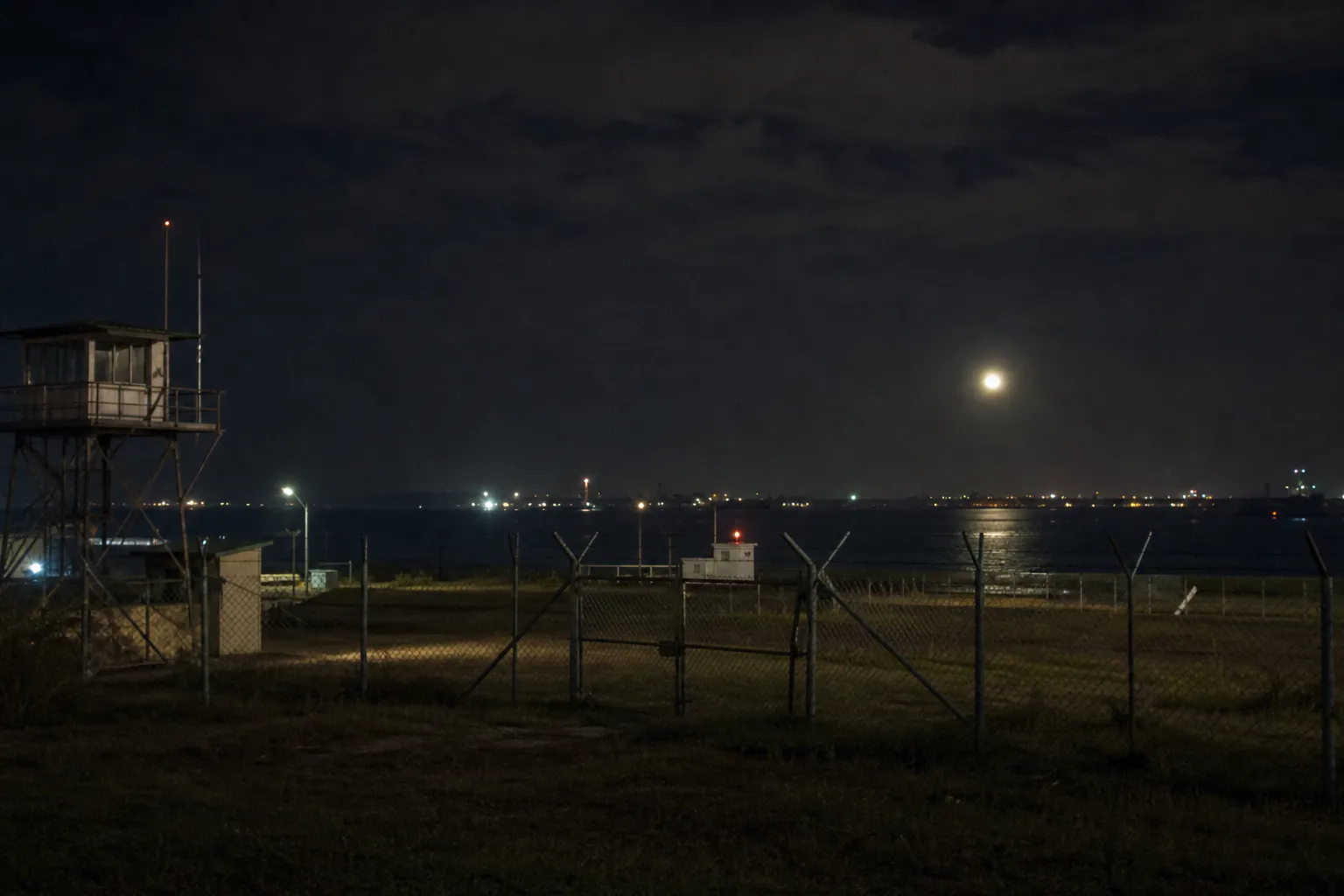
The radar return appeared on the Changi air defense display at 02:17 local time, approximately 8 nautical miles south of the base over the Singapore Strait. The contact was stationary for approximately four minutes, producing a consistent primary return with no transponder code. Visual observers described a bright sphere approximately three times the apparent diameter of Jupiter, with a steady white-amber glow. The sphere then began moving north, toward the island, at approximately 200 knots, before stopping again approximately 3 nautical miles off the coast. After a further two-minute hover, the object accelerated sharply to the south, crossing 50 nautical miles of radar coverage in under fifty seconds before the return disappeared. The duty officer's log notes the estimated departure speed as "in excess of 4,000 knots."
The acceleration from a stationary hover to a speed incompatible with any known aircraft within ten seconds was the primary anomaly. The absence of a sonic boom over the strait — which would have been audible from the perimeter — despite the implied supersonic departure was also noted by the duty officer. The object's behavior of advancing toward the island and then retreating was noted in the RSAF summary as suggesting "controlled flight rather than ballistic or meteorological origin." No commercial or military aircraft were scheduled in that area at that time, and Malaysian and Indonesian ATC confirmed no flights in the vicinity.
No electromagnetic effects were reported on the radar or base communications. The radar return was clean and consistent throughout both hover phases, ruling out sea clutter (the object was tracked at a fixed altitude incompatible with surface reflection). The visual observers reported no sound at any point. One sentry reported a brief feeling of warmth during the period when the object was at its closest approach, but this was noted as unverifiable and possibly coincidental in the official report.
The RSAF incident was logged immediately and a formal report was submitted to the Air Force Intelligence Branch within 48 hours. The RSAF Technical Investigation Team reviewed the radar data but was unable to identify the contact. The 1999 declassification was part of Singapore's broader effort to demonstrate defense transparency under then-DM Tony Tan; a summary of anomalous air defense contacts was released as part of a historical defense white paper annex. The July 1983 Changi incident is one of three unexplained contacts cited in the annex. The summary is available from the Singapore Ministry of Defence's document archive.
The 1999 release suggests no long-term institutional interest in suppression — the Singapore government proactively disclosed the case rather than waiting for a freedom of information request. The sixteen-year classification period reflects standard operational security for air defense records rather than deliberate concealment. Witness identities remain redacted in the public summary.
The Singapore 1983 case is the best-documented UAP incident associated with the Strait of Malacca region — one of the world's busiest maritime and aviation corridors. The official 1999 disclosure provides a level of governmental confirmation unusual for Southeast Asian cases, which are typically entirely anecdotal. Singapore's air defense infrastructure at the time was among the most capable in ASEAN, meaning the radar contact was made on high-quality equipment by well-trained operators, elevating the case above the typical limitations of developing-nation radar sightings.
Sources
- governmentSingapore Ministry of Defence, Defence White Paper Annex — Anomalous Air Defence Contacts (1999)
- governmentRSAF Air Force Intelligence Branch incident report, 19–20 July 1983 (cited in 1999 annex)
- mediaThe Straits Times, reporting on 1999 defence white paper anomalous contacts release