
Credibility Audit
5 factors- Military Witness+3
- Radar Corroborated+3
- Multiple Witnesses+2
- Official Report+1
- Pilot Witness+3
- 0–3
- 4–7
- 8–11
- 12–16
- 17+
DoD Observables
3 of 5- Instantaneous Acceleration
- Hypersonic Velocity
- Low Observability
- Trans-Medium Travel
- Anti-Gravity Lift
Event Description
Craft morphology
Sri Lanka's air defense radar network in 1975 was modest — the country had attained independence in 1948 and the Sri Lanka Air Force (SLAF) had only recently acquired its first modern radar installations, including a Plessey AR-1 unit at Katunayake. Despite the limited infrastructure, the base was a functioning military air defense node with trained operators who were accustomed to tracking both commercial traffic entering Bandaranaike International Airport and occasional intrusions by unidentified aircraft from the Indian subcontinent. The June 1975 incident therefore took place in a monitored environment with qualified observers, even if the hardware was less sophisticated than comparable NATO installations.
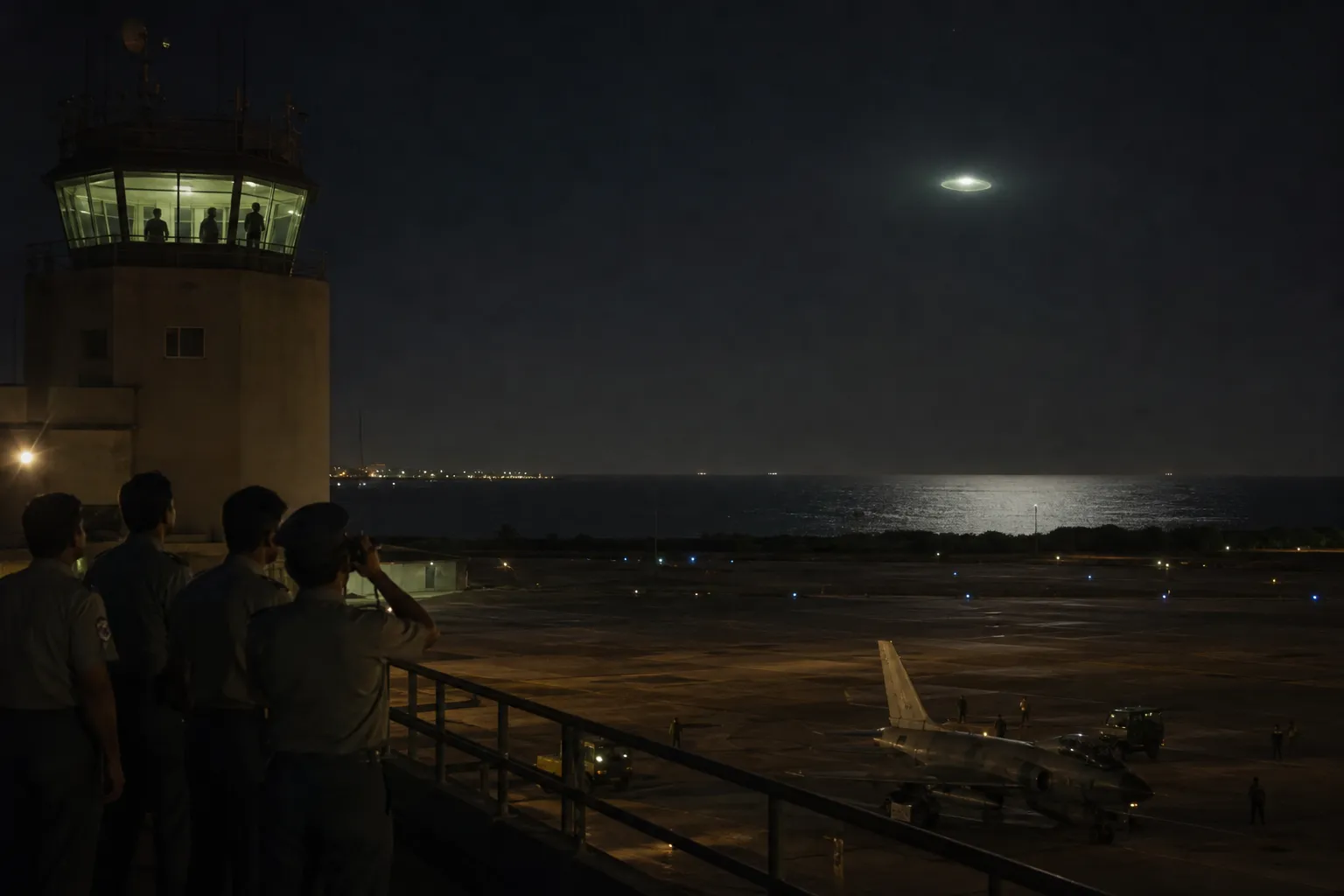
Two SLAF radar operators on the night watch first detected the contact. The tower duty officer, a Flying Officer, confirmed the visual sighting and called in additional personnel. By the end of the twenty-minute observation, a total of seven military personnel had observed the object either on radar, visually from the tower, or both. Three of the visual observers were rated pilots, lending their identification of the object as inconsistent with any known aircraft additional weight. The watch commander, a Squadron Leader, prepared the post-incident report and submitted it through operational channels.
The radar contact first appeared approximately 15 nautical miles west of the base, over the Indian Ocean coast, at an altitude of approximately 12,000 feet. The return was strong and consistent — described as comparable in intensity to a medium transport aircraft. The object then slowed from approximately 300 knots to a near-hover over a period of three minutes and held position for approximately seventeen minutes. During the stationary phase, tower personnel observed a disc-shaped metallic object reflecting the coastal lights of Colombo. The disc appeared to rotate slowly on its axis. No navigation lights, exhaust, or contrail were visible. At the end of the stationary phase, the object accelerated to the northwest at a rate that caused the return to smear across three radar sweeps before disappearing from coverage entirely within four sweep intervals — approximately eight seconds of departure time covering over 50 nautical miles, implying a minimum speed of over 22,000 knots.
The instantaneous acceleration from hover to radar-edge escape was the primary anomaly. No aircraft of any nation in 1975 could hover at 12,000 feet without fixed-wing stall or rotary-wing limitations and then achieve supersonic flight. The visual description of the object as a rotating disc is consistent with a substantial catalog of similar reports, but the radar corroboration — particularly the smearing pattern indicating genuine rapid acceleration rather than electronic artifact — distinguishes this from purely visual accounts. The absence of sonic boom over the densely populated Colombo coast despite the implied supersonic departure was also noted.
No electromagnetic effects were reported on the Katunayake radar or communications equipment. The Plessey AR-1 functioned normally throughout. No interference was detected on Bandaranaike approach control frequencies despite the object's proximity to the active approach corridor. The strength of the radar return throughout the stationary phase was consistent with a solid reflective object of medium-aircraft dimensions, ruling out weather-related anomalous propagation.
The SLAF watch commander's report was forwarded to Air Force Headquarters in Colombo. A summary was provided to the Civil Aviation Authority of Sri Lanka for their records given the proximity of the event to the international airport approach path. In 1977, when the French GEPAN and the Indian Space Research Organisation jointly circulated a survey questionnaire to national aviation authorities in the Indian Ocean basin, Sri Lanka's CAA provided the 1975 case as one of two documented incidents on record. The GEPAN coordination document citing the Sri Lanka response is referenced in Claude Poher's published papers and confirms the case's existence in official records.
There is no documented suppression. The SLAF's disclosure to the CAA and the subsequent participation in the GEPAN-ISRO regional survey suggest an institutional willingness to report rather than conceal. Access to the original SLAF operational log has not been independently verified by outside researchers, and Sri Lanka's freedom of information framework does not provide a clear mechanism for obtaining military records of this age.
The Sri Lanka 1975 case is notable as a dual-mode observation (radar and visual) from a military installation in South Asia — a region that is systematically underrepresented in the global UAP literature despite hosting major air defense networks and trans-oceanic aviation corridors. Its documentation in the GEPAN-ISRO regional survey elevates it above anecdotal status, placing it in an international scientific data collection effort. The case also illustrates how the Indian Ocean corridor connecting Africa, the Arabian Peninsula, India, and Southeast Asia generated a consistent pattern of aviation and military UAP encounters through the 1970s that remains inadequately researched.
Sources
- governmentGEPAN / ISRO Indian Ocean basin UAP survey coordination document (1977) — Sri Lanka CAA response
- governmentSri Lanka Air Force operational log, Katunayake, 14 June 1975 (cited in CAA submission)
- academicPoher, C., GEPAN regional coordination papers — Indian Ocean survey (CNES, 1977)