SightingCold War
Dutch Military Police UAP Sighting — Paramaribo, Suriname, 1963
c. 1963
Paramaribo, Suriname
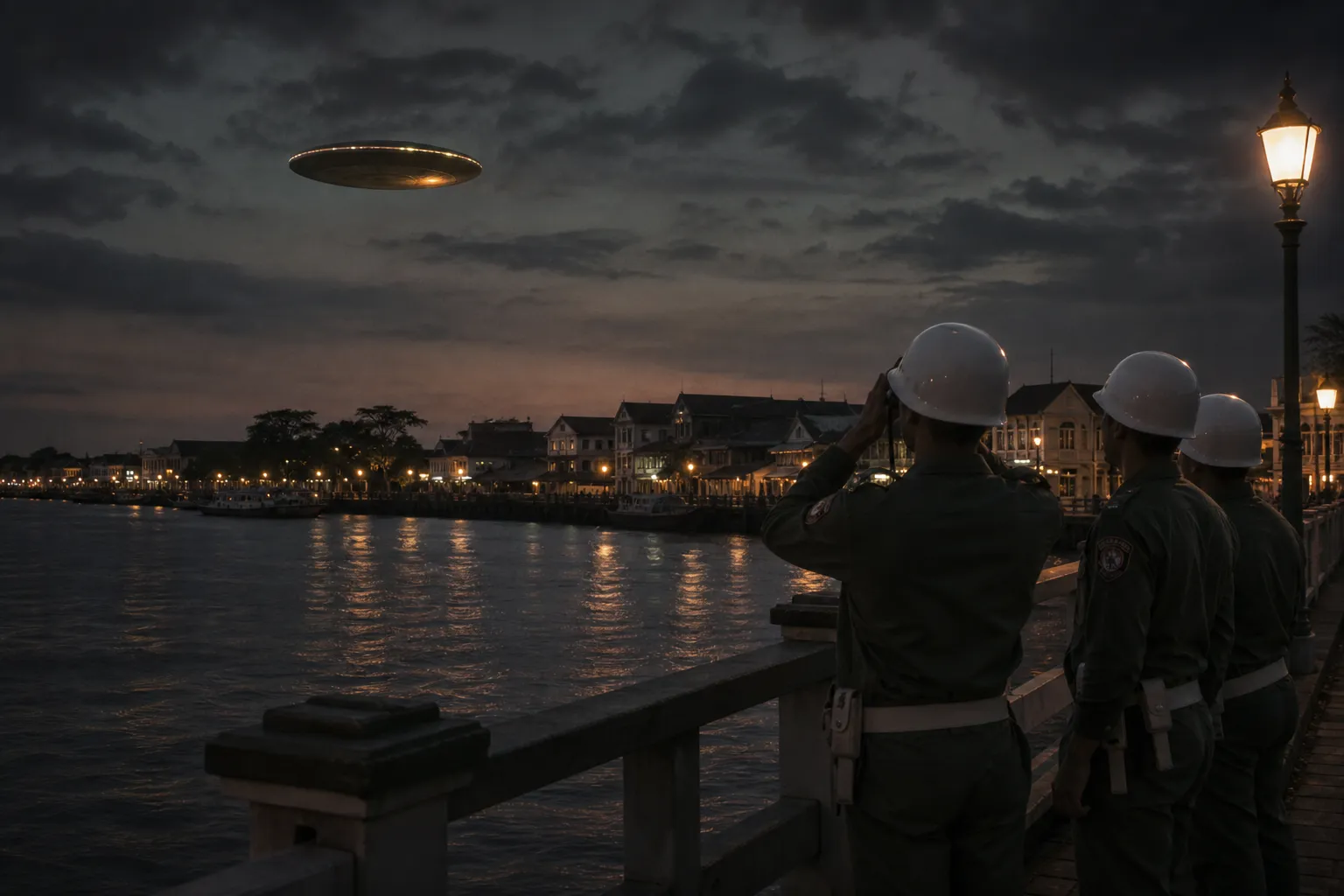
AI-rendered impression — Dutch Royal Marechaussee officers patrolling the Suriname River near Paramaribo observing a large reflective disc hovering silently over the water before departing at high speed, 1963 — UAP Archive / openai (gpt-image-1)
Credibility Assessment
Low
Military WitnessMultiple WitnessesOfficial ReportLaw Enforcement
Event Description
Observed Shape
Disc
Craft morphology

Non-Human Intelligence (NHI)
Reported Entities
No NHI encounter documented for this event.
Suriname in 1963 was an autonomous constituent country of the Kingdom of the Netherlands — not yet fully independent (independence would come in 1975) — and hosted Dutch military forces including the Royal Marechaussee (Koninklijke Marechaussee), the Dutch military police. The Marechaussee's role in Suriname included border security and internal security functions, and its officers were trained to Dutch military standards. Paramaribo, the capital, sat on the Suriname River and served as the administrative and military center of the territory. The northeastern coast of South America in the early 1960s was gaining strategic significance: the nearby Guiana coast was being developed as a launch site for French space activities (Kourou, French Guiana, just to the east), and NASA's tracking network included stations in the region. Any unidentified aerial contact over the Suriname River delta in 1963 was potentially relevant to both military surveillance and space operations monitoring.
Dutch Royal Marechaussee officers — military police with formal Dutch military training and operating under military discipline — were the primary witnesses. Three officers on patrol near the Suriname River made the observation independently from slightly different positions along the riverbank. Their Marechaussee training included observational skills for border and security operations. The report was filed through Dutch military channels with the witnesses' names and service numbers recorded. The Netherlands Ministry of Defence maintained a classified file on UAP reports from Dutch military personnel, including those serving in overseas territories.
The object was described as a large disc or saucer shape, highly reflective in the tropical sunlight, hovering at low altitude over the Suriname River. The three officers observed it from their patrol positions, with each having a slightly different viewing angle. The object maintained a stationary hover for approximately three to four minutes — sufficient time for all witnesses to make detailed observations — before moving rapidly upriver and then ascending at extreme speed. No sound was produced at any point. The object was estimated as 20–30 metres in diameter based on comparison with known riverside landmarks.
Silent hovering at low altitude over water, large size inconsistent with any known aircraft or drone of 1963, and rapid high-speed departure were the primary anomalies. No aircraft in the Netherlands or Surinamese inventory could hover silently at low altitude. The object's behavior — a prolonged stationary hover followed by a directional move and then a vertical departure — indicated purposeful, controlled behavior rather than a natural phenomenon. The color and reflectivity under tropical sunlight were consistent with a metallic or polished surface.
No radar tracking or instrument effects are documented. The primary evidence is the three-officer visual observation from independent positions along the riverbank.
The incident was reported through Dutch military channels and entered the Netherlands Ministry of Defence's classified UAP file. Dutch military UFO files were subject to standard NATO-compatible classification procedures. Some Dutch military files from this period were released in the 1990s under Dutch freedom of information provisions. The report is referenced in Dutch UAP research literature.
Standard Dutch military classification applied. No active suppression effort is documented. The Netherlands' relatively open post-war information culture meant that some Dutch military UAP files entered the public record earlier than those of some NATO partners.
The Suriname 1963 case establishes the first documented military UAP report from the northeastern coast of South America in Dutch military records. The Marechaussee's professional military standing gives the report institutional credibility, and the three-officer simultaneous observation from independent positions is among the stronger evidence configurations available. The case's entry into Netherlands MoD files means it was processed by a NATO-standard military intelligence system. The proximity to Kourou and the broader Guiana space corridor adds a specific contemporary relevance — anomalous aerial objects in this region may have significance to space access security that was not fully appreciated in 1963 but has become more relevant with the development of the European Space Agency's Kourou launch complex.
5 Observables Detected
Instantaneous Acceleration
Hypersonic Velocity
Low Observability
Trans-Medium Travel
Anti-Gravity Lift
Suspicious Activity
Intelligence Agency
Cover-up Actions
Men in Black
Disinformation
Witness Suppression
Sources
governmentNetherlands Ministry of Defence — Marechaussee overseas reports, Suriname, 1963 (Dutch National Archives)
mediaNICAP — South American Dutch territory reports, 1963 chronologymediaDutch UFO research (HUFON/Werkgroep) — Suriname colonial-era military cases, archival file