SightingCold War
Tallinn Airport Radar Anomaly — Aeroflot Flight 8352, Estonian SSR, 1985
January 1985
Tallinn, Estonian SSR (USSR)
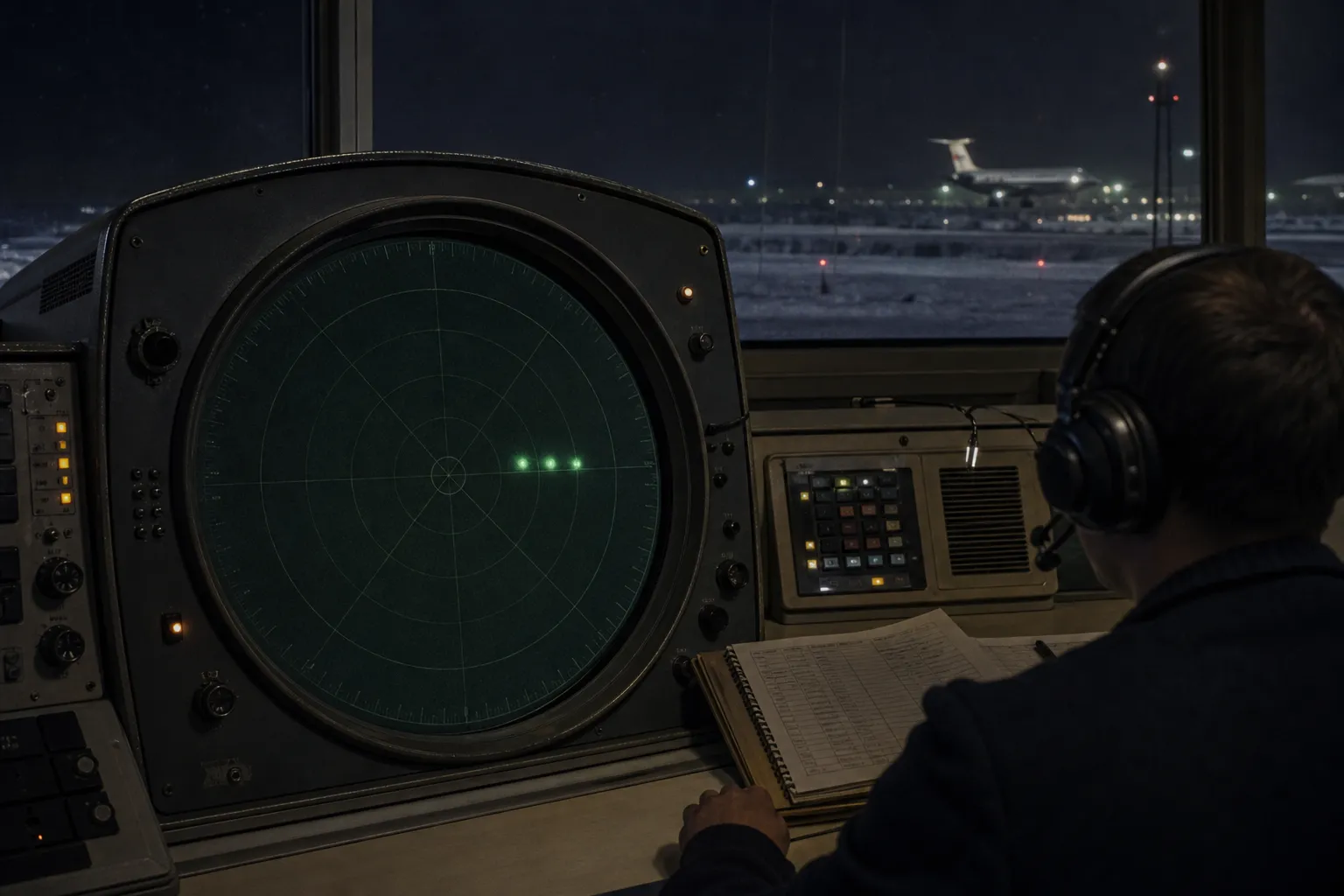
AI-rendered impression — Tallinn Airport radar screen showing three blips in close formation during the approach of Aeroflot Flight 8352, January 1985, with two anomalous returns shadowing the Tu-134 — UAP Archive / openai (gpt-image-1)
Credibility Assessment
Moderate
Pilot WitnessRadar CorroboratedMultiple WitnessesExpert WitnessOfficial Report
Event Description
In January 1985, as a Tupolev Tu-134A operated by the Estonian Administration of the USSR Ministry of Civil Aviation neared the end of its overnight domestic flight from Tbilisi, Georgian SSR, to Tallinn, Estonian SSR, air traffic controllers at Tallinn Airport observed something unexpected on their surveillance radar: the aircraft's transponder return was accompanied by two additional radar blips traveling in close formation, at a time when no other aircraft were assigned to or operating in the arrival corridor. The flight crew of Aeroflot Flight 8352, under the command of Igor Alekseyevich Cherkashin with copilot Gennadiy Ivanovich Lazurin, had spent most of the preceding night observing a massive luminous object that appeared to track their aircraft from above. The radar contact at Tallinn constituted the most objective element of an encounter that the USSR Academy of Sciences would subsequently refuse to explain away.
The crew of the Tu-134A were professional Aeroflot pilots licensed under Soviet civil aviation standards and employed by the Estonian Administration — the regional civil aviation authority responsible for operations based in Tallinn. Commander Cherkashin and copilot Lazurin were the primary flight crew; additional cabin crew and a variable number of passengers also observed the phenomena from cabin windows during the flight. The crew of a second Aeroflot aircraft traveling the opposite direction — Tallinn to Tbilisi — independently observed the same luminous phenomena at the same time, providing corroboration from a separate platform at a different position. Air traffic controllers at Minsk, overflown earlier in the flight, acknowledged visual flashes of light in the direction of Flight 8352 without a corresponding radar contact. At Tallinn, arrival controllers were the final official witnesses, observing the anomalous radar returns.
The encounter began at approximately 4:00 a.m. when the second officer noticed a bright star-like object above and to the right of the aircraft's course that appeared to project a beam of light downward toward the terrain. As additional crew members observed, the phenomenon expanded from a point source into a large yellowish-green luminous cloud, estimated by the crew to span approximately twenty-five miles. The cloud's cone of light swept the ground below in a manner that the crew described as deliberate scanning behavior. Most strikingly, at one point the luminous formation appeared to replicate the silhouette of the Tu-134 itself — mirroring the aircraft's own external profile — before resuming its formation. Smaller lights zigzagged within the larger mass. The phenomena continued for over an hour as the aircraft crossed Soviet airspace. As the Tu-134 approached Tallinn on final approach, the Tallinn Airport surveillance radar showed the aircraft's own radar return with two additional blips in close proximity — consistent with two objects tracking the airliner in formation. No other aircraft were logged in that corridor.
The simultaneous presence of two anomalous radar blips in the Tallinn approach corridor — coinciding with the crew's visual observation of an accompanying phenomenon throughout the flight — constitutes a dual-modality detection that is difficult to explain within conventional frameworks. The apparent replication of the Tu-134's silhouette by the luminous cloud has no counterpart in any known atmospheric optical phenomenon. The scale of the observed cloud (twenty-five miles apparent diameter at cruise altitude) is inconsistent with any weather formation at that altitude and in the absence of any documented meteorological anomaly that night. The second aircraft's independent confirmation rules out crew-specific misperception. The selective radar presentation — visible to Tallinn radar but not initially detected at Minsk — suggests a phenomenon with variable radar cross-section.
The Tallinn Airport surveillance radar recorded two additional returns in close proximity to the Tu-134A's transponder blip during the arrival phase. The aircraft experienced no reported avionics interference, engine anomalies, or loss of communications. No EM effects on onboard instruments were documented. No physical evidence — debris, burn marks, or ground traces — was collected. Minsk ATC observed visual phenomena (flashes) consistent with the crew's account but without a matching radar contact, suggesting the phenomenon's radar reflectivity was intermittent or geometry-dependent.
The crew filed a formal incident report through Aeroflot's civil aviation channels upon landing at Tallinn. The case was reviewed by Soviet authorities connected to the USSR Academy of Sciences' systematic study of anomalous aerial phenomena. In March 1985, approximately two months after the incident, the Academy of Sciences publicly stated that the crew of Flight 8352 had encountered "something we call UFOs." No explanation was provided. The CIA subsequently obtained the case summary and filed it in its reading room as document 0005516658, accessible through the FOIA. No disciplinary measures against the crew were documented; the Soviet civil aviation system's reporting procedures at this period explicitly allowed for UAP documentation without adverse professional consequences for crew who reported through proper channels.
None documented. The USSR Academy of Sciences' public acknowledgment of the encounter stands in contrast to the suppressive handling typical of Soviet military pilot cases from earlier Cold War decades. By 1985 the Soviet defense and scientific establishment had operated an open, if classified, UAP collection program for approximately seven years under a Ministry of Defense directive, and the civil aviation reporting framework had been similarly adjusted to encourage rather than suppress crew reports.
The Tallinn radar contact is the most instrumentally concrete element of the broader Flight 8352 incident, which spans two Soviet republics. For Estonia, it represents the strongest documented Cold War UAP encounter in the historical record: an event with professional pilot witnesses, independent airborne corroboration, multi-city air traffic control awareness, and radar instrument data at the national capital's primary airport. The USSR Academy of Sciences' public statement — "something we call UFOs" — is one of a very small number of formal on-record Soviet scientific acknowledgments of an unresolved UAP encounter, placing Flight 8352 alongside the 1977 Petrozavodsk phenomenon as a case that the Soviet establishment could not fully contain. Estonia's role as both the home base of the crew and the site of the radar confirmation gives this case a specific geographic anchor in what is today an independent EU and NATO member state.
5 Observables Detected
Instantaneous Acceleration
Hypersonic Velocity
Low Observability
Trans-Medium Travel
Anti-Gravity Lift
Suspicious Activity
Intelligence Agency
Cover-up Actions
Men in Black
Disinformation
Witness Suppression