SightingCold War
Aeroflot Tu-134 UFO Encounter — Minsk, 1984
September 7, 1984
Near Minsk, Byelorussian SSR
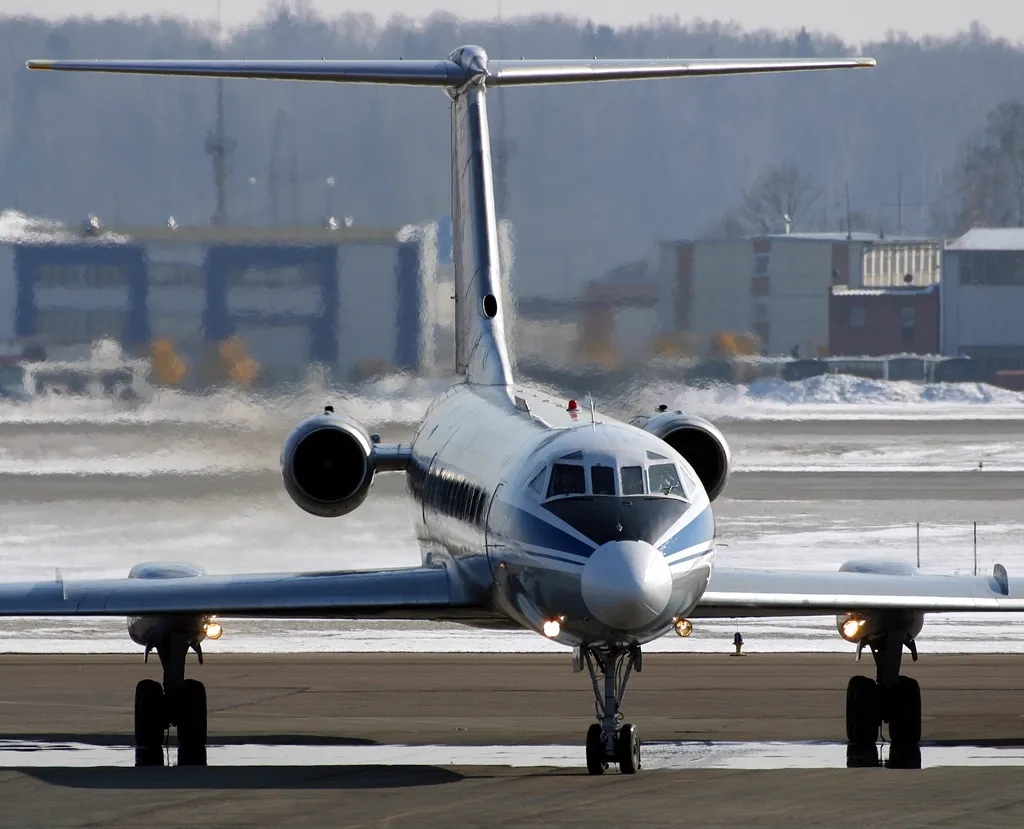
A Tupolev Tu-134A in Aeroflot livery at Sheremetyevo International Airport, Moscow — the same aircraft type operated on the Tbilisi–Tallinn route on September 7, 1984. — Leonid Faerberg / Russian AviaPhoto Team, via Wikimedia Commons (GNU FDL)
Credibility Assessment
High
Govt. AcknowledgmentPilot WitnessRadar CorroboratedMultiple WitnessesOfficial Report
Event Description
Observed Shape
Sphere
Craft morphology

Non-Human Intelligence (NHI)
Reported Entities
No NHI encounter documented for this event.
At approximately 04:10 local time on September 7, 1984, an Aeroflot Tupolev Tu-134 operating flight service from Tbilisi to Tallinn was cruising at altitude over the Byelorussian SSR, southwest of Minsk, when the flight crew observed an anomalous light source off their forward-right window. What began as a bright, star-like point rapidly evolved into something the crew could not explain using any standard category of aviation phenomena. The encounter would last approximately ten minutes and produce one of the most thoroughly corroborated civilian aviation UAP cases in Soviet history.
According to crew accounts published in Soviet scientific literature and later cited in the Skeptical Inquirer, the object first appeared as an intensely bright star. It then discharged what the crew described as a laser-like beam directed downward toward the ground. This initial beam thinned and diffused, sweeping the terrain below like a search cone. The object subsequently turned that cone toward the aircraft itself — crew members reported that the concentrated illumination partially obscured their forward vision. The original point source then expanded, swelling into a large yellowish-green luminous cloud estimated at approximately 25 miles (40 kilometers) in diameter. Co-pilot Gennady Lazurin made a series of sketches during the encounter; these drawings were later published in the journal Science in the USSR in 1991, providing a contemporaneous visual record.
Corroboration came from multiple independent directions. A second Aeroflot aircraft traveling in the opposite direction — northbound while the Tbilisi-Tallinn flight was proceeding northwest — reported observing the same phenomenon from their vantage point. The two crews' accounts, gathered without prior coordination, aligned on the key characteristics: the directionality of the beam, the scale of the luminous cloud, and its behavior toward the first aircraft. Additionally, early-rising civilians in Sweden and Finland, across the Baltic from the incident area, independently reported seeing a strong globe of light on the same morning, sometimes described as having a skirt or fringe structure beneath it. These cross-border observations were not connected to Soviet sources at the time they were made.
When the Tbilisi-Tallinn flight landed at Tallinn Lennart Meri Airport, air traffic controllers confirmed that their radar had tracked two additional returns in proximity to the aircraft during the relevant time window — returns that could not be attributed to the Tu-134 itself or any other known traffic. This radar corroboration is central to the evidentiary weight of the case: it provides an instrument-based data point independent of any crew perception or civilian eyewitness testimony.
The Soviet official response was, by the standards of the era, remarkable. In March 1985, the USSR Academy of Sciences issued a statement formally acknowledging the September 7 encounter. The Academy's language did not attribute the observation to a natural or man-made phenomenon it could identify; instead, it characterized the object as, in effect, what it called a UFO. TASS, the Soviet state news agency, reported on the incident. This represented an extraordinary departure from the standard Soviet posture of official silence or dismissal on such matters. The Trud newspaper had already published an article on the incident on January 30, 1985, generating public attention before the Academy statement followed.
American researcher James Oberg, a longtime skeptic of UAP claims, subsequently proposed that the sighting was caused by the exhaust plume of a ballistic missile launched from the Plesetsk Cosmodrome during the same pre-dawn window. Oberg noted that the visual descriptions — concentric rings, a diffuse cloud, luminous arcs — are consistent with documented photographic records of nighttime missile launches. The hypothesis is not without merit as a baseline explanation. However, the USSR Academy of Sciences, which had access to both the crew testimony and the Soviet military launch schedule, did not adopt a conventional explanation in its 1985 statement. If the Academy had possessed records confirming a Plesetsk launch as the cause, the politically simpler course would have been to close the case with that attribution. It did not do so. The disinformation field for this event notes Oberg's hypothesis as a false explanation that the Academy's own statement effectively contradicts.
The case remains significant for several overlapping reasons. It is one of a small number of Cold War civilian aviation UAP encounters in which a government — specifically the Soviet government — issued an official acknowledgment rather than a denial. It features professional flight crew testimony backed by a contemporaneous co-pilot sketch series, independent confirmation from a second flight crew, cross-border civilian observations spanning two NATO-adjacent nations, and radar corroboration from ground control. Taken together, these elements satisfy the criteria that skeptical investigators typically invoke when assessing whether an anomalous aerial observation warrants serious consideration: multiple independent witnesses, instrument data, professional observers, and official acknowledgment. The death of Captain V. Goridze in 1985, attributed by some to electromagnetic radiation from the encounter, has never been independently substantiated and should be treated as unconfirmed.
5 Observables Detected
Instantaneous Acceleration
Hypersonic Velocity
Low Observability
Trans-Medium Travel
Anti-Gravity Lift
Suspicious Activity
Intelligence Agency
Cover-up Actions
Men in Black
Disinformation
Witness Suppression