
Credibility Audit
4 factors- Pilot Witness+3
- Multiple Witnesses+2
- Official Report+1
- Expert Witness+2
- 0–3
- 4–7
- 8–11
- 12–16
- 17+
DoD Observables
2 of 5- Instantaneous Acceleration
- Hypersonic Velocity
- Low Observability
- Trans-Medium Travel
- Anti-Gravity Lift
Event Description
Craft morphology
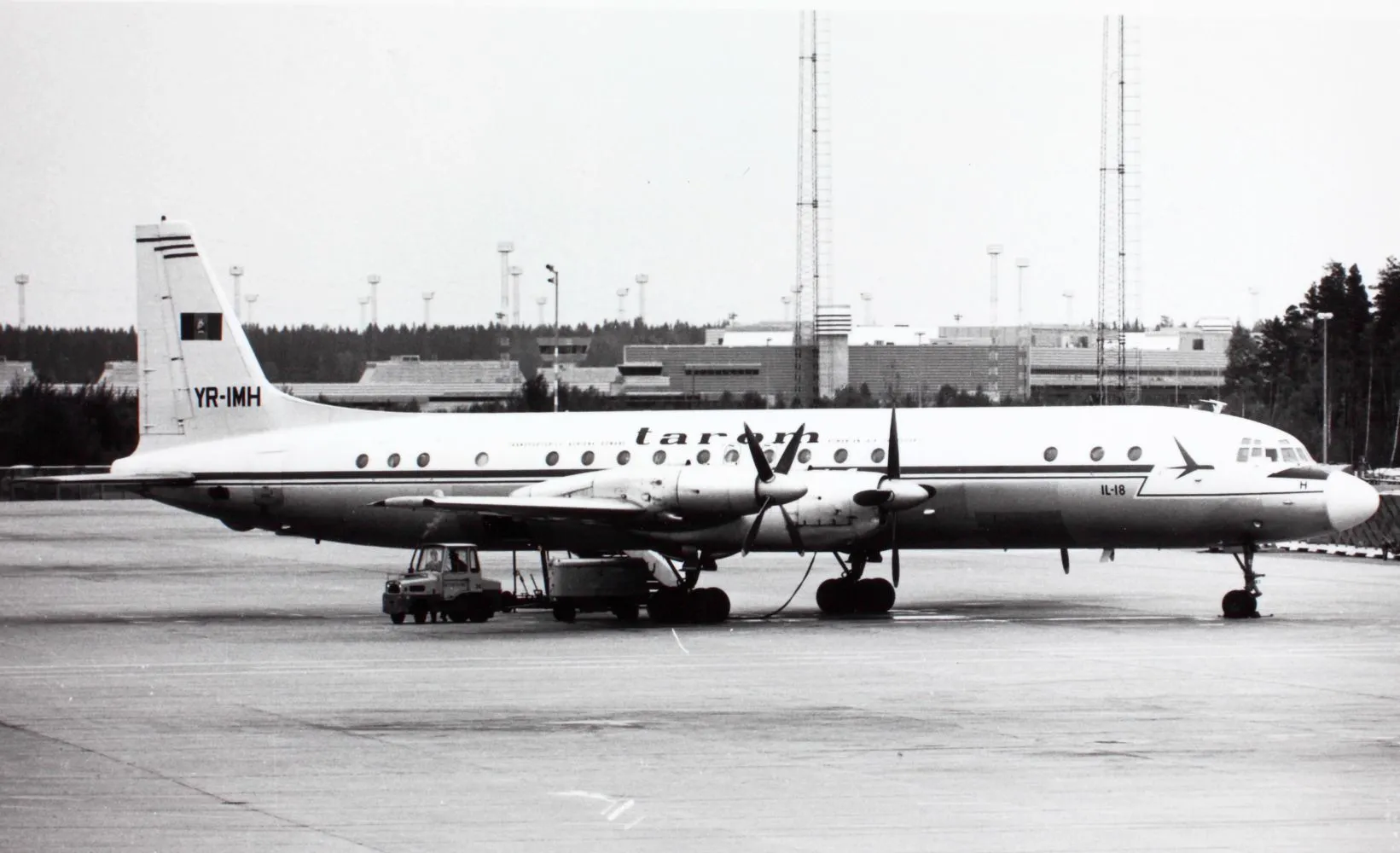
On the evening of August 17, 1968, at 20:21 local time, a TAROM (Transporturile Aeriene Române) Ilyushin IL-18 turboprop airliner was cruising at 7,600 metres on a scheduled route from Constanța's Mihail Kogălniceanu Airport to Düsseldorf, West Germany. As the aircraft passed near Oradea in northwestern Romania, close to the Hungarian border, Captain Beniamin Gabrian and two crew members — Alexandru Niculescu and Marian Constantinescu — observed an unidentified aerial object moving at high speed on the opposite heading.
Captain Gabrian later told the Romanian newspaper Dobrogea Nouă in an interview published the following day, August 18, 1968: "I suddenly observed on our right, at a distance of approximately one kilometre and some 300 metres higher, an oval object moving at great speed and emitting a dazzling, extremely strong, greenish light." He estimated the object's diameter at 2.5 to 3 metres. The crew watched it for approximately 10 to 15 seconds before it accelerated sharply and disappeared to the west. Gabrian noted that the object appeared briefly to slow its velocity — as though matching their speed — before its final acceleration. He stated: "Perhaps this was because the crew of the extraterrestrials was very interested in our aircraft and what was inside it," a quote that, while speculative, was published in a state-controlled Communist Party newspaper, lending it an unusual degree of contemporary documentation.
Following the sighting, Captain Gabrian contacted the control tower at Vienna's airport. Controllers confirmed that no conventional aircraft were operating within a 400-kilometre radius of the aircraft's position at the time of the observation. Approximately 2.5 minutes after the TAROM crew's sighting, Budapest airport relayed a report from the crew of a Hungarian Malev Airlines aircraft, which had independently observed a similar oval object moving rapidly westward over Austrian airspace. If both sightings involved the same object, the calculated ground speed between the two observation points yields an approximate velocity of 14,000 kilometres per hour — a figure far beyond the capability of any aircraft in service in 1968. At the time, the fastest operational military aircraft, the Lockheed SR-71 Blackbird, had a maximum speed of approximately 3,500 km/h and operated at significantly higher altitudes.
The incident was further investigated by civilians using optical instruments. Topographical engineer St. Mureșan from Cluj and technician Gh. Norodot from Apahida independently measured the object's altitude using theodolites, arriving at an estimate of 8,000 to 9,000 metres — consistent with the TAROM crew's reported figure of 7,600 metres and the object being approximately 300 metres above the aircraft. This triangulated ground measurement corroborates the crew's estimate and rules out the possibility of a low-altitude hoax or misidentification of a ground-based light source.
The sighting occurred within what Romanian UFO researchers have since termed the "1968 wave" — a concentrated period of aerial observations across Romania during August and September of that year. The wave included multiple sightings over Transylvanian cities including Cluj-Napoca, Bistrița, Sighișoara, Brașov, and Deva. The most famous case from the same wave, Emil Barnea's four photographs of a metallic disc above the Hoia-Baciu forest near Cluj, occurred the very next day, August 18, 1968. Barnea, who held Communist Party membership and military credentials, subsequently suffered professional consequences including demotion — illustrating the suppressive environment in which reporting such phenomena carried career risk under Nicolae Ceaușescu's regime.
In the context of Romanian political conditions in 1968, the open publication of Gabrian's interview in a state newspaper is noteworthy. Romania was in a period of cautious semi-independence from Soviet orthodoxy — Ceaușescu had condemned the Warsaw Pact invasion of Czechoslovakia that same month, August 1968 — which may explain the unusual press latitude. However, no formal official investigation of the TAROM sighting has been identified in the public record, and no Romanian military or civil aviation authority report on the incident has been declassified or published. The institutional silence following an event with multiple credible professional witnesses and independent corroboration from a foreign airline crew is consistent with the broader pattern of non-disclosure observed across Eastern Bloc aviation authorities during the Cold War period.
The TAROM-Oradea incident stands as one of the most thoroughly corroborated Cold War-era airliner UAP encounters from Eastern Europe. It features trained flight-crew witnesses, independent confirmation by a second airline crew from a different nation, air traffic control verification of no conventional traffic, and civilian theodolite triangulation — a convergence of independent data sources that sets it apart from single-witness aviation reports of the era. The case is documented by the Romanian Association for the Study of Unidentified Aerial Phenomena (ASFAN) and is referenced in Dan D. Farcaș's book "UFOs Over Romania" (2016), the principal English-language survey of Romanian UAP history. The Ilyushin IL-18, introduced in 1957, was a standard Soviet-bloc long-haul turboprop operated by TAROM throughout the 1960s on international routes to Western Europe — making its crews experienced professional aviators whose testimony carries the credibility weight established in global aviation UAP literature.
Sources
- mediaDobrogea Nouă newspaper — Captain Gabrian interview, August 18, 1968
- academicASFAN (Romanian Association for the Study of Unidentified Aerial Phenomena) — "A Romanian Airliner Meets a UFO in 1968"
- mediaRevista Magazin — "Apariția OZN-ului în august și septembrie 1968 în România"
- academicDan D. Farcaș — UFOs Over Romania (2016), SIRIU Publishing
- mediaRealitatea.net — "Întâlnire-șoc cu un OZN în România"