
Credibility Audit
5 factors- Military Witness+3
- Radar Corroborated+3
- Multiple Witnesses+2
- Govt. Acknowledgment+4
- Official Report+1
- 0–3
- 4–7
- 8–11
- 12–16
- 17+
DoD Observables
3 of 5- Instantaneous Acceleration
- Hypersonic Velocity
- Low Observability
- Trans-Medium Travel
- Anti-Gravity Lift
Event Description
On the night of May 12, 1969, personnel at Taszár Air Base — a frontline Hungarian People's Army installation near Kaposvár in Somogy County — reported an unidentified aerial object hovering directly above the runway. Hungary at the time was a Soviet-aligned Warsaw Pact state, its military fully integrated into the Soviet command structure. What followed was not a routine security alert but one of the most significant military responses to an unidentified aerial phenomenon documented anywhere in the Eastern Bloc during the Cold War.
The object emitted light of extraordinary intensity, rendering its shape impossible to identify. Witnesses — base personnel, ground guards, and pilots — reported that the brightness created an optical distortion that masked any structural detail. Radar operators established contact with the object, tracking it over the airfield before it subsequently vanished from their screens. The failure of radar to maintain lock was itself anomalous: the object had produced a return, confirming physical reality, yet later became untrackable — a pattern consistent with what U.S. military observers would later classify as "low observability."
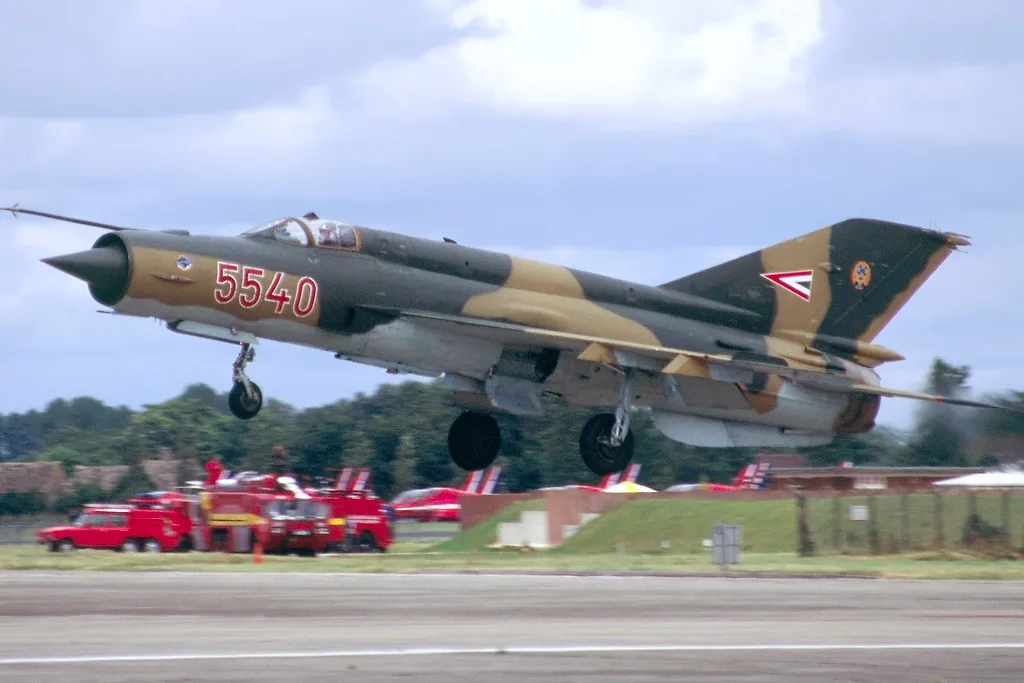
The base commander's response was exceptional in its scale. He ordered sixteen MiG-21 Fishbed fighter jets — the Soviet Union's premier interceptor of that era, fully armed with air-to-air missiles — to scramble and intercept the object. Sixteen armed aircraft represents an extraordinary commitment of resources; a standard Soviet-era intercept protocol called for two to four aircraft. The decision to deploy sixteen suggests the commander assessed the situation as a genuine and serious threat. Simultaneously, Soviet military units dispatched additional support alongside the Hungarian jets, indicating that the incident triggered a cross-national Warsaw Pact response at a level above a single national air force.
Ground guards were ordered to approach the object on foot and were subsequently halted at a certain distance — the decision to stop them was never officially explained. Whether this was a precaution against the object's intense light, concern about potential weapon interaction, or a response to the object's behavior remains unknown. The object itself exhibited what witnesses described as extreme agility: rapid, unpredictable movements that no MiG-21 — capable of Mach 2 — could match or anticipate. Despite sixteen fully armed aircraft and the resources of two allied military forces, every interception attempt failed.
The object ultimately disappeared from visual observation and ceased producing a radar return. No debris, no exhaust trail, no sonic signature was recovered or recorded. The Hungarian base command filed no public report. No official findings were ever released despite the entirely unprecedented scale of the military response. In Soviet-aligned states, the standard approach to anomalous military incidents was either total classification or quiet suppression; the Taszár incident received the latter treatment.
Hungary's military UAP records were opened to the public in 1992 following the political transformation of 1989–1990, placing this event within a documented, accessible archive. The 1969 Taszár incident appears in those declassified files, and has since been reported by Hungarian journalists and researchers who examined the records. The existence of an archival entry confirms that the event was formally noted within the Hungarian military bureaucracy — not dismissed or left unrecorded. The scale of the institutional response effectively constitutes an acknowledgment that the encounter was treated as real and unresolved.
The significance of the Taszár intercept extends beyond Hungary. It stands as one of the most dramatic Warsaw Pact military encounters with an unidentified aerial object during the Cold War. For context: the famous 1976 Tehran incident — widely regarded as the gold standard of Cold War UFO intercept cases — involved two F-4 Phantom fighters. Taszár involved sixteen MiG-21s plus Soviet reinforcements. The asymmetry is striking. That an event of this magnitude remained almost entirely unknown outside Hungarian-language sources for decades speaks to the effectiveness of Soviet-era information control — and to how much of the Eastern Bloc's UAP history remains underexamined by Western researchers.