
Credibility Audit
5 factors- Pilot Witness+3
- Radar Corroborated+3
- Multiple Witnesses+2
- Expert Witness+2
- Official Report+1
- 0–3
- 4–7
- 8–11
- 12–16
- 17+
DoD Observables
1 of 5- Instantaneous Acceleration
- Hypersonic Velocity
- Low Observability
- Trans-Medium Travel
- Anti-Gravity Lift
Event Description
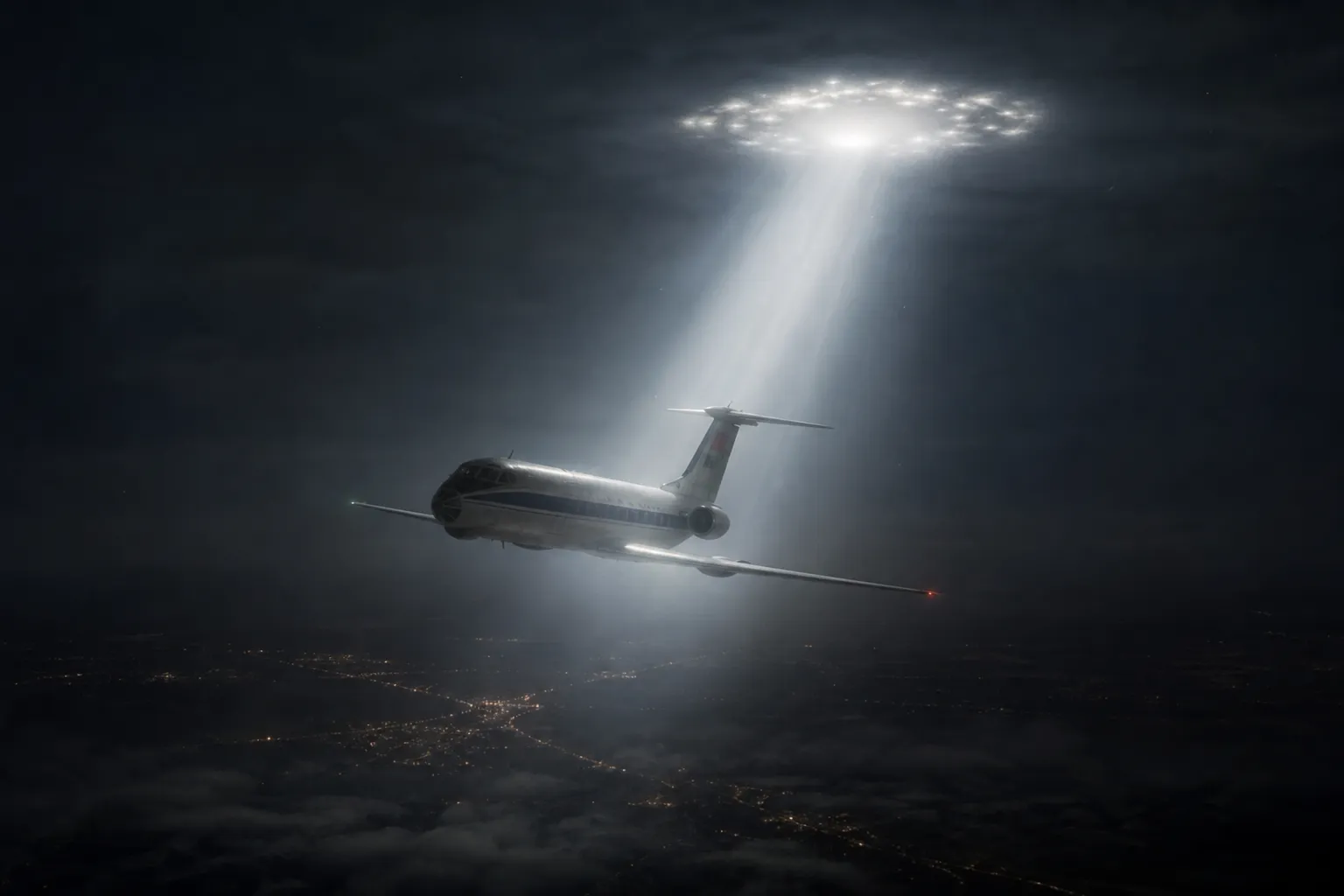
Sometime in January 1985, an Aeroflot Tupolev Tu-134A departed Tbilisi Airport in the Georgian Soviet Socialist Republic on a scheduled domestic flight to Tallinn, the capital of the Estonian SSR. The flight, designated Aeroflot Flight 8352, was operated by a crew from the Estonian Administration of the USSR Ministry of Civil Aviation and carried passengers on what was intended to be a routine overnight leg across Soviet territory. At approximately 4:00 a.m. local time, over the darkened landscape between Tbilisi and Minsk, the incident began with a single unusual light — and escalated into an encounter that Soviet scientists would later publicly refuse to explain away.
The primary witnesses were the professional flight crew of the Tu-134A: aircraft commander Igor Alekseyevich Cherkashin and copilot Gennadiy Ivanovich Lazurin, both licensed transport category pilots operating for the state carrier under Soviet civil aviation standards. Additional crew and passengers aboard the aircraft also witnessed the phenomena. Air traffic controllers at Minsk initially could not verify the sighting by radar but acknowledged seeing "flashes of light on their horizon." A second Aeroflot aircraft flying the opposite route — Tallinn to Tbilisi — also observed luminous phenomena at the same time, providing independent corroboration from a separate platform. At Tallinn Airport, controllers monitoring the approach of Flight 8352 observed anomalous radar returns.
The second officer first noticed a bright star-like object above and to the right of the aircraft's heading that appeared to fire a laser-like beam directed toward the ground. The crew gathered at the cockpit windows. The initial stellar point evolved over subsequent minutes into what was described as a large yellowish-green cloud, estimated to span approximately twenty-five miles in apparent diameter — an extent far exceeding any atmospheric formation consistent with weather phenomena at cruise altitude. The cloud appeared to scan the terrain below with a cone of light, clearly illuminating the landscape. At one point, the witnesses noted that the cloud seemed to replicate the external silhouette of the Tu-134 itself, mirroring the aircraft's outline — a detail that proved impossible to attribute to any natural optical explanation. Within the larger luminous mass, smaller lights were observed zigzagging in irregular patterns. The phenomena remained visible for the duration of the flight's passage over the affected area, estimated at more than one hour.
The described behavior of the luminous object — a sustained, directed cone of light scanning the ground, followed by apparent replication of the aircraft's own profile — is incompatible with any known atmospheric optical phenomenon, including noctilucent cloud formations, ball lightning, or aircraft contrail illumination. The estimated angular size of twenty-five miles at cruise altitude implies either an extraordinarily large source or one that was at a very short relative distance. The matching of the Tu-134's silhouette, as reported by multiple crew members, suggests structured behavior rather than passive atmospheric interaction. No engine noise or exhaust was observed by the crew. The independent observation by the opposite-direction aircraft rules out a crew-specific optical artifact. The radar returns at Tallinn — two additional blips in close formation with the aircraft's own return at a time when no other traffic was logged in the corridor — constitute instrument corroboration of a proximate anomalous presence.
Air traffic control radar at Tallinn Airport recorded two additional radar returns in close proximity to the Tu-134A's transponder blip during the final approach phase, at a time when no other aircraft were assigned to or operating in the arrival corridor. The Minsk ATC center noted visual flashes of light in the direction of the flight without a corresponding radar contact, suggesting the primary phenomenon had selective radar reflectivity. No physical samples, landing traces, or photographic documentation were obtained. The phenomena produced no reported EM interference with the aircraft's avionics, no engine anomalies, and no adverse physiological effects on the crew beyond the visual observation.
The crew reported the encounter upon landing at Tallinn and filed incident documentation through civil aviation channels. The case was reviewed by authorities connected to the USSR Academy of Sciences' ongoing systematic study of anomalous aerial phenomena — a program that had been operating since the late 1970s. In March 1985, approximately two months after the incident, the Academy of Sciences issued a public statement acknowledging that the crew of Flight 8352 had encountered "something we call UFOs." This constitutes one of the most explicit on-record acknowledgments by a Soviet scientific body of an unexplained aerial encounter during the Cold War. No explanation was offered. No disciplinary action against the crew was reported. The CIA subsequently obtained and filed the case summary, which was later released through the agency's FOIA reading room as document 0005516658.
None documented. The USSR Academy of Sciences' willingness to publicly acknowledge the encounter — rather than suppressing or pathologizing the crew's report — may reflect the relative openness that characterized Soviet official UAP research between 1978 and 1990, during which the Ministry of Defense formally authorized the armed forces' information-gathering apparatus to collect UAP reports across Soviet territory. Unlike many military pilot cases in Eastern Europe where witnesses faced career pressure to remain silent, Flight 8352's crew reported through institutional channels without documented adverse consequences.
The Flight 8352 case is notable for three reasons that distinguish it from the broader mass of Soviet-era UAP reports. First, the USSR Academy of Sciences made an on-record statement naming the phenomenon a UFO — unusual in a political environment where unidentified aerial phenomena were routinely attributed to atmospheric optics or Western intelligence assets. Second, the Tallinn radar contact provides objective instrument corroboration beyond crew testimony, placing it in the small category of cases with both visual and electronic evidence. Third, the case spans two Soviet republics — originating in Tbilisi, Georgian SSR, and concluding in Tallinn, Estonian SSR — with independent witness corroboration at both ends of the flight corridor, making it one of the geographically broadest single-incident UAP encounters in Soviet aviation history.