
Credibility Audit
3 factors- Pilot Witness+3
- Radar Corroborated+3
- Physical Evidence+3
- 0–3
- 4–7
- 8–11
- 12–16
- 17+
DoD Observables
1 of 5- Instantaneous Acceleration
- Hypersonic Velocity
- Low Observability
- Trans-Medium Travel
- Anti-Gravity Lift
Event Description
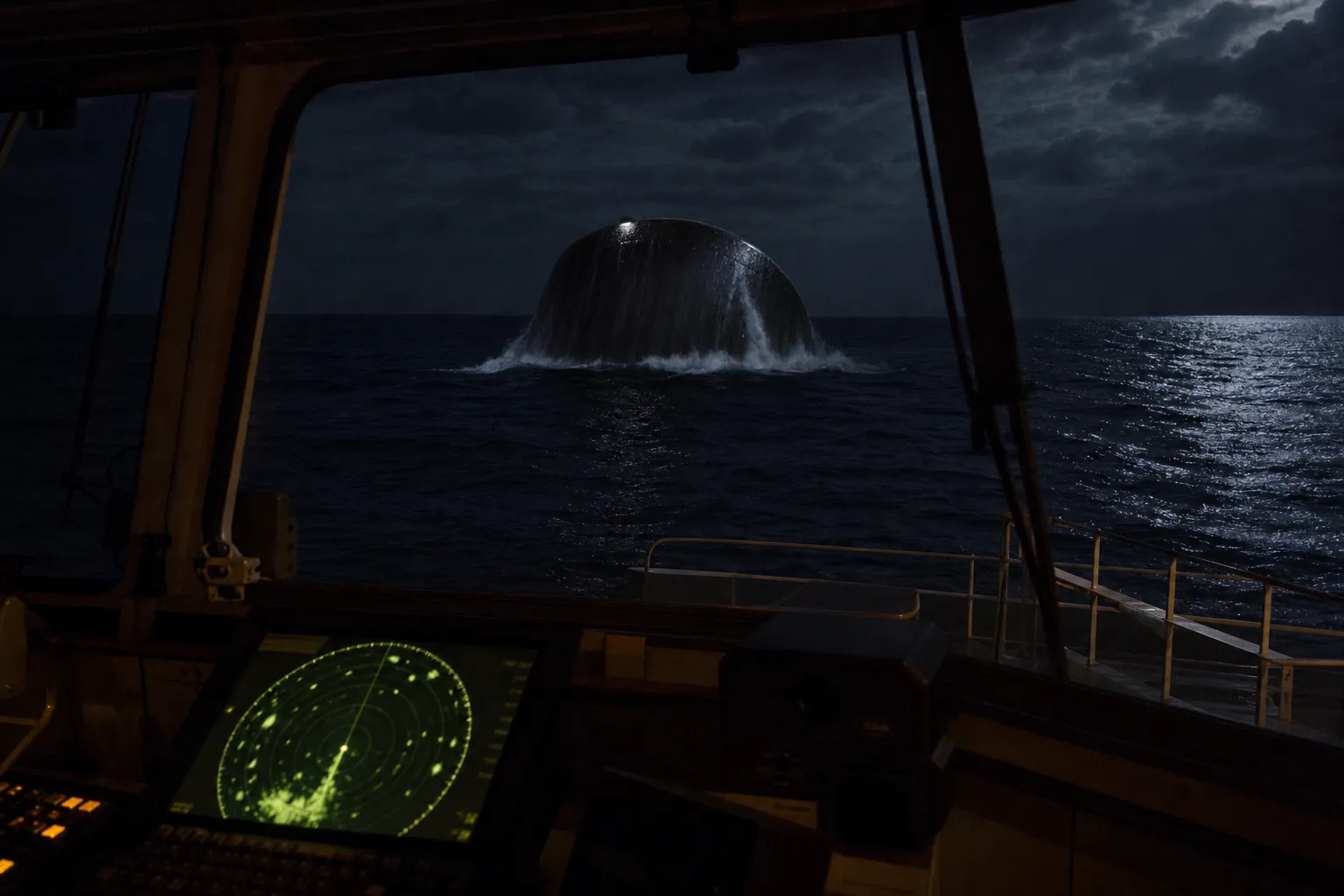
On December 28, 1995, a seismic survey ship operating in the Atlantic waters off the coast of Trinidad encountered a large underwater object that first physically struck the vessel's towed geophysical equipment — causing measurable damage — before rising from the ocean and generating a radar return visible for approximately ten minutes. The incident was reported to the National UFO Reporting Center (NUFORC) on April 4, 1996, via telephone, by the ship's captain. NUFORC director Peter Davenport, who personally conducted the initial interview, noted in the case file that "we spoke with this witness at length, and we found him to be quite credible and convincing."
Trinidad and Tobago sits at the southern terminus of the Caribbean island chain, with the waters off its eastern coast in the Atlantic Ocean and those off its western and southern coasts draining into the Gulf of Paria and the Caribbean Sea. The region is heavily traversed by commercial shipping and offshore energy operations; the waters around Trinidad have significant hydrocarbon deposits and are regularly surveyed by seismic and oceanographic research vessels. Such vessels deploy towed arrays of acoustic transducers and geophones, connected by cables and streamers that can extend thousands of meters behind the ship, creating a large and sensitive underwater contact surface.
The primary witness was the captain of a commercial seismic survey vessel — a professional mariner with navigational and watch-keeping responsibilities, commanding a crew conducting scientific survey operations. His professional role required technical competence and situational awareness, and his report was made not in the immediate emotional aftermath of a frightening event but weeks later, suggesting deliberate reflection rather than panic-driven reporting. NUFORC director Peter Davenport's direct telephone interview assessment — "quite credible and convincing" — carries additional weight given Davenport's established practice of filtering out low-quality reports. The ship's crew would have included additional witnesses to both the physical damage event and the radar observation, as watch-keeping on commercial survey vessels requires multiple personnel on the bridge.
The incident unfolded in two phases. In the first phase, while the vessel was conducting seismic survey operations with towed equipment, something in the water made contact with the deployed streamer or array with enough force to cause physical damage to the equipment. Towed seismic arrays are substantial pieces of engineering, typically comprised of tens to hundreds of hydrophone groups connected by buoyant tubing, and the force required to damage them while under tow is considerable — ruling out ordinary marine life or debris collision as routine explanations. In the second phase, the object responsible for the collision (or a separate object in the same vicinity) rose from the ocean surface and was detected on the ship's navigation radar. The radar contact persisted for approximately ten minutes before disappearing from the scope. No details of the object's shape, size, or direction of departure are specified in the abbreviated NUFORC report summary, but the radar duration of ten minutes is sufficient for a skilled radar operator to establish a track and estimate bearing and speed.
The defining anomaly of this case is the transition of the object from a submerged, physically impactful underwater presence to an airborne radar contact — the transmedium behavior documented in the DoD's Unidentified Aerial Phenomena task force reports. Objects that can operate both underwater and in the air without conforming to the known signature of any conventional submarine, unmanned underwater vehicle, or aircraft represent one of the most anomalous categories in UAP research. The physical damage to the towed equipment provides a form of hard evidence beyond eyewitness testimony, establishing that the object had mass and velocity sufficient to strike and damage industrial marine equipment. Damage to seismic streamers has defined replacement and repair costs and would have been documented in the vessel's operational logs.
Two independent forms of physical/instrument evidence are present in this case. First, the towed equipment sustained physical damage from contact with the underwater object — this would be documented in the ship's operational and maintenance logs and represented a direct economic cost to the survey operation. Second, the object was tracked on shipboard radar for approximately ten minutes after rising from the ocean. Marine navigation radar (typically X-band or S-band) detects solid objects on and above the ocean surface; a ten-minute persistent radar return is not consistent with sea spray, birds, or atmospheric phenomena, and represents genuine detection of a physical object that had sufficient radar cross-section to be tracked continuously.
No official response from the Trinidad and Tobago government, US Coast Guard, or any other authority is documented. The incident was reported to NUFORC, a civilian organization, approximately three months after it occurred. No official maritime incident investigation was triggered, at least none that has been made public.
None documented. The witness's decision to report through a civilian UFO reporting channel rather than maritime or government authorities suggests either uncertainty about proper channels or concern about professional repercussions — a pattern common among maritime officers who encounter unexplained phenomena at sea.
The Trinidad 1995 case is one of a small number of documented USO (Unidentified Submerged Object) cases in the Caribbean that involves physical evidence in the form of equipment damage combined with radar confirmation of the object after it transitioned to an aerial state. The transmedium behavior — submerged operation followed by aerial detection — matches the profile of the DoD's highest-concern UAP category as described in the 2021 UAP Task Force preliminary assessment, which specifically noted trans-medium objects as a category of particular interest. The case predates the current era of UAP disclosure by over two decades, suggesting that transmedium phenomena have been present in Caribbean waters for at least thirty years. Trinidad and Tobago's position near major Atlantic shipping lanes and regional hydrocarbon survey operations makes the waters off its coast a relevant domain for maritime UAP documentation.