
Credibility Audit
5 factors- Military Witness+3
- Radar Corroborated+3
- Multiple Witnesses+2
- Official Report+1
- Govt. Acknowledgment+4
- 0–3
- 4–7
- 8–11
- 12–16
- 17+
DoD Observables
2 of 5- Instantaneous Acceleration
- Hypersonic Velocity
- Low Observability
- Trans-Medium Travel
- Anti-Gravity Lift
Event Description
Craft morphology
At noon on July 12, 1987, air traffic control radar at a Czechoslovak military installation in southern Moravia acquired an unidentified contact over the Vranov nad Dyjí region, near the tightly monitored border with Austria. The object returned no IFF (Identification Friend or Foe) transponder signal and matched no known flight plan. It was traveling along the Iron Curtain boundary at a velocity that ground radar operators could not immediately classify. A scramble order went out to the 51st Helicopter Regiment, stationed at Božice.
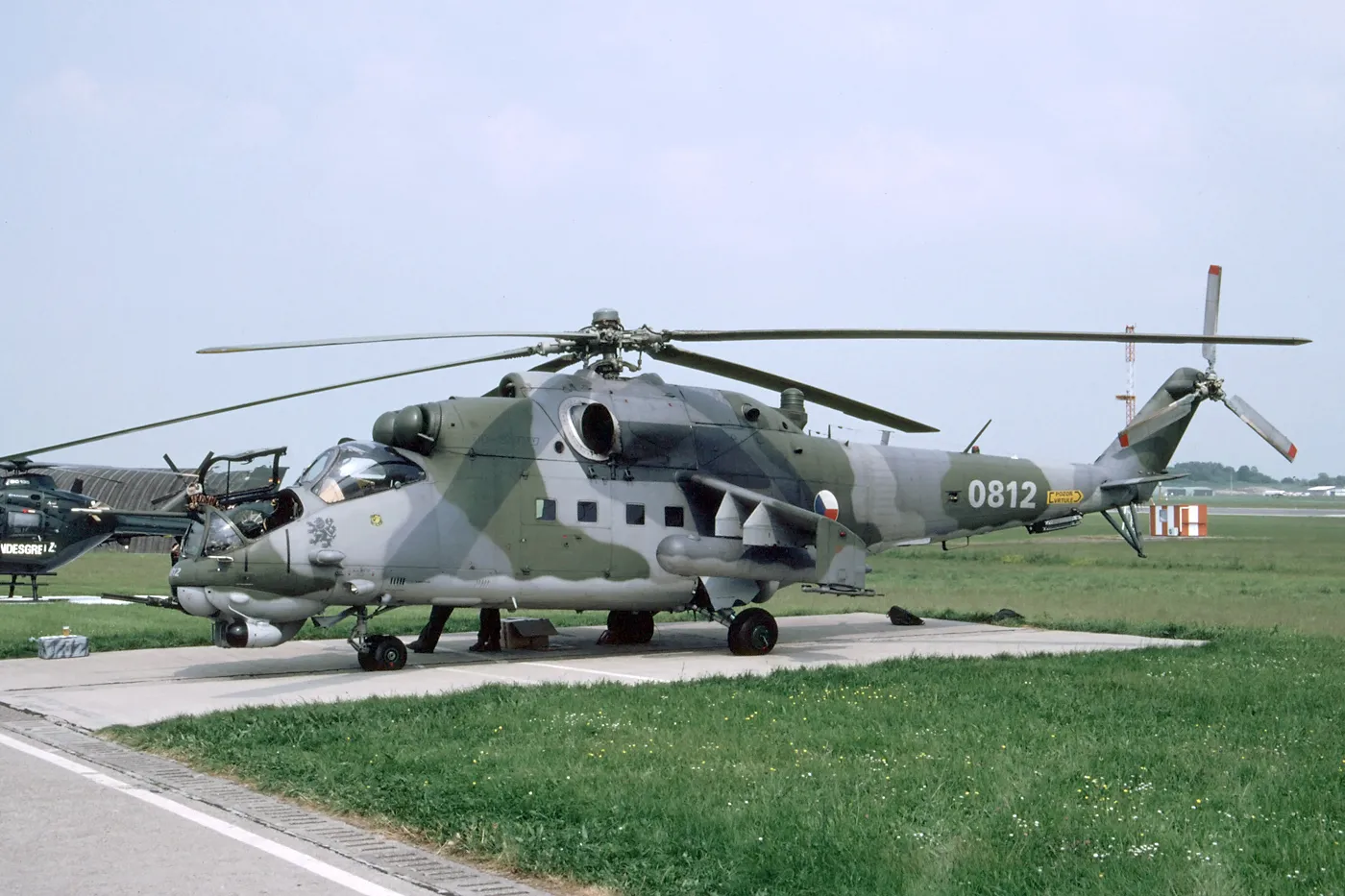
The crew assigned to intercept consisted of Captain Čestmír Tesařík (pilot), Flying Officer Ivan Pospíchal (navigator), and Flying Officer Milan Šero. They launched in a Mil Mi-24 military helicopter — the Soviet-designed attack helicopter then operated by Czechoslovak Air Force units throughout the Warsaw Pact. The regiment was among the most capable helicopter forces in Central Europe, trained under Soviet doctrine for both ground attack and intercept operations. None of the three men were novices.
At altitude, the crew located the object visually. What they observed was a dark, cigar-shaped craft flying silently and without wings — described by witnesses as resembling an aircraft fuselage stripped of all external structures. There was no cabin visible, no exhaust plume, no aerodynamic surfaces. Ground control tracked the contact continuously by radar and relayed distance updates. At its closest, the object passed within an estimated 200 to 600 meters of the helicopter. The crew received a direct order from ground control to engage and fire on the contact.
The order could not be executed. Every time Captain Tesařík maneuvered the Mi-24 to place the object in his weapons crosshairs, it changed direction immediately — a response so consistent that the crew concluded the object was actively evading. The object also repeatedly repositioned toward the sun, degrading visual acquisition for the crew. A secondary constraint made firing impossible regardless: the Vranov Reservoir directly below was crowded with civilian vacationers during the summer peak season. Dozens of witnesses on the reservoir surface observed the aerial pursuit from below. Firing into that airspace was prohibited.
Throughout the encounter, Captain Tesařík and Flying Officer Pospíchal calculated the object's flight performance. Their estimates placed its speed at a minimum of 60 km/h — a near-hover by aviation standards — and a maximum of approximately 2,700 km/h, well into the supersonic range, achieved without any observable propulsion signature, shock wave, or sonic boom reported by ground witnesses. After approximately two minutes of visual contact, the object accelerated away at high speed. Radar tracked it moving north over Brno, then east toward Jaslovské Bohunice in Slovakia, and onward toward Bratislava. Slovak radar at Bratislava separately confirmed the track. The object then disappeared from all radar coverage entirely.
Upon returning to base at Prostějov, the crew received orders from military command to destroy all records: radio correspondence logs, flight parameters, and associated documentation from the sortie. The cover-up was immediate and direct — not a classification order assigning restricted access to the records, but a destruction order. No official file was to remain. The crew complied. The incident did not enter any publicly accessible Czech military archive at the time.
The Vranov nad Dyjí helicopter pursuit stands as one of the most operationally detailed UAP intercept incidents documented in Cold War Central Europe. It involves three named, credentialed military witnesses in an active weapons platform with a direct fire order; continuous radar tracking by both Czechoslovak and Slovak military installations providing multi-station corroboration; and a civilian witness population at the reservoir below that was in a position to independently confirm the aerial activity overhead. The destruction order issued upon landing constitutes an institutional acknowledgment that something occurred that day — an acknowledgment the military chose to erase rather than explain.