
Credibility Audit
3 factors- Multiple Witnesses+2
- Historical Document+1
- Law Enforcement+2
- 0–3
- 4–7
- 8–11
- 12–16
- 17+
DoD Observables
1 of 5- Instantaneous Acceleration
- Hypersonic Velocity
- Low Observability
- Trans-Medium Travel
- Anti-Gravity Lift
Event Description
Craft morphology
In the autumn and winter of 1896–1897, thousands of Americans across California, the Midwest, and the central plains reported seeing large, powered airships navigating the night sky with controlled, purposeful flight — more than a decade before the Wright Brothers demonstrated sustained powered flight in December 1903. The wave began in Sacramento, California in November 1896 and spread eastward over the following months, generating newspaper coverage, formal testimonies from public officials, and a national debate about what people were seeing.
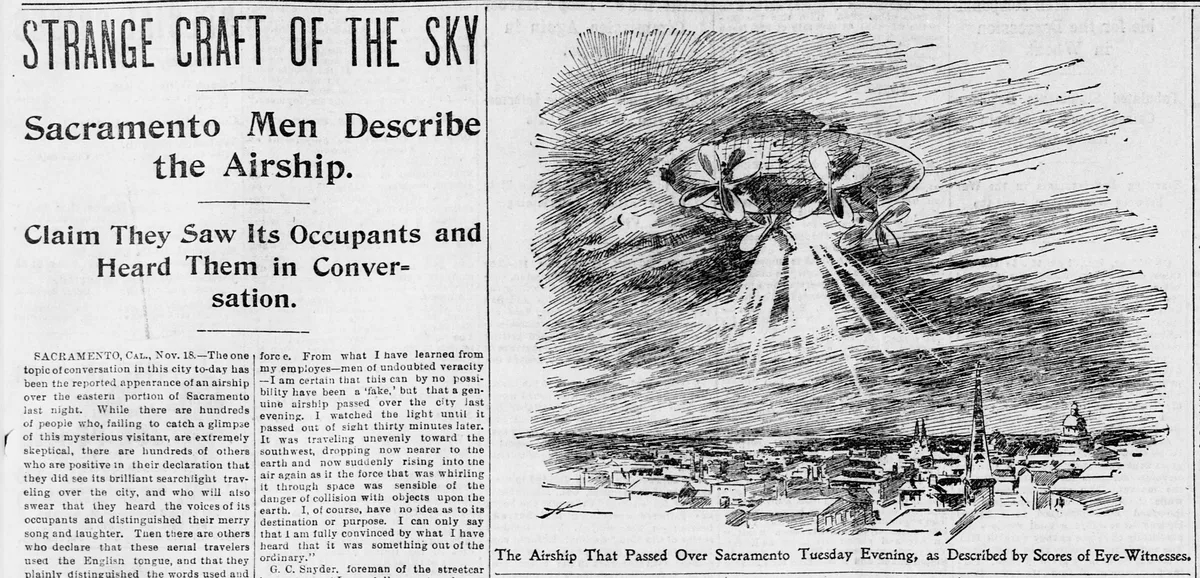
The objects described in 1896–97 reports were not vague lights or atmospheric anomalies — witnesses consistently described structured craft with elongated cigar or dirigible shapes, powerful searchlights projecting downward from the underside, and in many cases propeller or wing-like structures suggesting mechanical propulsion. Multiple reports described the craft operating at low altitude over populated areas, illuminating the ground with its searchlight. In some cases, witnesses described hearing engine sounds from the craft.
The Sacramento wave began on November 17, 1896, when hundreds of witnesses — including city aldermen, a deputy secretary of state, and numerous other public officials — observed an illuminated craft with a bright headlight cross the city from west to east at relatively low altitude and then turn north. The California Secretary of State was among those who reported the sighting in the Sacramento Evening Bee. The concentration of credible civic witnesses in Sacramento gave the initial reports unusual documentary weight.
As the wave spread eastward through early 1897, reports multiplied across Nebraska, Kansas, Missouri, Iowa, Illinois, and Texas. Newspapers competed for the most dramatic accounts, and fabrication undoubtedly contaminated many reports — several stories claimed interactions with crew members who gave implausible explanations. However, researchers separating hoaxes and newspaper sensationalism from the underlying core of consistent, independently reported craft observations have concluded that a genuine phenomenon was being observed: structured, illuminated, powered objects in controlled flight over American cities.
No individual or organization in 1896–97 claimed ownership of the craft, and no private inventor produced anything remotely resembling what was described. Count Ferdinand von Zeppelin did not fly his first airship until 1900, and no other dirigible program in the world had produced craft of the performance described. The mystery of what Americans were seeing in 1896–97 was never resolved, and the Great Airship Wave remains a significant unsolved chapter in the history of unidentified aerial phenomena — particularly because it predates the cultural framework of flying saucers and science fiction rockets that would shape later UAP narratives.