
Credibility Audit
3 factors- Multiple Witnesses+2
- Physical Evidence+3
- Historical Document+1
- 0–3
- 4–7
- 8–11
- 12–16
- 17+
DoD Observables
0 of 5- Instantaneous Acceleration
- Hypersonic Velocity
- Low Observability
- Trans-Medium Travel
- Anti-Gravity Lift
Event Description
Craft morphology

Sole pilot of the crashed airship; described as 'not of this world' by witnesses, speculated to be 'a native of Mars.' Received a Christian burial in Aurora Cemetery.
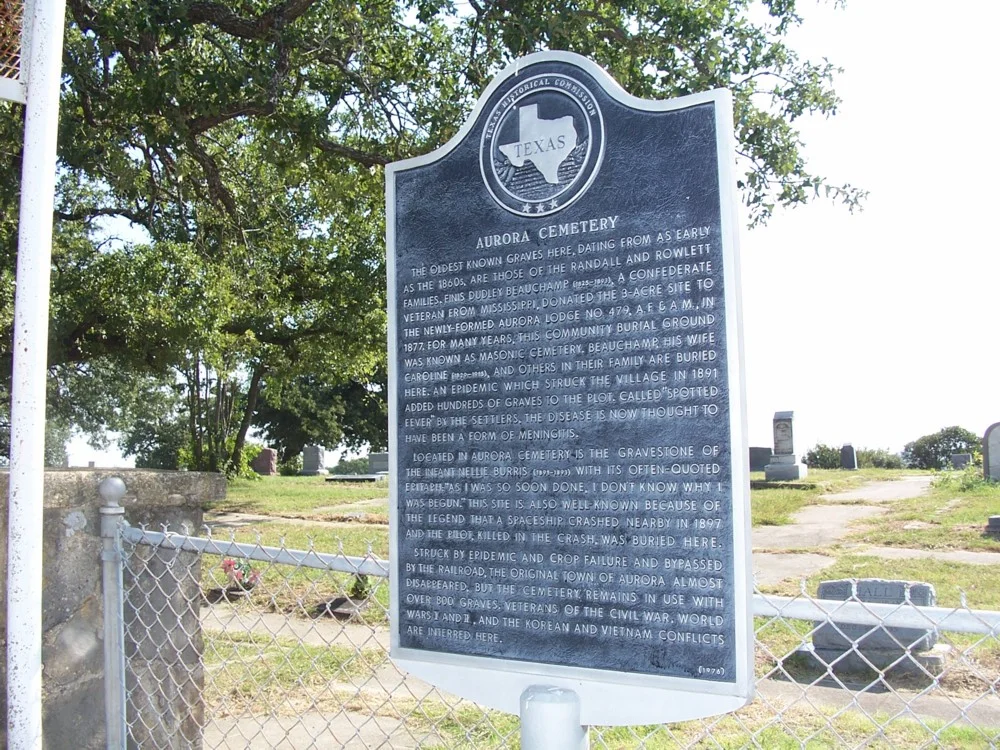
On April 17, 1897, at approximately 6:00 AM, amid the nationwide 1897 mystery airship wave that had produced hundreds of sightings across the central United States, a slow-moving cigar-shaped craft reportedly appeared over Aurora, Texas — a small farming community 20 miles northwest of Fort Worth — flying at an estimated 10 to 12 miles per hour at low altitude. This sluggish pace, witnesses suggested, indicated the craft was experiencing mechanical difficulty. The object struck the windmill on the farm of Judge J.S. Proctor, exploded on impact, and scattered debris across several acres of the property.
The Dallas Morning News published the account on April 19, 1897, in an article by local correspondent S.E. Haydon headlined 'A Windmill Demolishes It.' Haydon reported that the sole occupant — killed in the crash — was recovered and described as 'not of this world,' with the speculation offered that he was 'a native of Mars.' Papers recovered from the pilot were reportedly written in an indecipherable script resembling hieroglyphics. The wreckage was thrown into a well on the Proctor property; the pilot was given a Christian burial in Aurora Cemetery under a rough stone marker.
MUFON began investigating in 1973 under Texas state director Bill Case, making 27 separate visits to Aurora over subsequent years. Soil samples from the crash area were analyzed and found to contain fragments that were approximately 95% aluminum and 5% iron — notably lacking zinc, which is normally present in both natural and manufactured aluminum alloys of the period. A 2008 investigation opened the well and retrieved metal pieces with anomalous high aluminum content. Investigation of the cemetery identified a grave site with a marker bearing an etched design resembling a flying disc — but immediately after MUFON's findings became public, the original marker disappeared from the cemetery. A pipe was driven into the grave site, and subsequent metal detector surveys of the area returned no readings.
A 1980 interview with 86-year-old Aurora resident Etta Pegues, conducted by Time magazine, produced a flat statement that Haydon had fabricated the story to attract attention to a town that was dying economically. MUFON's own official conclusion was 'evidence inconclusive; hoax not ruled out.' The Aurora case remains unresolved — its primary published source may have been a fabrication, but the physical evidence investigations produced results that have not been satisfactorily explained within either a hoax or conventional framework.
Sources
- mediaS.E. Haydon, 'A Windmill Demolishes It,' Dallas Morning News, April 19, 1897
- witnessBill Case, MUFON Texas director — 1973 field investigation, 27 visits, anomalous metal analysis
- witnessMary Evans and Charlie Stephens — childhood witnesses interviewed by MUFON 1973