
Credibility Audit
5 factors- Pilot Witness+3
- Military Witness+3
- Multiple Witnesses+2
- Photo Evidence+2
- Official Report+1
- 0–3
- 4–7
- 8–11
- 12–16
- 17+
DoD Observables
3 of 5- Instantaneous Acceleration
- Hypersonic Velocity
- Low Observability
- Trans-Medium Travel
- Anti-Gravity Lift
Event Description
Craft morphology
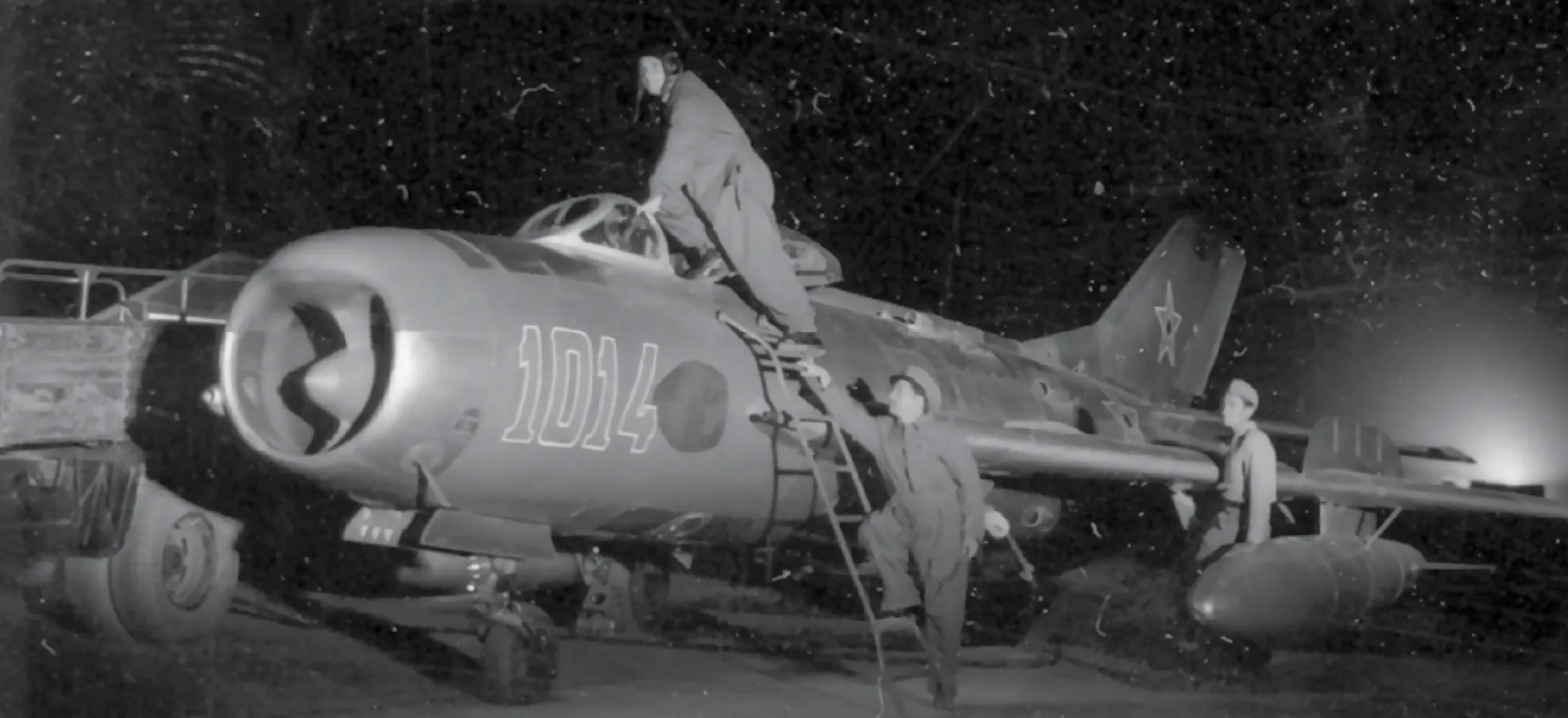
Sometime in 1966 or 1967 — the exact date was never publicly released — Romanian Air Force squadron commander Captain Mihai Bărbuțiu and his wingman, Major Dumitru Răducanu, were flying two single-seat MiG-19 supersonic fighters at an altitude of approximately 12,500 meters during a night intercept exercise above the cloud deck west of Timișoara. The routine training mission was being directed by a ground command station. What began as a standard exercise would become the most significant and best-evidenced encounter in the four-decade career of one of Romania's most experienced Cold War interceptor pilots.
Bărbuțiu was born in Arad on February 21, 1929, and had held a military pilot's license since 1951, progressing through several aircraft types before achieving supersonic qualification. By the mid-1960s he was serving as squadron commander at the fighter-interceptor regiment in Timișoara, with thousands of hours on MiG-series aircraft. He would later fly civilian aircraft — the AN-24 and TU-154B — until 1979. His professional credentials are not in question: he occupied command-level roles, had frontline experience across multiple jet generations, and was trusted with night intercept missions, among the most demanding flying tasks of the Cold War era.
As the two pilots formed up to return to Timișoara following their intercept exercise, Bărbuțiu saw a large object ahead of them at distance, well above the dense cloud layer below. A full moon was providing exceptional visibility — Bărbuțiu later said the light was bright enough to read by without cockpit illumination. He initially stayed silent, wary of another secrecy inquiry after an earlier encounter weeks before in which he and Colonel Gheorghiță had seen an unidentified object showing alternating red and green position lights on the Cluj-to-Oradea route, neither registering on radar. That first sighting had already resulted in both pilots being summoned to Bucharest and required to sign non-disclosure undertakings. When Răducanu then spotted the same object and reported it, Bărbuțiu was left with no choice but to confirm. Ground radar could not acquire the target. Only the two pilots' own aircraft were visible on the station's screens.
The object's scale was its most striking characteristic. Bărbuțiu described it as grey, circular, and without wings or visible portholes — roughly the size of a football field. When he flew beneath it at a distance of approximately 500 meters, he reported spending ten to fifteen seconds in a shadow it cast from the moonlight above, and experienced a strong sensation he called "electric pressure," analogous to being near a high-voltage field. His navigation instruments began to spin erratically. Neither aircraft's radar acquired any return from the object throughout the encounter. The ground command post ordered Răducanu to fire a warning shot and force the object to land; as Răducanu armed his guns and approached, the object vanished instantaneously. Moments later Bărbuțiu turned to find it had repositioned directly to his right, flying in formation with him. He reported this to the ground station and received orders to attempt to fall behind it and force it down — an impossible task, he said, because the object moved to maintain the same relative position no matter how tightly he maneuvered. Eventually it pulled ahead, turned west, climbed rapidly toward Serbia and disappeared. Bărbuțiu, by then above Belgrade and near fuel limits, broke off and returned to land.
During the pursuit phase, Bărbuțiu activated his aircraft's fotomitralieră — the onboard gun camera, a standard fitting on all Romanian Air Force MiG-19s used to document gunnery and intercept exercises. Upon landing, he told his film technician, a man named Jilă, to pull the cartridge and prepare a copy for him. The following morning, Jilă reported that a counterintelligence officer had collected the undeveloped film cassette overnight. Neither Jilă nor Bărbuțiu ever saw a single frame. Both pilots were subsequently required to sign additional non-disclosure commitments. No official acknowledgment of the film's existence or fate has ever been issued by Romanian military authorities.
The significance of the Bărbuțiu case rests on several converging factors. First, both pilots independently confirmed the sighting before the ground station was informed — this was not a case of one witness influencing another. Second, the object produced measurable physical effects: disrupted navigation instruments and the electrostatic field sensation, consistent with effects reported in other high-credibility military UAP cases globally. Third, the gun camera was running — the film existed, was in institutional custody, and was deliberately removed before it could be processed or seen. This places the case in a category with a very small number of Cold War UAP events where documentary evidence can be shown to have existed and to have been suppressed, rather than simply never captured. The case was documented by Dr. Dan Farcaș, president of ASFAN (Asociația pentru Studiul Fenomenelor Aerospațiale Neconvenționale), Romania's principal aeronautical UAP research organization, in interviews conducted at Arad on March 4, 2015, when Bărbuțiu was 85 years old and willing to speak for the first time. Farcaș noted that Bărbuțiu had signed secrecy undertakings and remained silent about all four of his military UAP encounters for decades, only agreeing to disclose them late in retirement. The Ceaușescu-era Romanian military maintained strict information controls over any anomalous aerial events, and the removal of undeveloped film by a counterintelligence officer was not an administrative accident — it was standard suppression procedure. The encounter remains one of the most credibly attested Cold War UAP cases from Eastern Europe.
Sources
- academicDan D. Farcaș, ASFAN — 'Four UFO Encounters of a Romanian Fighter Pilot' (interview with Mihai Bărbuțiu, March 4, 2015)
- mediaASFAN (Romanian) — 'Întâlniri ale unui pilot militar cu obiecte neidentificate' — Dan Farcaș
- mediaLovendal.ro — 'Un fost pilot militar român, care a văzut un OZN cât un stadion' (2018)