
Credibility Audit
5 factors- Military Witness+3
- Multiple Witnesses+2
- Radar Corroborated+3
- Photo Evidence+2
- Official Report+1
- 0–3
- 4–7
- 8–11
- 12–16
- 17+
DoD Observables
1 of 5- Instantaneous Acceleration
- Hypersonic Velocity
- Low Observability
- Trans-Medium Travel
- Anti-Gravity Lift
Event Description
Craft morphology
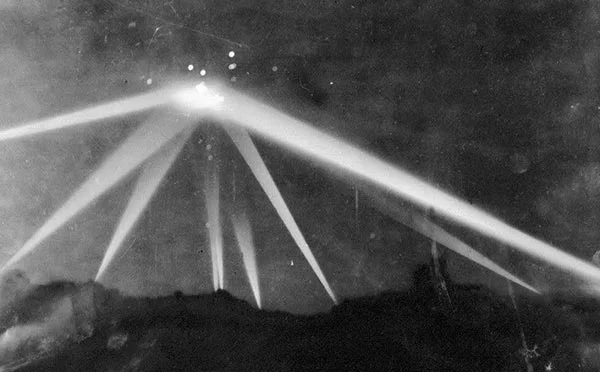
Three weeks after the Japanese attack on Pearl Harbor brought the United States into World War II, the city of Los Angeles was thrown into its worst civilian crisis since the Great Earthquake of 1906. At 2:25 AM on February 25, 1942, air raid sirens sounded across Southern California. The Western Defense Command issued a Blackout Order. Anti-aircraft batteries positioned across the Los Angeles basin opened fire, ultimately expending 1,430 rounds over a period of several hours.
The iconic Los Angeles Times photograph — taken at the height of the barrage — shows the convergence of military searchlight beams from multiple batteries all targeting a single point in the night sky above the city. Three civilians died of heart attacks during the incident; three more were killed in automobile accidents in the blackout chaos. No Japanese aircraft were identified, confirmed, or even reported by any US or Allied intelligence source anywhere near the California coast that night.
What followed in official Washington was remarkable for its contradictions. Secretary of War Henry Stimson attributed the event to 'war nerves' and suggested that perhaps Japanese weather balloons had triggered the alarm. Secretary of the Navy Frank Knox held a separate press conference the same day and told reporters it had been a false alarm — that no aircraft of any kind had been present. Two Cabinet members, speaking within hours of each other, gave mutually incompatible official explanations. President Roosevelt was briefed personally on the incident. Congressional hearings followed without producing a definitive account.
The Army's own Western Defense Command later produced a confidential report acknowledging that an unidentified object had been tracked on military radar moving slowly from Santa Monica to Long Beach at low speed — behavior inconsistent with any Japanese aircraft type and far too slow for a conventional airplane of the era. Whatever was in the sky above Los Angeles on February 25, 1942, absorbed 1,430 rounds of anti-aircraft fire without being brought down, without producing observable debris, and without any physical evidence of its presence or departure. It remains one of the most heavily military-corroborated and officially self-contradicted aerial phenomena events in American history.