
Credibility Audit
4 factors- Military Witness+3
- Multiple Witnesses+2
- Historical Document+1
- Official Report+1
- 0–3
- 4–7
- 8–11
- 12–16
- 17+
DoD Observables
2 of 5- Instantaneous Acceleration
- Hypersonic Velocity
- Low Observability
- Trans-Medium Travel
- Anti-Gravity Lift
Event Description
Craft morphology
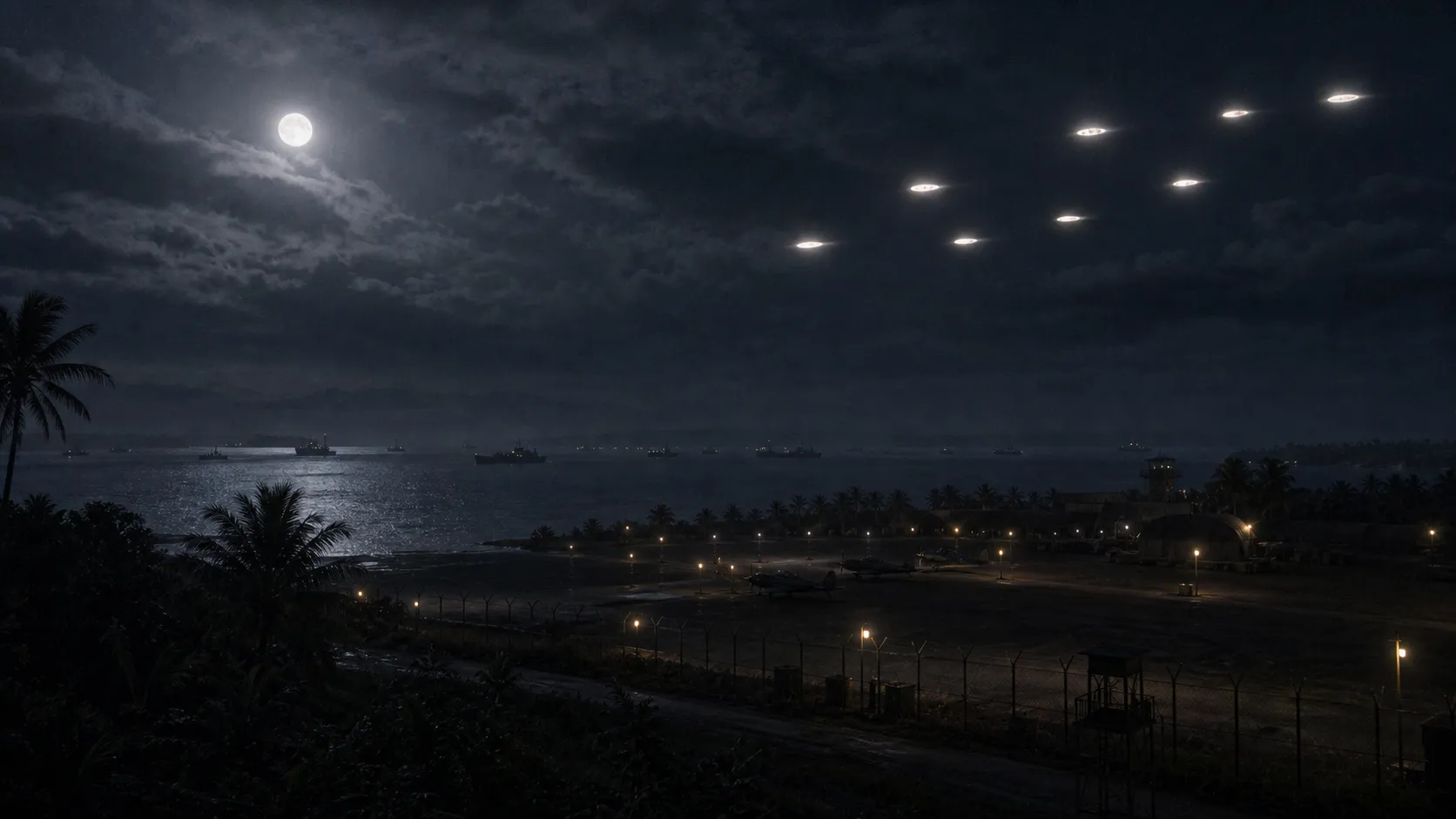
On the night of August 12, 1942 — less than a week after the first US amphibious landing of the Pacific War — personnel of the 1st Marine Division and attached Navy units at the newly captured Henderson Field on Guadalcanal observed a formation of bright, disc-shaped objects moving in tight formation over Iron Bottom Sound and the Lunga River plain. The sighting occurred during a period of intense Japanese air activity, yet the objects' behavior distinguished them sharply from the Mitsubishi Zero fighters and Nell bombers that had been harassing the perimeter for days. Rather than following approach corridors or bomb-run vectors, the objects performed rapid altitude changes and abrupt lateral movements at speeds that outpaced anything in either nation's inventory.
Primary witness Sergeant Stephen Brickner, USMC, described the objects in a sworn statement later reproduced in Kenneth Arnold and Ray Palmer's 1952 volume *The Coming of the Saucers*. Brickner counted approximately fifteen to twenty objects in a loose V-formation moving southwest to northeast. Supporting witnesses were drawn from the Henderson Field perimeter defense detail — at minimum twelve individuals from two separate defensive positions who corroborated the V-formation and the unusual silence of the objects. Brickner was a combat-trained noncommissioned officer with experience identifying Japanese aircraft silhouettes by this point in the campaign, making his confident rejection of conventional aircraft identification significant. Navy personnel near the Lunga Point beachhead also reported lights consistent with the same objects during the same time window.
Brickner described the objects as metallic-appearing discs visible in partial moonlight. Each object was estimated to be roughly twice the wingspan of a Douglas Dauntless dive bomber, though this was an impression rather than a measured figure. The formation moved at an estimated speed far exceeding P-400 Airacobras, the fastest Allied fighters then based at Henderson. Critically, the objects were silent — a detail that eliminated conventional propeller aircraft. The objects executed what Brickner described as a "wobbling" motion, consistent with descriptions of disc-shaped craft in many subsequent post-war cases. After approximately ninety seconds of observation, the formation climbed steeply and disappeared over the mountains to the north.
Three distinct anomalies set this sighting apart from misidentification of Japanese aircraft. First, the silence: no propeller or jet noise was reported by any witness. Second, the kinematics: the objects reversed direction twice in the span of the observation, behavior physically impossible for any fixed-wing aircraft of the era. Third, the absence of any Japanese reconnaissance or attack that night — the objects appeared on no subsequent intelligence summary as a Japanese mission, and no attack or flare-drop followed the observation, which would have been the expected purpose of any Japanese nocturnal intrusion. Henderson Field's radar — a cobbled-together SCR-268 unit just becoming operational in this period — did not definitively track the objects, though the radar log for that night has not been located.
No physical effects on personnel or equipment were recorded. Anti-aircraft crews initially trained weapons on the formation, but fire was not ordered because the objects did not conform to Japanese approach patterns and a friendly-fire incident could not be ruled out in the chaotic early days of the Guadalcanal perimeter defense. No aircraft wreckage, electromagnetic anomalies, or physiological effects were documented.
The incident was recorded in unit logs. It was later cited in Project Blue Book's predecessor investigations (Air Technical Intelligence Center) as an example of credible multi-witness military observations preceding the modern UFO era. The case appears in the ATIC summary documents compiled by Edward Ruppelt during his tenure as Blue Book director in the early 1950s as part of a broader review of WWII-era military sightings. No formal investigation was conducted at the time — Henderson Field was under near-constant attack, and command priorities precluded anything beyond a log entry. The case was not classified, simply unremarked upon in the chaos of the Guadalcanal campaign.
No active suppression is documented. The case was published openly by Brickner in 1952 and was available to researchers from that date. The absence of a radar record is a genuine gap, though given the state of Henderson Field's radar in August 1942, this is explicable by equipment limitations rather than deliberate concealment.
The Guadalcanal sighting is one of a cluster of well-attested WWII-era military observations from both the Pacific and European theaters that predate the post-war "flying saucer" narrative. Its significance lies in its evidentiary context: the witness was a trained military observer in a combat zone, familiar with the full inventory of Japanese aircraft, with no cultural framework for "flying saucers" (a term not coined until 1947), and filing his account as a straightforward military observation. The case sits within the broader pattern of WWII foo fighter and disc sightings reported by Allied and Axis aircrew alike, lending cross-cultural corroboration to the underlying phenomenon and challenging the hypothesis that post-war UFO reports arose from Cold War anxiety or civilian misidentification.
Sources
- academicArnold & Palmer, The Coming of the Saucers (1952) — Brickner sworn statement
- governmentATIC / Project Blue Book predecessor file — WWII military sightings summary (Ruppelt archive)
- mediaRuppelt, The Report on Unidentified Flying Objects (1956)