
Credibility Audit
4 factors- Pilot Witness+3
- Military Witness+3
- Historical Document+1
- Official Report+1
- 0–3
- 4–7
- 8–11
- 12–16
- 17+
DoD Observables
3 of 5- Instantaneous Acceleration
- Hypersonic Velocity
- Low Observability
- Trans-Medium Travel
- Anti-Gravity Lift
Event Description
Craft morphology
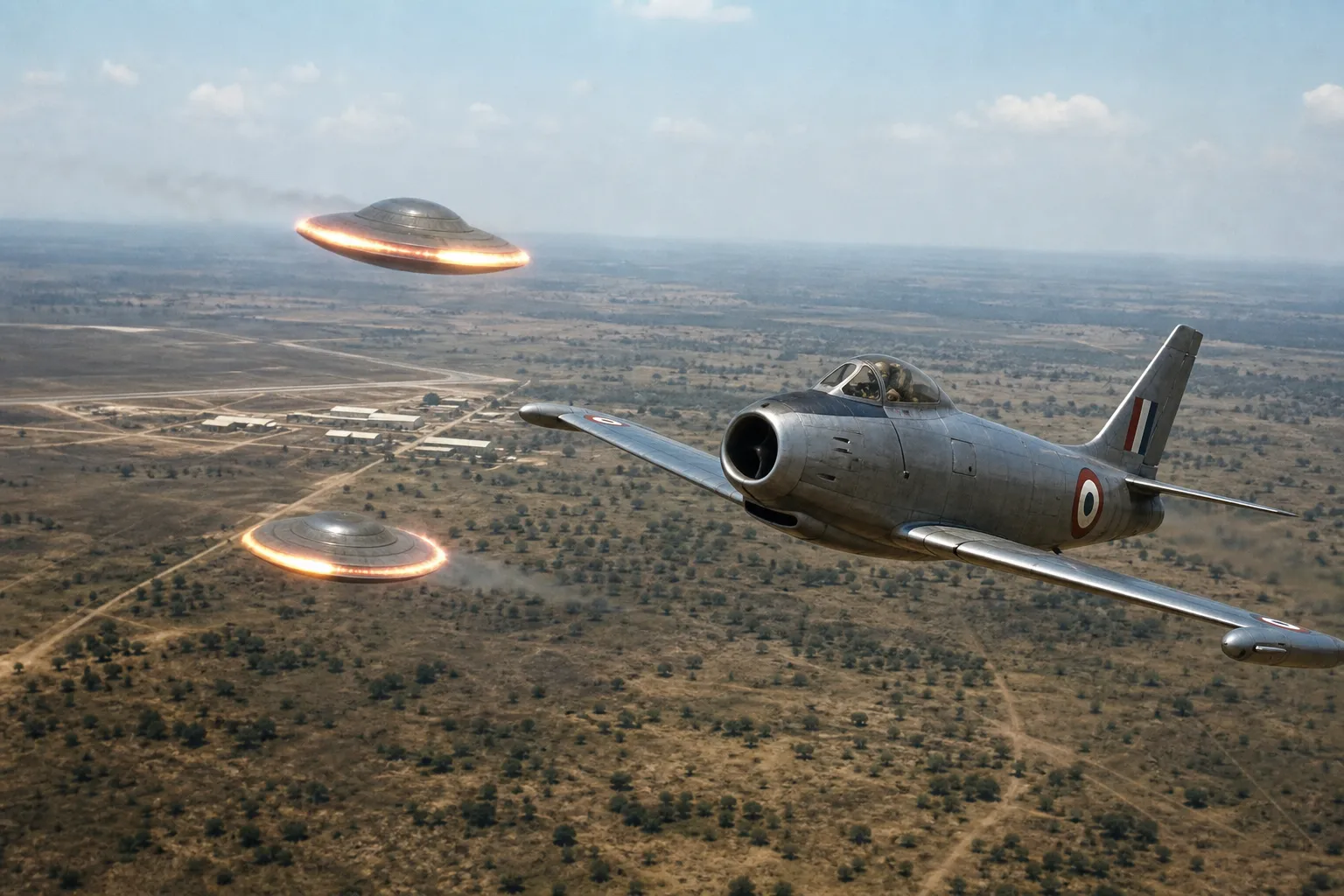
On the afternoon of March 29, 1952, the commander of the Élisabethville military airfield in the southern Belgian Congo spotted two fiery disc-shaped objects maneuvering over the region east of the Luapula River — the area containing the Shinkolobwe uranium mine, the single most strategically important raw-materials site in the Western world at the time. The day was clear and the altitude relatively low, allowing repeated close-range observation before a chase ensued. The incident was subsequently documented by the Central Intelligence Agency, which retained the report in its internal files, and was circulated via the Vienna newspaper Die Presse through the account of German journalist Fritz Sitte.
The primary pursuit witness was a Belgian officer identified as "Commander Pierre," the airfield commander at Élisabethville — today's Lubumbashi — in the Katanga Province of the Belgian Congo. His rank and position gave him immediate access to a fighter aircraft and the authority to initiate an intercept. Ground witnesses at or near the mine and airfield complex also observed the objects from below, corroborating Pierre's airborne account with independent visual descriptions from different angles. Journalist Fritz Sitte, who was present in the region, reported the incident and constructed a diagrammatic sketch of the objects' estimated dimensions and apparent operating principles, which was reproduced in the intelligence file. The CIA document does not name additional ground witnesses individually, but the multiplicity of observation angles — ground level and airborne — strengthens the evidentiary quality.
From below, the objects initially appeared as two bright spots. As they maneuvered, observers noted they alternately appeared as circular plates, ovals, and — when viewed edge-on — as thin dashes. The outer rims rotated visibly at high speed and were described as "completely enveloped in fire," producing the luminous appearance. The central section appeared stationary relative to the spinning rim and was metallic in color, resembling aluminium. Each disc was estimated at 12–15 meters in diameter. The objects repeatedly changed altitude from approximately 800 to 1,000 meters — the CIA summary notes these changes occurring in seconds rather than the gradual ascent or descent characteristic of conventional aircraft. The objects executed precise horizontal and vertical maneuvers, including zigzag flight patterns, before ultimately departing at high speed. Commander Pierre scrambled in his fighter and climbed to intercept altitude. He closed to within approximately 120 meters of one of the discs — the nearest documented airborne approach to a UAP in any CIA-retained African case — before the objects accelerated away.
The objects' most anomalous characteristic was instantaneous multi-axis acceleration. Pierre estimated their departure speed at approximately 1,500 km/h — transonic by 1952 standards, but the acceleration from a near-hovering state with no exhaust plume or sonic boom reported was the feature that could not be explained by any aircraft of the period. The spinning rim combined with a stationary central body implies a counter-rotating mechanism or field effect with no analog in 1952 aeronautical engineering. The objects also demonstrated altitude-change rates that would have exceeded the structural limits of any known aircraft. No sonic boom was reported despite the high estimated speed.
No radar return is documented in the CIA file — the Élisabethville airfield was not equipped with the tracking radar infrastructure of a major Cold War base. Pierre's pursuit was visual. Journalist Sitte constructed a theoretical design sketch of the object based on witness testimony, suggesting sufficient detail was available to attempt a dimensional reconstruction. No physical trace evidence (landing marks, material residue) is recorded — the objects did not land. Pierre gave up the chase after 15 minutes when the objects' speed made continued pursuit futile.
The incident was captured in the CIA's internal records and is currently accessible through the agency's FOIA Electronic Reading Room as document DOC_0000015463, titled "Flying Saucers Over Belgian Congo Uranium Mines." The document's existence — routed through CIA intelligence channels — indicates the agency assessed the sighting as warranting formal retention, even if no definitive conclusion was drawn. The Belgian colonial administration did not issue a public statement. No investigation file has surfaced from the Force Publique, the Belgian Congo's military force, though this is consistent with the highly classified nature of any incident in the proximity of Shinkolobwe.
No direct suppression effort is documented, but the strategic context is significant. The Shinkolobwe mine supplied the uranium for the Trinity test device and both atomic bombs dropped on Japan in 1945; by 1952 it remained a critical Western strategic asset. Any unusual aerial activity over or near the mine was inherently classified at the highest levels. The CIA's decision to retain the file internally rather than release findings publicly is consistent with a broader pattern of intelligence compartmentalization around uranium-related UAP reports observed in the same period over American nuclear facilities. The Die Presse report by Fritz Sitte appears to have circulated the details independently of CIA channels, suggesting some information escaped official control via the press.
The Belgian Congo 1952 case occupies a distinctive position in UAP history: it is one of only a handful of documented Cold War incidents in which unidentified disc-shaped objects were directly observed in proximity to a nuclear-critical materials extraction site, and in which a trained military pilot attempted a physical intercept and closed to within 120 meters. The CIA's decision to preserve the report — under a title that directly names both the phenomenon and the strategic asset — is itself an implicit acknowledgment that the sighting could not be dismissed as inconsequential. The case also predates by several months the massive 1952 Washington D.C. radar-visual flap and sits within the same global wave of sightings that prompted the CIA to convene a formal review panel (the Robertson Panel) in January 1953. The fact that this incident occurred over Central Africa, in a colonial context with limited press freedom and no civilian UFO research infrastructure, makes its survival in the documentary record all the more notable.
Sources
- governmentCIA FOIA Document DOC_0000015463 — 'Flying Saucers Over Belgian Congo Uranium Mines'
- mediaThe Black Vault — 'CIA Document: Flying Saucers Over Belgian Congo Uranium Mines'
- mediaLive Science — 'The Real X-Files? CIA Reveals Weirdest UFO Stories' (references Belgian Congo case)
- mediaUFOAC — 'Flying saucers over Belgian Congo uranium mines, 1952'