
Credibility Audit
4 factors- Multiple Witnesses+2
- Expert Witness+2
- Historical Document+1
- Official Report+1
- 0–3
- 4–7
- 8–11
- 12–16
- 17+
DoD Observables
0 of 5- Instantaneous Acceleration
- Hypersonic Velocity
- Low Observability
- Trans-Medium Travel
- Anti-Gravity Lift
Event Description
Craft morphology
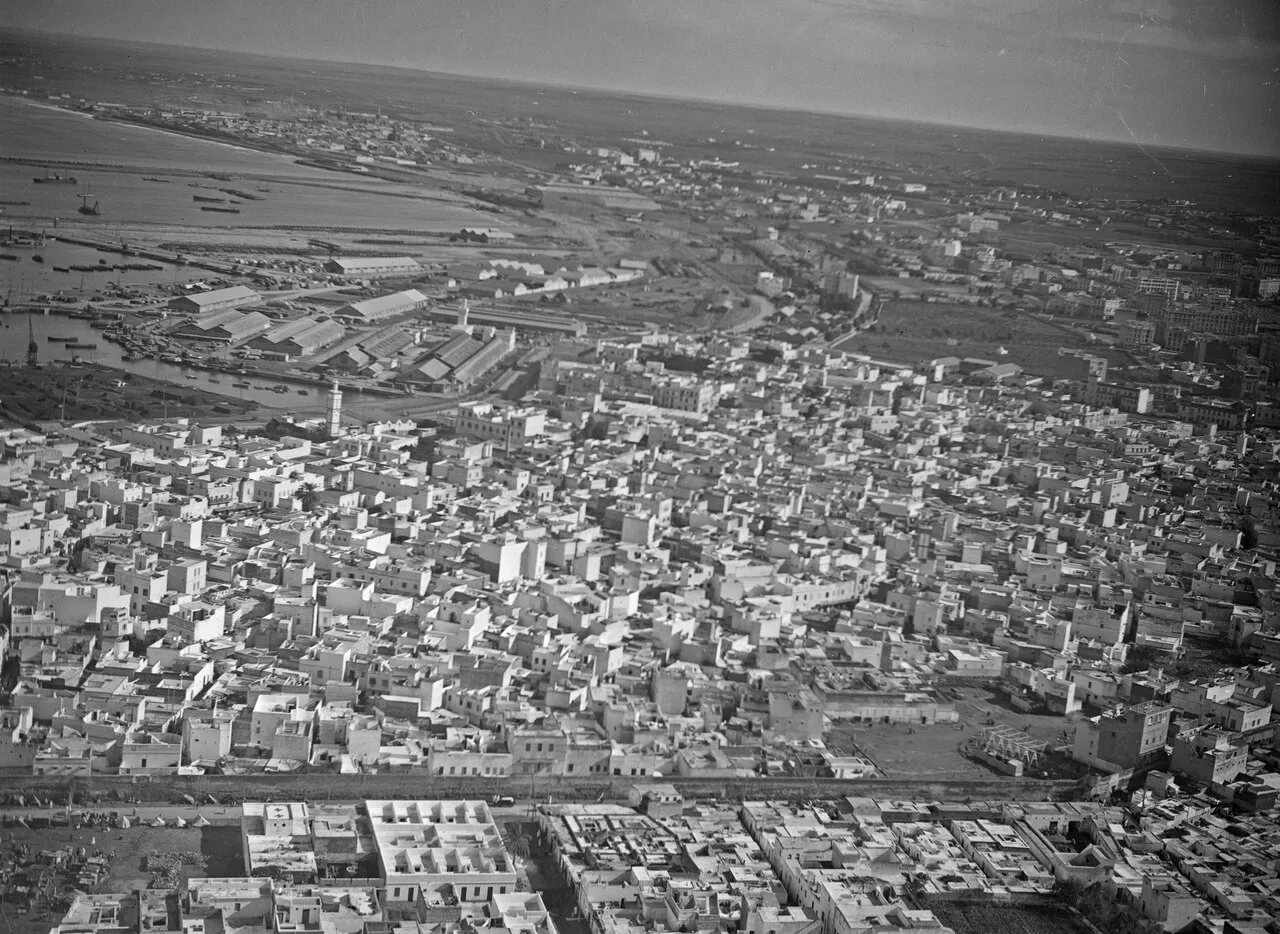
On the evening of September 21, 1952, approximately 5,000 spectators had gathered at an open-air venue in Casablanca, French Morocco, to watch a boxing match between Famechon and Bohbot. At around 18:20 local time, the entire crowd's attention was drawn skyward when a large luminous object appeared and traversed the sky above them. The event, designed to showcase athletic competition, became instead the setting for one of the largest simultaneous mass UAP observations ever recorded in North African history.
Witnesses described the object as an incandescent ball of pale green light trailing into a cone shape with reddish flames at its rear. The object was not a fleeting flash — it crossed the visible sky in a sustained, deliberate path that allowed thousands of onlookers sufficient time to observe its form, color, and motion clearly. No credible conventional explanation — aircraft, meteor, or weather phenomenon — was offered at the time that adequately accounted for the object's appearance and behavior as described by the assembled witnesses.
The Casablanca sighting did not stand alone. Two employees working at the local aerodrome's control tower independently observed the same object at approximately the same time, providing corroboration from trained personnel whose professional duties required them to be familiar with the appearance of conventional aircraft, balloons, and other aerial phenomena. Simultaneous reports also arrived from observers in Tangier, Louis-Gentil (now Youssoufia), and Marrakech — demonstrating that whatever crossed the sky that evening was visible across a wide geographic arc of French Morocco, not merely a localized anomaly confined to the boxing venue.
The Casablanca incident occurred within a broader, CIA-documented wave of unidentified aerial observations that swept across Morocco and North Africa during the summer and autumn of 1952. Central Intelligence Agency FOIA document DOC_0000015466 — titled "Unidentified Flying Objects Over Morocco" — documents this sighting directly alongside other reports from the region during the same period. A companion CIA document (0000015465), titled "Flying Saucers in Spain and North Africa," places these Moroccan observations within a wider pattern of UAP activity recorded across allied and NATO-adjacent territories throughout 1952. The CIA's active collection and documentation of these reports reflects institutional attention to the phenomenon at the highest levels of the American intelligence apparatus during the Cold War's early years.
The 1952 North Africa wave coincided with what UFO historians and US Air Force analysts recognized as an extraordinary global spike in UAP reports. In the United States, the same summer produced the Washington D.C. flap of July 1952 — in which unidentified objects appeared on radar over restricted airspace near the White House — and Project Blue Book's single busiest reporting period. The Moroccan observations, documented independently by American intelligence, add a significant non-American dimension to this wave, demonstrating that 1952's anomalous aerial activity was geographically broad rather than limited to American airspace or American observers.
The Casablanca sighting is significant for several reasons beyond its scale. First, the sheer number of simultaneous, independent witnesses — approximately 5,000 at the boxing venue alone, plus airport staff, plus multi-city corroboration — makes coordinated misidentification or fabrication statistically implausible. Second, the airport control tower employees' independent observation is particularly meaningful: these were individuals trained to identify aircraft, whose professional competence depended on accurate identification of aerial objects. Third, the multi-city corroboration from Tangier, Louis-Gentil, and Marrakech, spread across hundreds of kilometers of Moroccan territory, rules out a purely local or venue-specific atmospheric effect. Fourth, the CIA's decision to document and preserve this specific sighting in an intelligence report reflects that American agencies regarded the account as credible and worth tracking. The Casablanca boxing match sighting remains one of the best-attested mass UAP events of the Cold War era.