
Credibility Audit
3 factors- Pilot Witness+3
- Official Report+1
- Historical Document+1
- 0–3
- 4–7
- 8–11
- 12–16
- 17+
DoD Observables
2 of 5- Instantaneous Acceleration
- Hypersonic Velocity
- Low Observability
- Trans-Medium Travel
- Anti-Gravity Lift
Event Description
Craft morphology
In August 1987, a pilot with an established professional reputation in Ghana witnessed and reported an unidentified aerial object of extraordinary size and performance. The report was considered significant enough to be forwarded through official channels — from the U.S. Defense Attaché Office (DAO) in Ghana to the Defense Intelligence Agency and the Joint Chiefs of Staff in Washington. The resulting chain of communications was later declassified and obtained by researcher John Greenewald Jr. of The Black Vault under Freedom of Information Act requests, making the Ghana case one of the most documentable UAP incidents in West African history despite the modest scale of the individual sighting.
The primary witness was described in DIA communications as a pilot "with an established reputation" — the specific framing used in intelligence reporting to indicate a witness whose professional standing lends credibility to the account. The pilot's name was not released in the declassified documents. No additional independent witnesses are identified in the available file, though the incident was considered sufficiently credible by the DAO to warrant formal reporting through diplomatic-military channels. The DIA's internal response — however dismissive in tone — implicitly acknowledged the witness's credibility by noting his standing.
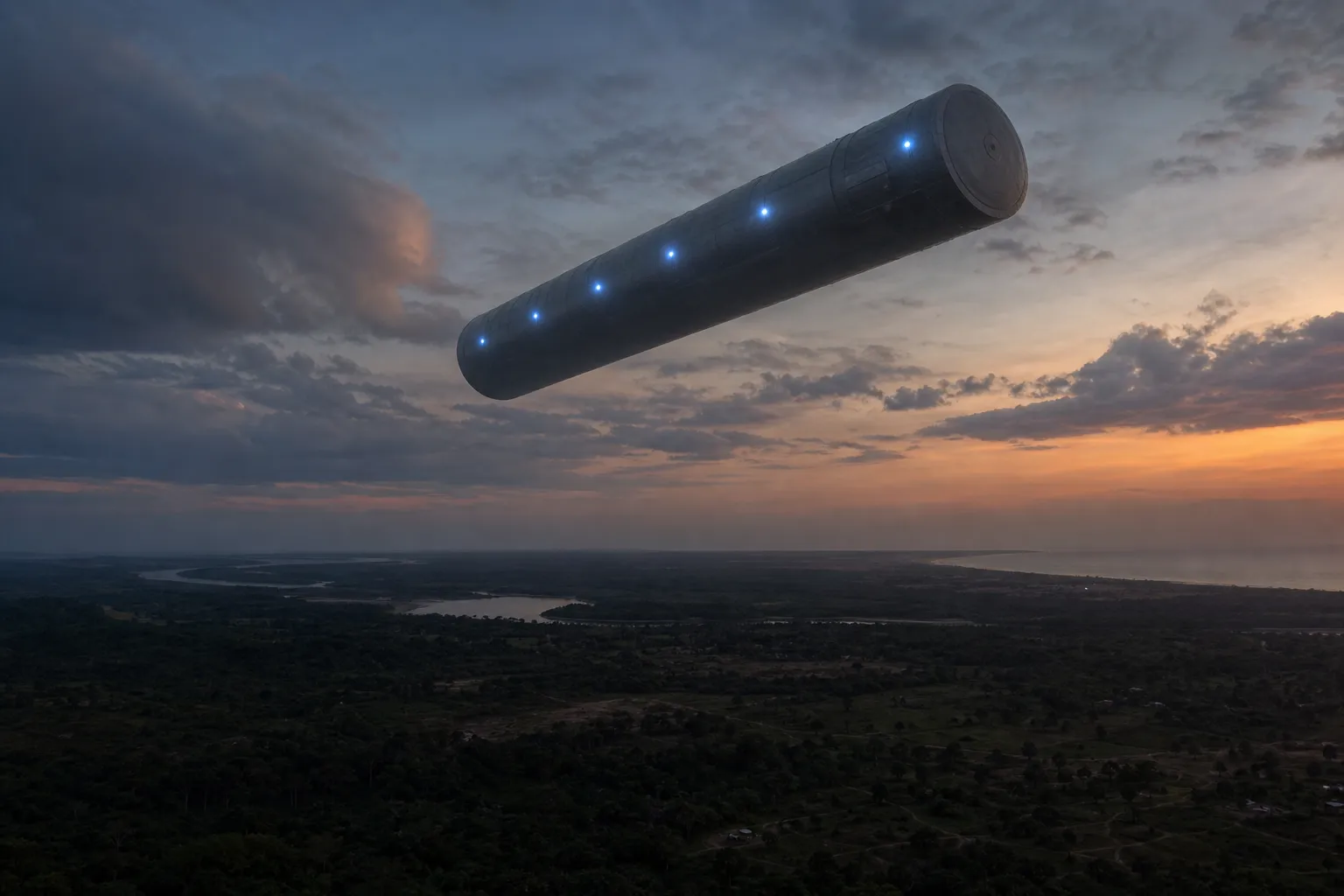
The pilot described an object shaped like an aircraft fuselage — an elongated cylindrical body — but with no visible wings, control surfaces, or any of the conventional aerodynamic features that characterize fixed-wing aircraft. The object was enormous: the pilot estimated it at approximately three times the size of a Boeing 747, which would place its length at roughly 200 meters — a scale for which no conventional explanation existed in 1987 or since. Eight blue lights were visible on the craft; the pilot interpreted these as indicators of the propulsion system rather than navigation lights. The object was completely silent. It first appeared to be descending — an observation that initially led investigators to propose the "space debris" theory — but the pilot was explicit that the object then stopped its descent and began climbing, demonstrating controlled flight under its own power. This reversal of direction is the detail that most thoroughly undermines any passive reentry debris explanation.
The transition from descent to powered ascent without any visible or audible propulsion mechanism is the case's central anomaly. Space debris or natural meteors do not reverse course. The absence of wings on an object of this scale is inconsistent with any known aircraft design. The eight blue lights, described as propulsion-associated, have no counterpart in conventional aviation lighting schemes. The object's silence at close enough range to be identified as three times the size of a 747 — which would require relatively modest altitude — is inconsistent with any known propulsion system.
No radar data is documented in the available DIA file. The incident was reported through the DAO as a visual sighting only. No physical trace evidence or secondary instrument effects (EM anomalies, compass deviations) are described in the released documents. The evidentiary record is limited to the pilot's sworn account as transmitted through official intelligence channels.
The DIA response to the Ghana DAO report is notable less for its conclusions than for its tone. Internal communications contained sarcastic commentary — references to "extraterrestrial interference," jokes suggesting that only ancient Incas could observe UFOs, and a characterization of the sighting as fit only for "cocktail chatter." The official assessment was that the pilot had observed re-entering space debris from a satellite, despite the pilot's clear testimony that the object reversed its trajectory and climbed under its own power — a maneuver physically impossible for uncontrolled debris. No formal investigation was conducted; no site visit, no interview, no follow-up documentation appears in the released file.
The DIA's response represents a textbook example of institutional ridicule as a mechanism for closing a report without investigation. By mocking the incident in official correspondence, analysts created a paper trail that discouraged further inquiry without requiring formal debunking. The sarcastic tone — "only Incas can see UFOs," "good for cocktail parties" — mirrors documented patterns at other intelligence agencies in the same era, where social ridicule was used to manage inconvenient reports from credible sources. The pilot's identity was withheld in the released documents, preventing independent researchers from corroborating or extending the account.
The Ghana DIA file is significant primarily because it exists. In a region with almost no formal UAP documentation infrastructure in the 1980s, the chain of transmission — from a Ghanaian pilot to the U.S. Defense Attaché to the DIA to the Joint Chiefs — represents an anomalously complete institutional record. The case also illustrates the gap between the DIA's stated obligation to assess all credible intelligence reports and its actual practice of dismissing UAP accounts from trained observers through ridicule. The object described — silent, wingless, 200 meters in length, with reversible trajectory — cannot be explained by any 1987-era technology. The DIA's failure to investigate seriously, documented in its own sarcastic internal messages, is itself a data point about institutional behavior toward UAP reports during the Cold War's final decade.