
Credibility Audit
4 factors- Military Witness+3
- Pilot Witness+3
- Multiple Witnesses+2
- Official Report+1
- 0–3
- 4–7
- 8–11
- 12–16
- 17+
DoD Observables
1 of 5- Instantaneous Acceleration
- Hypersonic Velocity
- Low Observability
- Trans-Medium Travel
- Anti-Gravity Lift
Event Description
Craft morphology
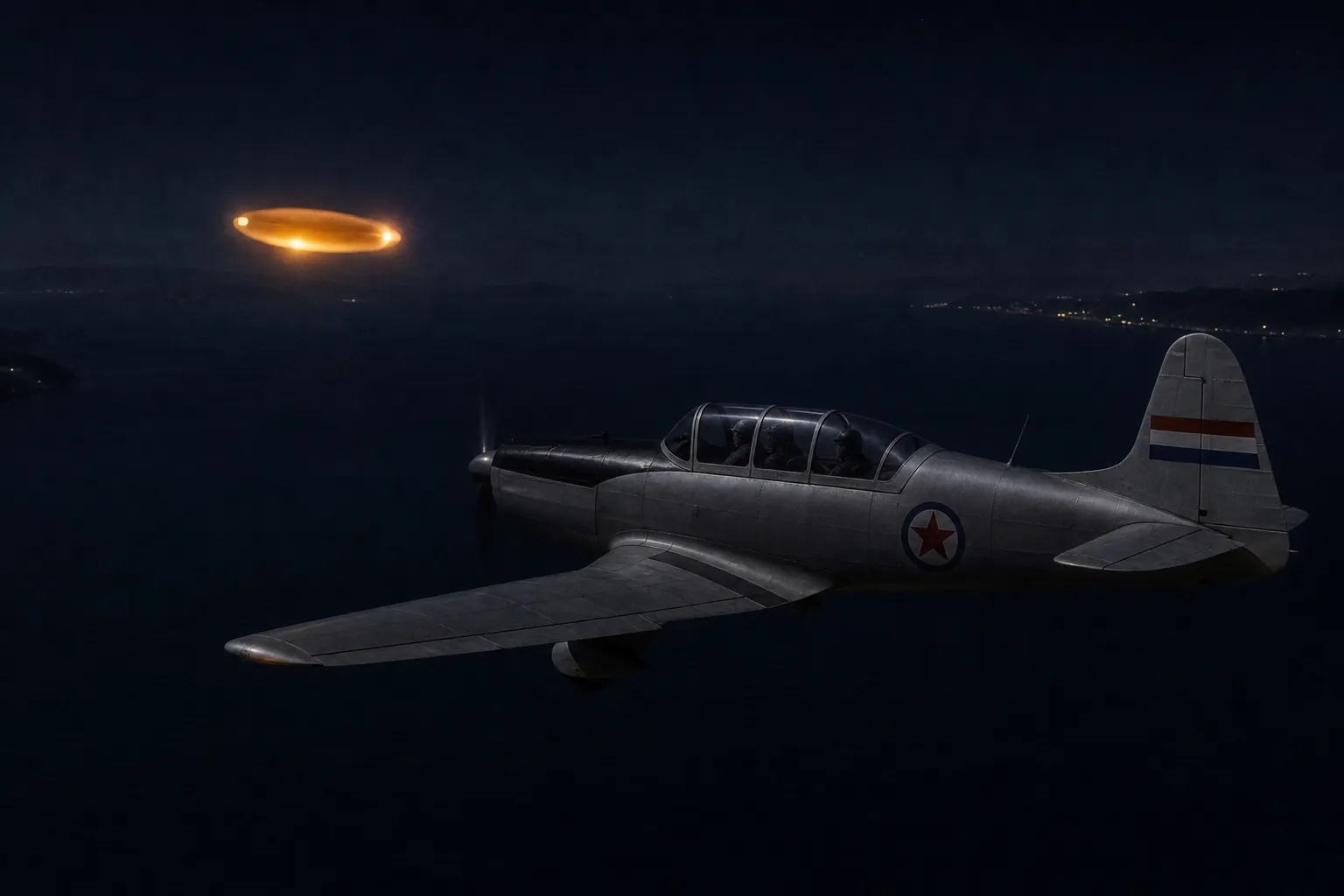
On a clear summer midnight in 1987, Yugoslav Air Force flight instructor Dragutin Prepust was conducting a night training exercise from Pula Airport, crossing the Adriatic corridor toward Zadar. Flying a Seagull (Jastreb) two-seat trainer at approximately 3,600 metres altitude, Prepust and his student were on their third crossing of the patrol route — Pula, via Opatija, to Bakanjac near Zadar, then a sharp return turn — when an anomalous object appeared at extremely close range off the nose of the aircraft. The encounter lasted only minutes but prompted immediate military inquiry: investigators were already on the ground at Pula when the aircraft landed, and crew were interrogated separately. The case remained suppressed within Yugoslav Air Force channels until Prepust gave public testimony years later.
Dragutin Prepust was a licensed Yugoslav Air Force flight instructor based at Pula. His professional standing as an aviation educator — responsible for training military pilots — constitutes significant credibility weight. His student occupied the rear seat and corroborated the sighting independently; their accounts were taken separately by investigating officers. A third witness was the Brion Island (Brijuni) air traffic controller, who stated explicitly: "I see it with my eyes, you're not crazy, but it is really not on radar" — thereby providing simultaneous visual confirmation of the object while simultaneously confirming the absence of any radar return. This triple-witness structure (instructor pilot, student pilot, ground controller) with an independent negative radar observation makes the Prepust case one of the more robust Croatian-territory Yugoslav military UFO cases in the record.
On the third crossing of the Pula–Opatija–Bakanjac route, at approximately midnight, Prepust observed an orange ellipse at a distance he estimated at approximately 50 metres from the aircraft. The object was at roughly the same altitude as the Seagull — 3,600 metres — and was moving at a heading consistent with an intercept or parallel-approach course. Prepust's immediate reaction was avoidance: "We turned sharply as our first logical thought was that it was a craft, and most important was to avoid possible collision." The object descended below 3,000 metres as the aircraft manoeuvred, and at that lower altitude the underside was observed to glow in a distinct red colour, contrasting with the orange appearance at distance. Speed was estimated at approximately 900 km/h based on relative motion observation during the encounter. The object did not respond to or mirror the aircraft's avoidance manoeuvre; it continued on its trajectory and departed without acceleration or sound. No navigation lights, strobe, fuselage shape, or exhaust signature were observed.
The most significant anomaly is the confirmed absence of any radar return across three independent military radar installations — Ljubljana, Zagreb, and Belgrade — all of which reported clear airspace. This is consistent with the low_observability observable in DoD's five-observable framework: an object simultaneously visible to multiple human witnesses and absent from radar. The 50-metre proximity to a manned aircraft combined with an estimated speed of 900 km/h, without any audible sonic signature or structural wake effect on the training aircraft, is consistent with the anti-gravity/propulsion signature cluster: no known subsonic or transonic conventional aircraft approaches another aircraft at 50 metres without creating aerodynamic effects perceptible to the crew. The elliptical shape with differential colour between the main body and the underside (orange vs. red) may indicate different emission characteristics at different surfaces of the object.
Three radar stations (Ljubljana, Zagreb, Belgrade) queried by Prepust on military radio reported no contact. The Brion Island controller confirmed visual sighting but no radar return. No avionics effects were reported on the training aircraft. No physical trace evidence was recovered. The visual encounter produced no photographic record. The instrument record is thus entirely negative — a confirmed no-return across multiple radar systems for an object confirmed visually by at least three independent parties simultaneously.
Yugoslav Air Force investigators were present at Pula Airport when Prepust and his student landed — indicating either that the military was monitoring the communications exchange in real time, or that the Brion controller had reported the event through military channels before the aircraft returned. Crew were placed in separate rooms and required to write independent reports. The reports were accepted. Prepust stated that the subject of those reports "was never mentioned again." No public announcement was made by the SFRY government or the Yugoslav Air Force. No formal investigation outcome was communicated to the crew.
The case follows the classic Yugoslav Cold War suppression pattern: immediate investigative collection of testimony, separation of witnesses to prevent coordination, followed by total institutional silence. The crew were not debriefed on findings, no conclusion was shared, and the reports disappeared into Yugoslav Air Force files — most of which were destroyed in the 1999 NATO bombing of Belgrade command infrastructure. Prepust went public only after Yugoslavia's dissolution, consistent with the pattern of Cold War military UFO witnesses speaking only after governmental dissolution or retirement removed the threat of career consequences. The case has no known disinformation narrative — it was simply buried.
The Prepust–Zadar encounter is the best-documented Croatian-territory Yugoslav Air Force UAP case in the open record. It is structurally distinct from the Pan Adria 1977 case (which is tagged to Serbian airspace) and the Cetinje 1975 case (Montenegro): it is the only known case placing the primary witness in Croatian territory as a military aviation professional, with simultaneous corroboration from a ground controller and a second aircrew member. The low_observability feature — visual confirmed, radar absent — is the specific signature that makes the case analytically significant; it eliminates conventional aircraft explanations and weather phenomena without reference to extraordinary physics, making it harder to dismiss on simple grounds. The immediate investigative response from the Yugoslav Air Force confirms institutional awareness and interest in the event.