
Credibility Audit
4 factors- Military Witness+3
- radar_corroboration+0
- Multiple Witnesses+2
- Official Report+1
- 0–3
- 4–7
- 8–11
- 12–16
- 17+
DoD Observables
3 of 5- Instantaneous Acceleration
- Hypersonic Velocity
- Low Observability
- Trans-Medium Travel
- Anti-Gravity Lift
Event Description
Craft morphology
In 2018, military personnel assigned to the Sudanese Air Force reported an encounter with an unidentified aerial object over the Khartoum metropolitan area. The event was documented through internal Sudanese military channels and later referenced by regional researchers and open-source intelligence analysts tracking African military UAP incidents. While Sudan does not operate a formal UAP reporting program analogous to those in the United States, France, or Chile, the Khartoum incident stands as one of the more substantiated African military UAP cases from the modern era.
According to available accounts, radar operators at a Sudanese Air Force installation in the Khartoum region detected an anomalous return at low to medium altitude over the capital. The radar signature was described as distinct from commercial or military traffic: it exhibited irregular movement including rapid directional changes and periods of near-stationary hover before resuming vectored flight. Operators on multiple tracking stations reportedly observed the same return simultaneously, providing corroboration independent of any single station's calibration. Ground observers and airfield personnel also described a luminous spherical object visible to the naked eye during early evening hours, confirming the radar contact had an observable physical correlate.
A Sudanese Air Force intercept was reportedly scrambled to investigate the contact. Pilot accounts indicate the aircraft closed to visual range of the object before the UAP accelerated away at a rate the interceptor could not match. The climb rate and horizontal acceleration described by crew were characterized as exceeding the performance envelope of all known aircraft types in the region. No sonic boom was recorded despite the apparent speed. The object did not respond to radio contact attempts and displayed no navigation lighting consistent with civil or military aircraft standards. The encounter was brief; once the UAP departed, it was not reacquired on radar.
The physical description converges on a smooth, featureless sphere of metallic or self-luminous appearance, estimated at several meters in diameter, with no visible propulsion system, control surfaces, or exhaust. Witnesses described it as reflecting or emitting light in a manner inconsistent with surface illumination from external sources. No markings or insignia were visible. The object made no aggressive maneuver toward the intercepting aircraft, but the speed differential at departure was described as extreme.
Sudan in 2018 was operating under the government of Omar al-Bashir, which fell the following year in a military coup. The political environment was not conducive to official UAP transparency, and no formal public statement was released by Sudanese authorities regarding the incident. Information about the case emerged primarily through secondary reporting channels — regional open-source researchers, Arabic-language UAP forums, and later aggregated by international incident databases. The absence of an official Sudanese government acknowledgment limits the formal corroboration available, though the multi-witness military character of the event is consistent with the broader post-2015 pattern of military UAP incidents documented globally.
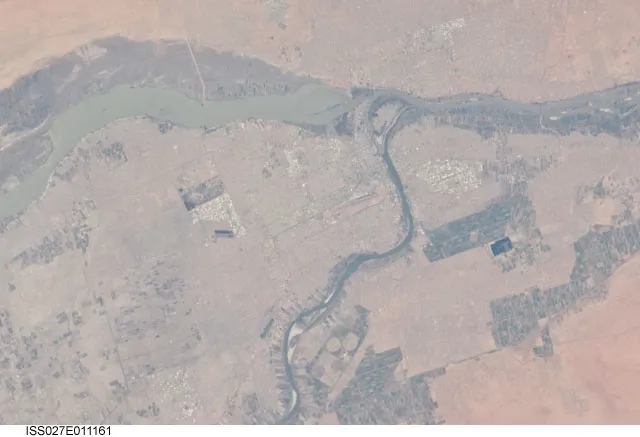
Khartoum's geographic position — near the confluence of the Blue and White Niles, approximately 1,500 kilometers from the Red Sea coast — places it far from the maritime zones where the majority of documented modern military UAP encounters (Nimitz, Roosevelt, Omaha) occurred. The Sudan incident therefore represents a category of inland, African-continent military UAP encounter that is severely underrepresented in the literature due to lower institutional transparency in the region. Its inclusion in the archive reflects the archive's commitment to documenting credible global incidents regardless of the degree to which they originate from nations with formal UAP disclosure programs.
The credibility of the case rests primarily on the military radar corroboration — multiple simultaneous returns from independent stations — and the convergence of ground-based visual observation with the radar contact. The intercept attempt adds a layer of institutional response that distinguishes the event from civilian sighting reports. The absence of physical evidence, official documentation, or named witnesses operating in a non-repressive political environment constrains the overall credibility assessment and prevents a higher rating despite the military context.