
Credibility Audit
5 factors- Military Witness+3
- Pilot Witness+3
- Official Report+1
- Govt. Acknowledgment+4
- Expert Witness+2
- 0–3
- 4–7
- 8–11
- 12–16
- 17+
DoD Observables
3 of 5- Instantaneous Acceleration
- Hypersonic Velocity
- Low Observability
- Trans-Medium Travel
- Anti-Gravity Lift
Event Description
Craft morphology
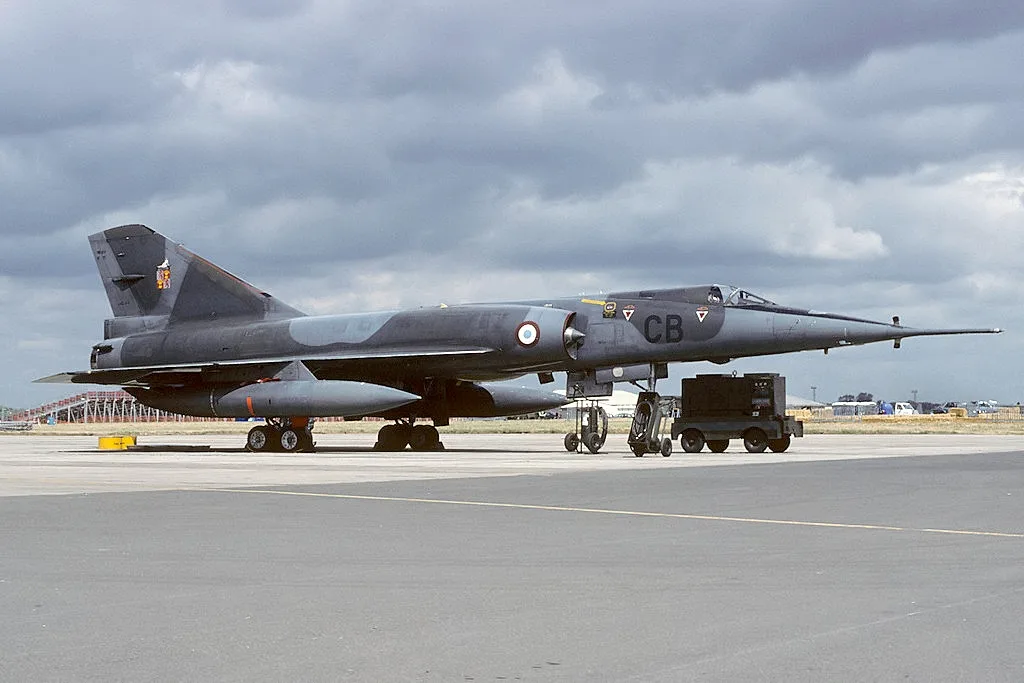
On March 3, 1977, French Air Force Major René Giraud and his navigator Captain Abraham were flying a Mirage IV nuclear-capable strike aircraft on a training mission at Mach 0.9 near Dijon in eastern France when they became aware of an unidentified luminous object pacing their aircraft. The object maintained a fixed position relative to the Mirage for an extended period, tracking the aircraft's heading and speed with precision.
Major Giraud initiated an evasive maneuver, executing a 6.5-g turn — near the structural and physiological limit for the aircraft and crew. The unidentified object matched the turn, maintaining its relative position throughout. The crew contacted their control station; ground radar tracking of the Mirage's position was confirmed, but the ground radar could not obtain a return from the object flying alongside it — it was radar-invisible to ground systems while remaining visually apparent to the crew.
The radio transmissions between Giraud, Abraham, and ground control during the encounter were officially recorded and subsequently retained in French Air Force records. The recordings documented the crew's real-time observations and the ground control's inability to corroborate the contact on radar. The incident was formally investigated by French Air Force intelligence and eventually reviewed by GEPAN, France's official government UAP investigation bureau.
The Mirage IV / Dijon encounter became one of the featured cases in the 1999 COMETA Report — the classified French military-intelligence review of UAP evidence. COMETA's authors noted that the object's ability to match a 6.5-g evasive maneuver at high speed while remaining invisible to ground radar was inconsistent with any known aircraft or natural phenomenon and represented one of the most technically demanding UAP performance demonstrations in the French military record. The case is notable not only for the crew's caliber — experienced military pilots in a high-performance nuclear strike aircraft — but for the existence of contemporaneous, officially-recorded radio transmissions that corroborate the account.