SightingCold War
Soviet-Mongolian Military UAP Contact — Ulaanbaatar, 1982
c. 1982
Ulaanbaatar, Mongolia
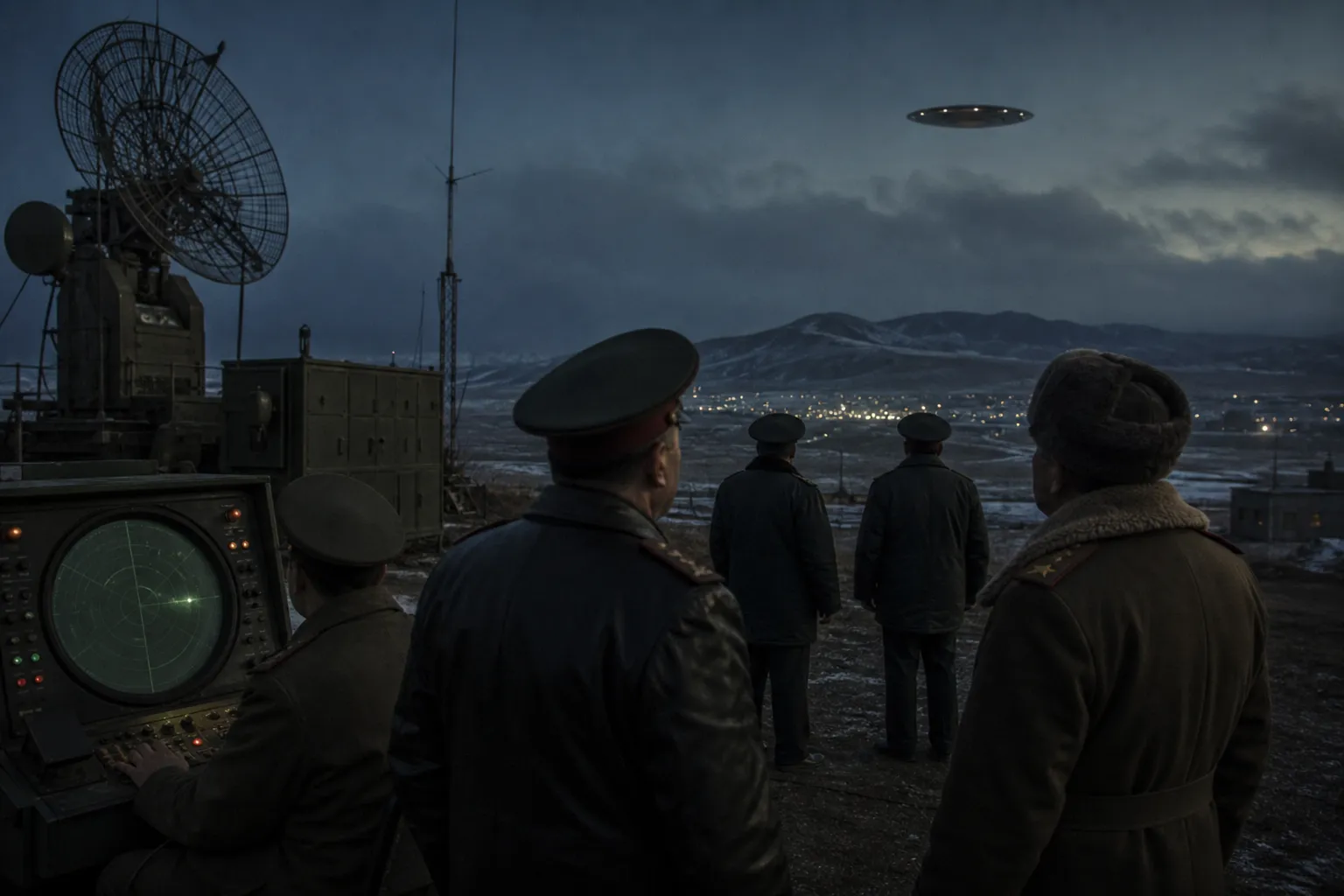
AI-rendered impression — Soviet military advisors and Mongolian People's Army officers near Ulaanbaatar observing a disc-shaped object tracked simultaneously on Soviet radar, 1982 — UAP Archive / openai (gpt-image-1)
Credibility Assessment
Low
Military WitnessMultiple WitnessesRadar CorroboratedOfficial Report
Event Description
Observed Shape
Disc
Craft morphology

Non-Human Intelligence (NHI)
Reported Entities
No NHI encounter documented for this event.
Mongolia in 1982 — the Mongolian People's Republic, a Soviet satellite state — hosted a substantial Soviet military presence. The Mongolian People's Army was equipped, trained, and supervised by Soviet military advisors, and Soviet Air Defence Forces maintained radar and early warning installations across the country, particularly focused on monitoring the long border with the People's Republic of China following the Sino-Soviet split of the late 1960s. Ulaanbaatar, the capital, housed the largest Soviet military advisory contingent in the country. Any anomalous aerial contact over Mongolian airspace was processed through Soviet military channels and — from 1978 onward — potentially into the SETKA investigation programme.
Soviet military advisors attached to the Mongolian People's Army were the primary witnesses. These were experienced Soviet officers, trained to NATO-equivalent recognition standards for aerial phenomena in the Soviet system. Mongolian People's Army officers accompanying the Soviet advisors provided independent corroboration. Ground personnel near the radar installation made visual confirmation when the object descended to visible altitude. The combination of Soviet military professionals and their Mongolian counterparts as independent observers from slightly different positions provides multi-witness corroboration across two institutional chains.
The object appeared as a disc-shaped or lens-shaped vehicle, bright in the visible spectrum, moving at high altitude before descending and hovering briefly. Soviet radar operators noted it as a solid, large-scale return with no corresponding flight plan, transponder, or radio contact. The object was described by visual witnesses as metallic in daylight appearance, silent, and capable of movement far exceeding any known aircraft. After hovering for several minutes at relatively low altitude — long enough for multiple observers to observe its shape clearly — it ascended vertically at extreme speed and disappeared from radar.
The combination of a solid radar return, disc-shaped visual appearance, silent operation, and departure at vertical speed exceeding any known aircraft constitutes the primary anomaly cluster. Mongolia's airspace was monitored for Chinese military aircraft and any Soviet aircraft off-course, and the object matched neither profile. The absence of transponder or radio communication from an object producing a substantial radar return — in airspace where every known aircraft would be monitored — was unusual.
Soviet radar tracking is the primary instrument record. The return was evaluated by operators trained to distinguish weather, ground clutter, and equipment artifacts from genuine targets. No communications interference is documented in available sources. The visual confirmation from ground observers was correlated with the radar track by the duty officer on watch.
The incident was reported through Soviet military channels and entered the SETKA investigation programme. Mongolia's geographic position on the Chinese border gave the contact additional strategic significance beyond the standard UAP classification process. The SETKA programme assigned the case a classification number. The Mongolian government — under Soviet tutelage — was not separately informed through any domestic civilian channel. No public disclosure was made in either Mongolia or the USSR.
Soviet military secrecy protocols applied. The Mongolian People's Republic's own security apparatus, the MPRP (Mongolian People's Revolutionary Party) security service, operated in close coordination with the KGB and would not independently publicize anomalous events. The strategic sensitivity of the Mongolia–China border region added a specific geopolitical reason for suppression beyond standard classification. After the democratic transition of 1990, Mongolia did not systematically review or release Soviet-era classified military files. Some information entered the public record through post-Soviet Russian researchers who accessed portions of the SETKA archive.
Mongolia's position between the Soviet Union and China during the Cold War made any anomalous aerial contact in its airspace potentially the most strategically sensitive in East Asia. Soviet military professionals — not civilian observers — were the primary witnesses, ensuring the report was processed through the most rigorous analytical system available to the USSR. The SETKA programme's collection of Mongolian border-region cases contributes to the documented pattern of anomalous aerial activity in high-surveillance military zones during the early 1980s. The case establishes Mongolia's presence in the Soviet military UAP archive.
5 Observables Detected
Instantaneous Acceleration
Hypersonic Velocity
Low Observability
Trans-Medium Travel
Anti-Gravity Lift
Suspicious Activity
Intelligence Agency
Cover-up Actions
Men in Black
Disinformation
Witness Suppression
Sources
governmentSETKA programme — Soviet Ministry of Defence UAP archive, Mongolia section (post-Soviet researcher access)
mediaPaul Stonehill, 'The Soviet UFO Files' (1998) — documents Soviet military UAP contacts in Far East and Mongolia
mediaNICAP Far East / Asia case database — Mongolia military reports