
Credibility Audit
5 factors- Military Witness+3
- Radar Corroborated+3
- Multiple Witnesses+2
- Historical Document+1
- Official Report+1
- 0–3
- 4–7
- 8–11
- 12–16
- 17+
DoD Observables
2 of 5- Instantaneous Acceleration
- Hypersonic Velocity
- Low Observability
- Trans-Medium Travel
- Anti-Gravity Lift
Event Description
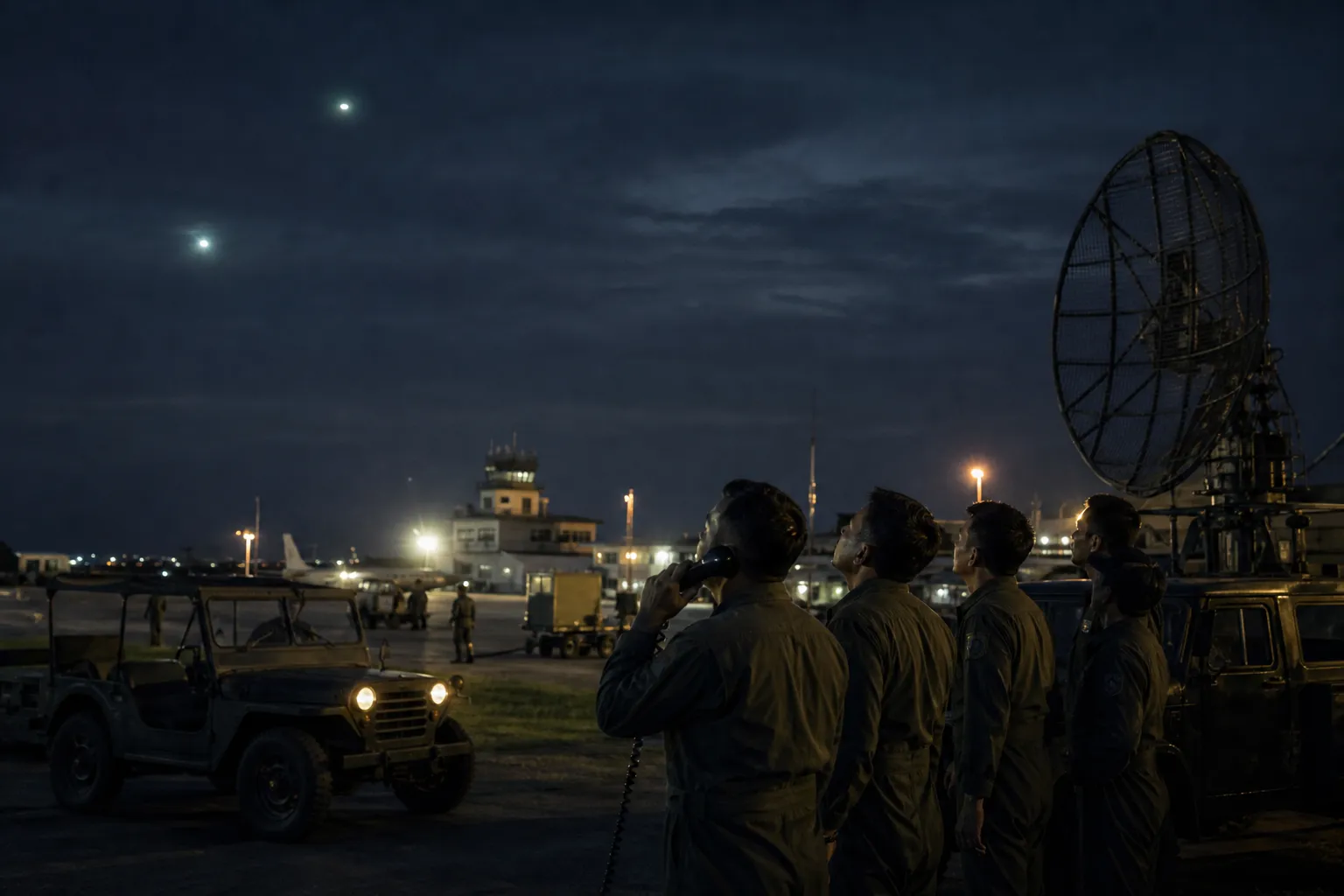
On November 28, 1968, in the early hours before dawn, radar operators at the Nakhon Phanom Command Post on Thailand's northeastern border with Laos detected multiple unidentified objects moving through restricted airspace. Nakhon Phanom Royal Thai Air Force Base (NKP) served as one of the most sensitive US intelligence facilities in Southeast Asia during the Vietnam War, housing the Infiltration Surveillance Center, signals intelligence operations, and command coordination for classified missions over Laos and North Vietnam. The base's radar coverage was among the most sophisticated in the region. When radar returns appeared that ground personnel could not identify, helicopters were scrambled in response. A formal US Department of Defense Intelligence Information Report was filed within weeks, and a second documented incident followed in 1969.
Thai military radar operators at the Nakhon Phanom Command Post were the primary witnesses to the November 1968 event. Their on-record confirmation that the contacts were "definitely not ghosts" — Air Force parlance for sensor artefacts or false echoes — indicates experienced radar crews making a considered assessment. The report was formally compiled by USAF Major Dale Fulton, the Air Attaché stationed in Vientiane, Laos, giving it the credibility of a senior US officer with direct access to classified intelligence. The September 1969 follow-up was compiled by OSI Special Investigator Robert Kaehler of the Office of Special Investigations. A separate first-hand account from a US Air Force Technical Sergeant who served at what is identified as the Nakhon Phanom intelligence coordination centre — reportedly in 1969 — describes tracking an object at 7,000 mph on multiple simultaneous radar returns, a claim he confirmed with top commanders from the Air Force, Army, Navy, and Marine Corps, all of whom confirmed no friendly aircraft was operating in that corridor at the time.
In the early hours of November 28, 1968, Thai military radar at Nakhon Phanom registered unidentified aerial contacts. The operators assessed the returns as genuine and alerted the Command Post. Two helicopters were scrambled in sequence: Knife-27 was dispatched first but returned without visual contact; Knife-28 was launched subsequently with the same negative result. Critically, as Knife-28 was returning to base, ground radar detected new unidentified contacts — suggesting the objects had either returned to the area or a second wave had appeared. No visual confirmation was obtained from either airborne crew. The 1969 incident involved both radar and visual sightings over the same base area. The Technical Sergeant's account, collected for the OSI report, described objects tracked on multiple simultaneous radar systems performing right-angle turns at speeds the investigator calculated at approximately 7,000 miles per hour. At the time, the fastest aircraft in the US inventory, the SR-71 Blackbird, had a top speed of approximately Mach 3.3 (2,200 mph). An object moving at over three times that speed while executing instantaneous directional changes was consistent with no known aircraft of any nation in 1968–1969.
The principal anomalies are flight performance characteristics inconsistent with any aircraft technology of the era. Right-angle turns at 7,000 mph represent an instantaneous-acceleration profile that would subject any conventional craft and crew to forces many hundreds of times beyond human or structural tolerance. The radar corroboration from multiple independent systems eliminates single-sensor artefact as an explanation for the 1969 case. The pattern of objects appearing after the first scramble helicopters returned — visible to ground radar but not to airborne crews — is consistent with a phenomenon demonstrating low optical observability while maintaining sufficient radar cross-section to produce trackable returns.
Both incidents rest primarily on radar evidence. In the November 1968 case, Thai military radar systems at Nakhon Phanom Command Post produced the trackable contacts; in the 1969 case, multiple simultaneous US radar systems produced consistent returns on the same object or objects. No photographic, gun-camera, or physical evidence was collected. The helicopter crews found nothing visually in the 1968 scramble. No electromagnetic effects on base equipment were reported in the available documents.
The November 28, 1968 incident was documented in a US Department of Defense Intelligence Information Report dated December 26, 1968, authored by USAF Major Dale Fulton. The report is classified as a DOD Intelligence Information Report and is preserved in declassified form. Major Fulton's official conclusion attributed the contacts to "natural or cultural phenomena," specifically noting that small balloons were commonly released during Thai religious festivals and fairs, and finding no confirmed evidence of hostile aircraft penetrating Thai airspace. The September 1969 incident was the subject of a separate OSI report filed September 6, 1969, authored by Robert Kaehler, titled "Unknown Entity — Unidentified Object Thought to be Helicopter." Kaehler similarly concluded the sightings were not evidence of actual aerial incursions, recommending ground-level border monitoring over aerial investigation. Both reports were filed through standard US military intelligence channels and are held in declassified archives.
No active suppression is documented. The base's classified status during the Vietnam War meant all incidents at Nakhon Phanom were inherently restricted at the time. The natural-phenomena explanation offered by Major Fulton — festival balloons — has been widely criticised by researchers as inadequate to explain objects tracked at thousands of miles per hour on multiple radar systems, yet the official record was not amended. No witness disciplinary actions or NDAs related to these specific incidents have surfaced in available documents. The existence of the DOD Intelligence Information Reports, once declassified, was not publicised by US authorities and came to wider attention primarily through UFO research communities and investigative journalists.
The Nakhon Phanom incidents are the best-documented military UFO encounters on record for Thailand. They are notable for three reasons. First, both incidents produced formal US military intelligence reports filed through proper channels — not informal witness statements — by commissioned and senior NCO-level personnel, giving them an unusually high evidential standard for the region and era. Second, Nakhon Phanom was one of the most radar-capable, intelligence-focused US facilities in Southeast Asia; a false reading on its systems was less likely than at a routine airfield. Third, the incidents occur within the broader pattern of Vietnam War-era UFO cases documented at US military sites in the region — including the Chu Lai 1969 and Nha Trang 1966 cases in the archive — suggesting a persistent UAP presence in the conflict zone that the US military documented but never satisfactorily explained.
Sources
- governmentUS DoD Intelligence Information Report — USAF Maj. Dale Fulton, Air Attaché Vientiane, December 26, 1968
- governmentUSAF OSI Report — Robert Kaehler, 'Unknown Entity – Unidentified Object Thought to be Helicopter,' September 6, 1969
- mediaOpenMinds.tv — 'UFOs During the Vietnam War' (details Nakhon Phanom cases with report citations)
- mediaHuffPost — 'UFOs Confront Soldiers During War, Says Ex-Air Force Intelligence Officer'