
Credibility Audit
5 factors- Govt. Acknowledgment+4
- Physical Evidence+3
- Multiple Witnesses+2
- Historical Document+1
- Official Report+1
- 0–3
- 4–7
- 8–11
- 12–16
- 17+
DoD Observables
1 of 5- Instantaneous Acceleration
- Hypersonic Velocity
- Low Observability
- Trans-Medium Travel
- Anti-Gravity Lift
Event Description
Craft morphology
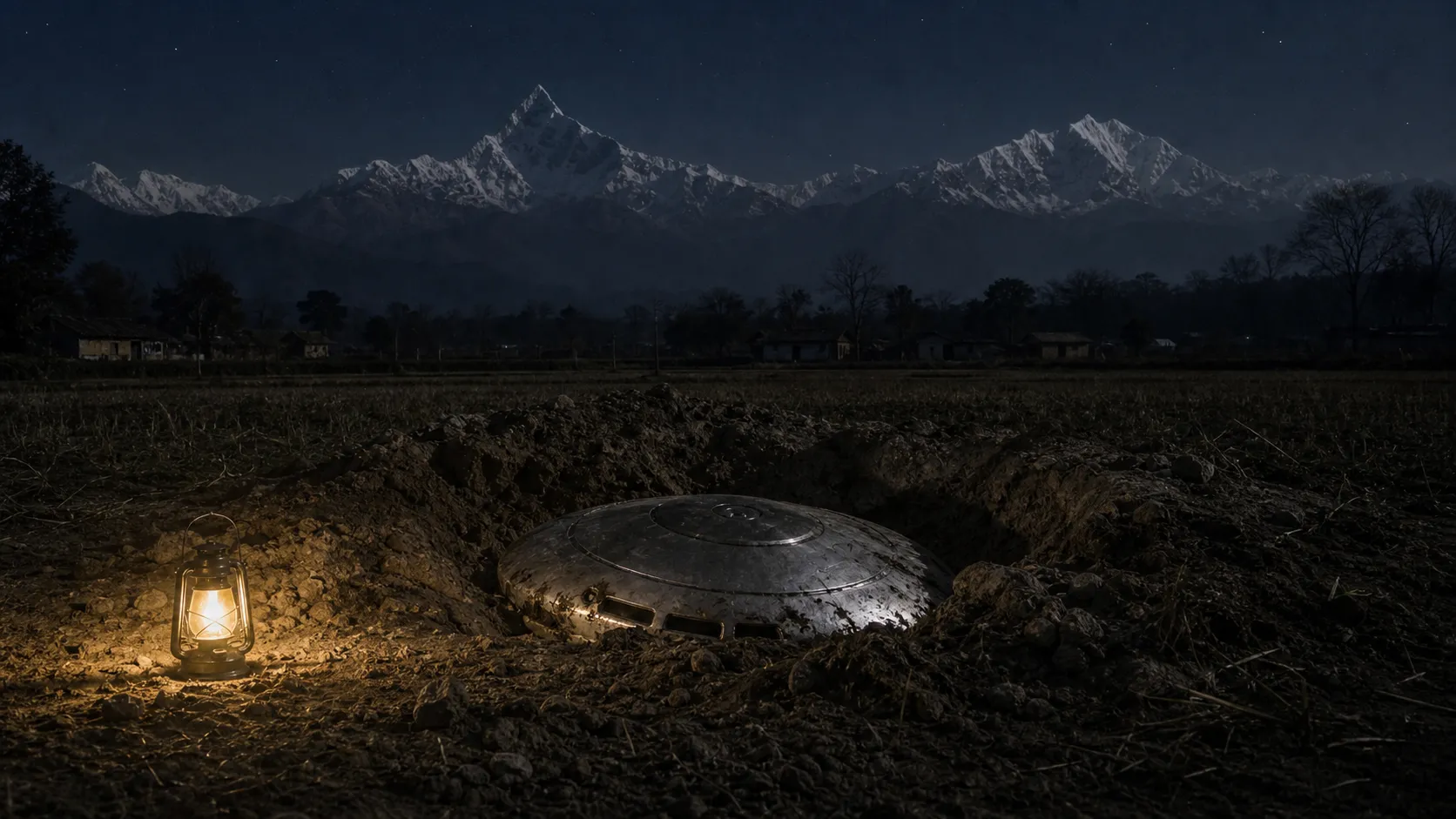
On the evening of March 25, 1968, at approximately 8:15 PM local time, a brilliant aerial object ripped across the night sky above Nepal's Kaski region, exploding with a thunderous detonation before fragments fell to earth in the village of Batulechaur, roughly five miles northeast of Pokhara. Residents in the small farming community discovered a metallic disc-shaped object embedded in a crater on the field of local farmer Kul Timilsina. The incident triggered one of the most intensive covert US government investigations into aerial phenomena ever conducted in South Asia, drawing in the Central Intelligence Agency, the State Department, and the classified Project Moon Dust recovery programme. The case remained concealed for decades until documents were approved for public release in 2001 and further declassified in the 2017 batch of CIA records.
The primary witnesses were residents of Batulechaur village. Kul Timilsina, the field owner on whose land the object came to rest, was the first to examine the debris. His wife, Gyanu Timilsina, who was approximately 22 years old at the time, recalled hearing a large explosion and seeing the sky become intensely bright before the object struck the earth. Kul Narayan Paudel, approximately 8 years old at the time, described the recovered fragment as "a four-sided metal sheet" with rounded corners, resembling a lid or covering. Ram Bahadur Baniya, a local teacher, was among the community witnesses who observed the aftermath and spoke to investigators in subsequent years. The broader CIA report also documents mass observations of associated aerial phenomena: dozens of residents across Olangchung Gola and Ghunsa in eastern Nepal on February 19 reported a long, thin light emitting green and red illumination on a northeast-to-southwest trajectory.
On the night of March 25, witnesses across the Kaski region described a blazing object crossing the sky from an elevated altitude, flashing intermittently as it descended, accompanied by a series of loud detonations comparable to thunder. The object appeared to disintegrate as it fell, scattering fragments over a radius that included Batulechaur, with additional pieces recovered at the neighbouring sites of Talakot and Turepasal. The largest recovered piece — described in the CIA report and later American Embassy correspondence as approximately six feet at the base and four feet in height, and by local witnesses as roughly two metres by one metre — was metallic, had rounded corners, and appeared engineered rather than naturally formed. The Nepalese government reportedly retained one piece; three other fragments were collected by American recovery personnel. An earlier related sighting on February 19 at Olangchung Gola and Ghunsa produced descriptions of a "long and thin" light source emitting green and red light moving from northeast to southwest at approximately 9:00–9:25 PM. The accumulated sightings pointed to a corridor of aerial activity stretching from Chinese-controlled Tibet through Nepal to Bhutan and into Ladakh over a five-week span.
The series of sightings across five jurisdictions — Ladakh, Sikkim, eastern Nepal, Kaski and Bhutan — within 34 days, combined with consistent witness descriptions of intermittent flashing, bright illumination, and explosive sound, points to a repeating phenomenon rather than an isolated event. The recovered disc-shaped metallic object did not match any civilian aircraft component or known natural meteorite morphology available in open literature. US Air Force Foreign Technology Division analysts concluded the debris could be associated with a Chinese missile test or the Soviet "Vehicle Venik" rocket; the US Embassy's August 28, 1968 letter to Washington suggested a possible connection to the Soviet Cosmos 208 military photo-surveillance satellite, launched March 21, 1968 aboard a Soyuz booster — four days before the Pokhara impact. The timing is consistent, but no definitive attribution was ever publicly confirmed.
The principal anomaly is the physical debris itself. A metallic disc-shaped object with a six-foot base and four-foot height was recovered from a crater at Batulechaur. Further fragments were found at Talakot and Turepasal. Three of the four recovered pieces were collected by US government representatives and shipped out of Nepal. A State Department telegram dated March 1, 1972 — over three years after the event — referenced the Pokhara material as a "space fragment" with cargo number 72-33365, described as a "restored space fragment" dispatched via Embassy support flight to Washington, confirming ongoing US custodial interest in the physical evidence. CIA analysts stated in a June 25, 1968 memo that the Foreign Technology Division considered the debris potentially significant as it might be related to a Chinese missile test or Soviet spacecraft hardware.
The CIA opened a classified investigation formally titled "Sighting of Unidentified Flying Objects in Ladakh, Nepal, Sikkim and Bhutan" and issued a Confidential Information Report dated April 11, 1968, covering the six regional sightings. The document was classified Restricted until April 2, 2001, when it was approved for public release, and became widely publicised in 2017 following a batch release of 800,000 CIA records via the CREST database. A CIA internal memo dated June 25, 1968 from Jerry C. Trippy to a "Mr. Farley" noted the US Air Force Foreign Technology Division's assessment of the debris. The American Embassy in Kathmandu sent a classified letter to Washington on August 28, 1968 proposing the Cosmos 208 re-entry hypothesis. US military intelligence activated Project Moon Dust — the classified programme for recovering space debris or foreign aerospace hardware — and is documented as having removed three of the four physical fragments from Nepal. American officials made multiple research trips to the Batulechaur site during the months following the incident, according to local witness accounts compiled by Nepali journalists decades later.
The CIA report remained restricted until 2001 and was not widely known until the 2017 CREST document release. The Nepali government was apparently not fully briefed on US conclusions; the Embassy cables show Washington receiving multiple intelligence assessments without any public disclosure being made to Nepal. The ultimate disposition of the three recovered fragments — shipped to the US per the 1972 State Department telegram — has never been publicly explained. No official US government statement has been made identifying the Pokhara object definitively as the Cosmos 208 re-entry, a Chinese missile component, or any other identified object. The 1974 CIA follow-up report cited by Nepali Times referenced the case under a classification that kept it out of public discourse for over 30 years.
The 1968 Pokhara case is the most evidence-rich UAP incident on record for Nepal and one of the most thoroughly government-documented in South and Southeast Asia during the Cold War. It is notable for four reasons. First, it involves recovered physical debris of unverified provenance that was covertly removed from a sovereign nation by US government personnel under the Project Moon Dust programme. Second, it is documented in multiple separate declassified US government records — CIA intelligence report, an Embassy cable, a Foreign Technology Division assessment memo, and a State Department shipment telegram — spanning a four-year period, suggesting sustained institutional attention. Third, it sits within a cluster of near-simultaneous sightings across five Himalayan jurisdictions, suggesting either a single event with wide visibility or a series of related events along a common trajectory. Fourth, competing official hypotheses — Chinese missile test, Soviet Kosmos 208 re-entry, U-2 reconnaissance artefact — remained unresolved in all declassified documents, which is itself significant: the US government's own analysts could not agree on what it was.
Sources
- governmentCIA — 'Sighting of Unidentified Flying Objects in Ladakh, Nepal, Sikkim and Bhutan', April 11, 1968 (declassified 2001)
- mediaNepali Times — 'UFO over Pokhara' (primary witness interviews, Batulechaur)
- mediaThe Himalayan Times — 'UFOs over Nepal? CIA had reported two sightings 49 years ago', January 2017
- academicKevin D. Randle — Project Moon Dust (1998), referencing July 23, 1968 US Embassy Kathmandu cable