SightingCold War
Cosmonaut Pavel Popovich Aircraft Sighting — 1978
1978
Over the Atlantic Ocean (Washington–Moscow route)
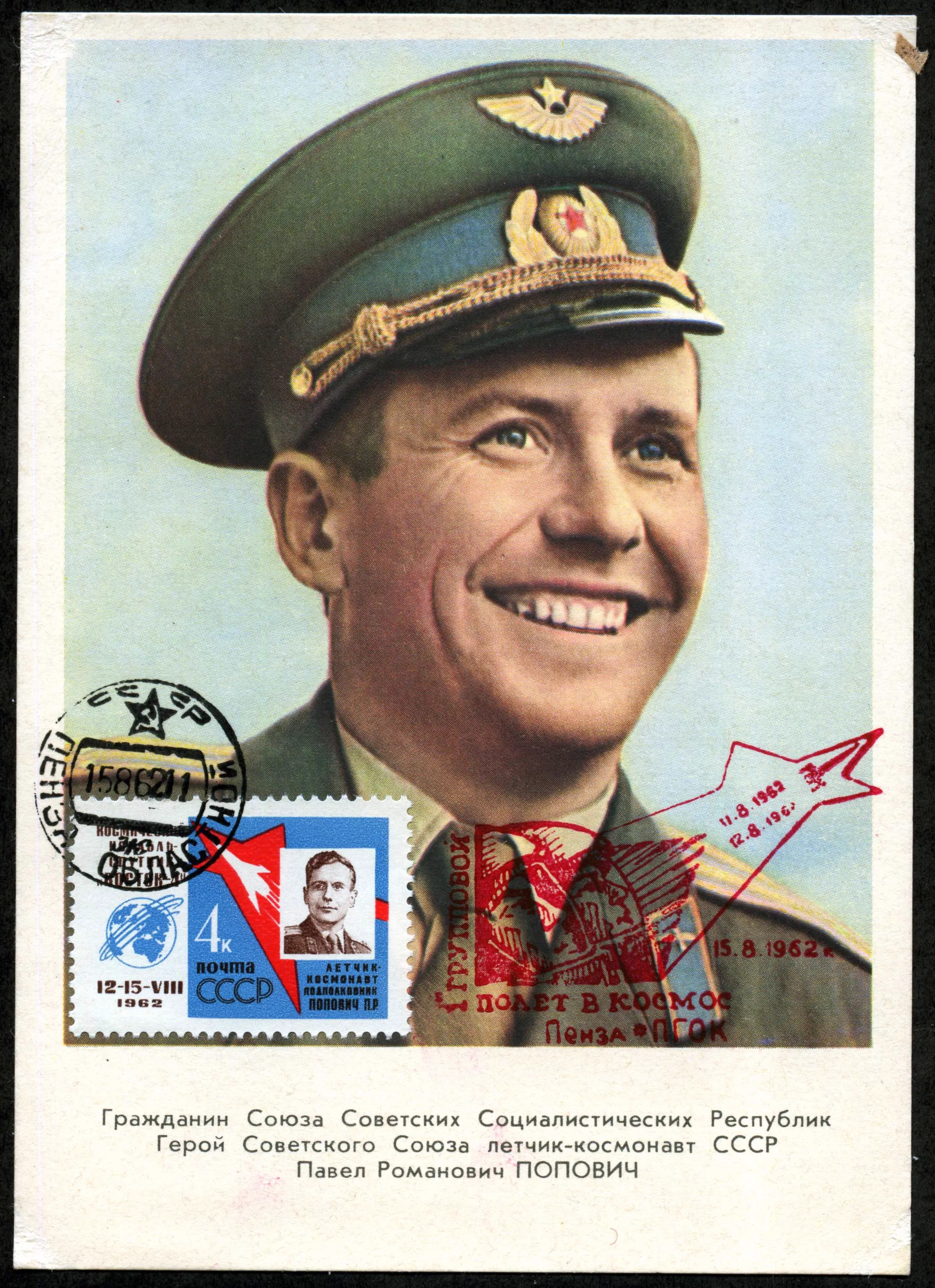
Soviet cosmonaut Pavel Popovich, twice Hero of the Soviet Union and commander of Vostok 4 (1962), who witnessed a radar-invisible triangular object pacing his transatlantic flight in 1978. — Soviet Space Programme archives / Wikimedia Commons (public domain)
Credibility Assessment
Low
Pilot WitnessMultiple WitnessesExpert Witness
Event Description
Observed Shape
Triangle
Craft morphology

Non-Human Intelligence (NHI)
Reported Entities
No NHI encounter documented for this event.
In 1978, Soviet cosmonaut Major General Pavel Popovich was travelling aboard a commercial aircraft on the Washington–Moscow route when he observed an unidentified triangular object flying at close range alongside the aircraft for nearly a minute. The encounter occurred in full view of all passengers aboard the flight. Popovich, who had piloted the Vostok 4 spacecraft in 1962 and logged thousands of hours as a Soviet Air Forces test pilot, was among the most technically qualified aviation witnesses to report a close-range UAP encounter in the Cold War Soviet record. Neither the aircraft's instruments nor ground-based tracking systems registered any radar return from the object.
The primary witness was Pavel Romanovich Popovich, born October 5, 1930, in Uzin, Ukrainian SSR. Popovich held the rank of Major General in the Soviet Air Forces, was a Hero of the Soviet Union (twice awarded), and flew as commander of Vostok 4 in August 1962 — the first simultaneously crewed dual spaceflight — and later commanded Soyuz 14 in 1974. He qualified as a test pilot in 1969 and accumulated extensive high-speed flight experience across a career spanning multiple decades. As a pilot, cosmonaut, and aerospace engineer, Popovich's observational training was of the highest calibre available in the Soviet system. All other passengers aboard the aircraft on the Washington–Moscow route also witnessed the object, constituting a group of independent civilian witnesses corroborating Popovich's account.
The unidentified object was described as white in colour, with a distinct isosceles triangle shape — a geometric outline consistent and stable enough for Popovich to characterise its form precisely. The object was estimated to be approximately 1.5 kilometres from the aircraft at the time of observation, positioned roughly 10 degrees above the aircraft's flight altitude, maintaining a consistent offset trajectory alongside the plane. Its apparent velocity was estimated by Popovich at approximately 1.5 times the speed of the aircraft — placing it at roughly 1,200–1,500 km/h given typical transatlantic cruising speeds of the era. The object held its relative position in relation to the aircraft for close to one minute: a sustained, stable pacing that precluded misidentification as a transiting aircraft or meteor. It departed without explanation after approximately sixty seconds of observation. Weather conditions at the time of the encounter were not specified in available accounts.
Two characteristics of the encounter are anomalous by the standards of the DoD observable framework. First, the complete absence of a radar return — confirmed by both the aircraft's onboard instruments and ground-based tracking systems — despite the object's visible physical presence and apparent solid structure places it in the low-observability category: visually confirmed yet radar-invisible. Second, the object's estimated speed of 1.5 times a commercial airliner's cruise speed, combined with its apparent structural stability and controlled pacing of the aircraft, suggests a performance envelope inconsistent with any known atmospheric phenomenon or man-made vehicle of the 1978 period capable of operating without a radar signature. The triangular geometry, stable for a sustained observation window, rules out atmospheric optics or plasma phenomena as explanations.
No onboard radar return was generated by the object, despite its proximity and apparent physical solidity. Ground-based radar operators tracking the aircraft's route likewise reported no corresponding contact. No other instrument readings — electromagnetic, pressure, or thermal — have been publicly reported from the flight. No structural or physiological effects on the aircraft or its passengers were documented. The object left no physical trace that could be independently verified after the event.
No official Soviet investigation of this specific incident was initiated at the time of the sighting, as Popovich did not report the encounter through formal military channels during the flight. The event entered the broader Soviet UAP record when Popovich began disclosing his personal research and experiences in public forums starting around 1990, as Soviet glasnost policies created space for such disclosures. He subsequently obtained access to the KGB's classified 'Blue Folder' — a 124-page dossier on Soviet UAP contacts compiled by state security services — and cited his 1978 encounter in the context of broader Soviet military UAP documentation. Popovich disclosed the encounter in detail during the 2002 documentary 'Out of the Blue,' produced by James Fox, which remains the primary source for the incident's public record. The SETKA programme — the concurrent official Soviet UAP investigation that operated from 1978 onward — was not directly linked to Popovich's sighting in available documentation.
No active suppression of this specific encounter has been documented. Popovich did not report it through official channels at the time, and no evidence exists of pressure to conceal or retract the account after its public disclosure. His ability to obtain and reference the KGB 'Blue Folder' in the glasnost and post-Soviet period suggests that by the early 1990s the Soviet state was selectively tolerating, if not encouraging, controlled disclosure of UAP material by credentialed figures. The broader suppression context — the Soviet system's long-standing policy of classifying UAP reports and ordering service members not to record contacts in official logs — is relevant background, but there is no evidence it directly applied to Popovich's civilian-route sighting.
The Popovich sighting is one of the few cases in the Soviet Cold War UAP record in which both the principal witness's identity and credentials are fully established in the public domain and the account has been disclosed in a named, documented format. Popovich's dual status as a combat-qualified test pilot and a trained cosmonaut places him among the most technically rigorous UAP witnesses in the global record. The radar-invisible triangular object he described pacing an airliner at supersonic cruise speed is consistent with other credible Soviet and Western pilot-reported UAP encounters of the same era. The case is further notable because Popovich later became a prominent institutional figure in Soviet and Russian UAP research — his personal encounter formed part of his broader argument, made publicly from 1990 onward, that the Soviet military had accumulated compelling, classified evidence of anomalous aerospace phenomena that warranted serious scientific attention.
5 Observables Detected
Instantaneous Acceleration
Hypersonic Velocity
Low Observability
Trans-Medium Travel
Anti-Gravity Lift
Suspicious Activity
Intelligence Agency
Cover-up Actions
Men in Black
Disinformation
Witness Suppression
Sources
witnessPavel Popovich — personal account, disclosed in 2002 documentary 'Out of the Blue'
mediaOpenMinds.tv — 'Pilot and Cosmonaut Pavel Popovich and UFOs'mediaSott.net — 'Pilot and cosmonaut Pavel Popovich and UFOs'