
Credibility Audit
6 factors- Military Witness+3
- Multiple Witnesses+2
- Radar Corroborated+3
- Video Evidence+2
- Govt. Acknowledgment+4
- Congressional Record+4
- 0–3
- 4–7
- 8–11
- 12–16
- 17+
DoD Observables
4 of 5- Instantaneous Acceleration
- Hypersonic Velocity
- Low Observability
- Trans-Medium Travel
- Anti-Gravity Lift
Event Description
Craft morphology
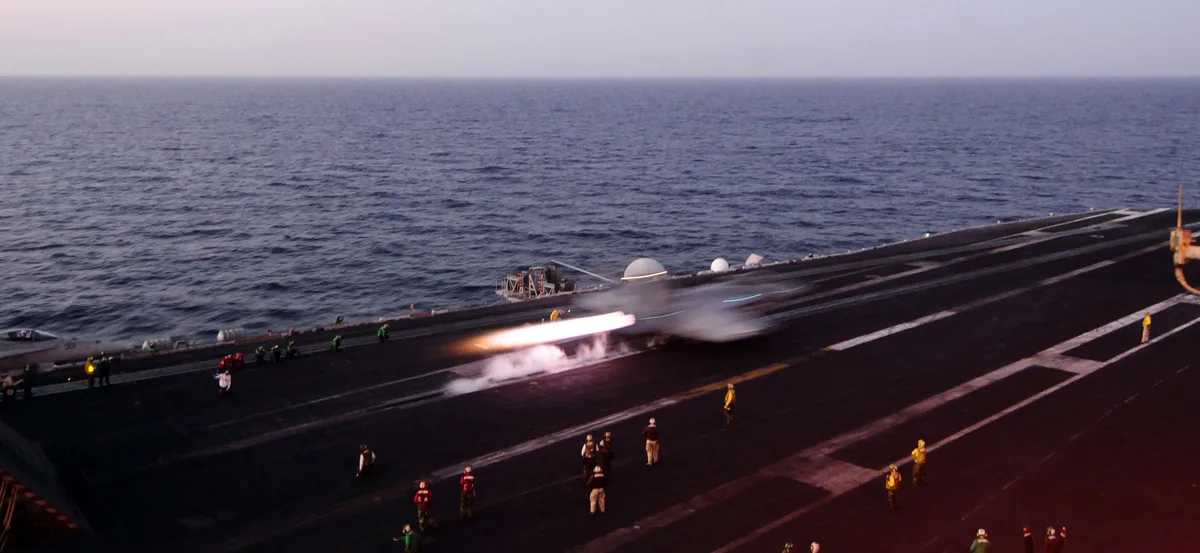
Between 2014 and 2015, Navy pilots assigned to the USS Theodore Roosevelt carrier strike group encountered unidentified aerial phenomena with such regularity — in some accounts almost daily — that squadron commanders initiated a formal reporting chain to Navy leadership. The encounters occurred in restricted military airspace off the US East Coast, primarily along a corridor between Virginia and Florida. The objects demonstrated flight characteristics that defied explanation: they appeared at altitudes of 30,000 feet, descended rapidly to just above the water, hovered, and departed at speed. They had no apparent propulsion, no exhaust, no wings or rotors, and produced no sonic booms despite reported supersonic velocities.
Two videos from these encounters — designated GIMBAL and GOFAST — were officially released by the Department of Defense in April 2020, following the New York Times' initial December 2017 reporting. GIMBAL, filmed from an F/A-18 using an Advanced Targeting Forward Looking Infrared (ATFLIR) pod, shows a rotating object moving against the wind at an estimated 13,000 feet. The object's rotation was confirmed as real — not a sensor artifact — by the pilot, Lt. Ryan Graves, who noted it appeared to rotate against the prevailing wind direction. GOFAST captures a small object skimming the ocean surface at approximately 25,000 feet descent altitude, moving at a speed that Navy analysts could not reconcile with any known platform.
Lt. Ryan Graves, an F/A-18F Super Hornet pilot with VFA-11 Red Rippers, became the public face of the Roosevelt encounters after speaking on the record to The New York Times and later testifying before the House Oversight Committee's UAP hearing in July 2023. Graves stated that UAP were observed in restricted airspace on a near-daily basis and that pilots were concerned about mid-air collision risk. He reported that a wingman had come within approximately 50 feet of one of the objects. Despite filing safety reports, the pilots received no official explanation.
Navy leadership eventually met with the squadron and, according to pilot accounts, acknowledged the observations were real but offered no explanation. In 2019, the Navy officially updated its reporting protocols for UAP — the first time in decades — citing the Roosevelt incidents as a catalyst. The Pentagon's formal UAP Task Force was established in August 2020 in direct response to sustained Congressional pressure stemming from these encounters. GIMBAL and GOFAST remain two of only three videos officially released by the DoD and are central exhibits in the ongoing Congressional UAP investigation.