
Credibility Audit
2 factors- Military Witness+3
- Multiple Witnesses+2
- 0–3
- 4–7
- 8–11
- 12–16
- 17+
DoD Observables
2 of 5- Instantaneous Acceleration
- Hypersonic Velocity
- Low Observability
- Trans-Medium Travel
- Anti-Gravity Lift
Event Description
Craft morphology
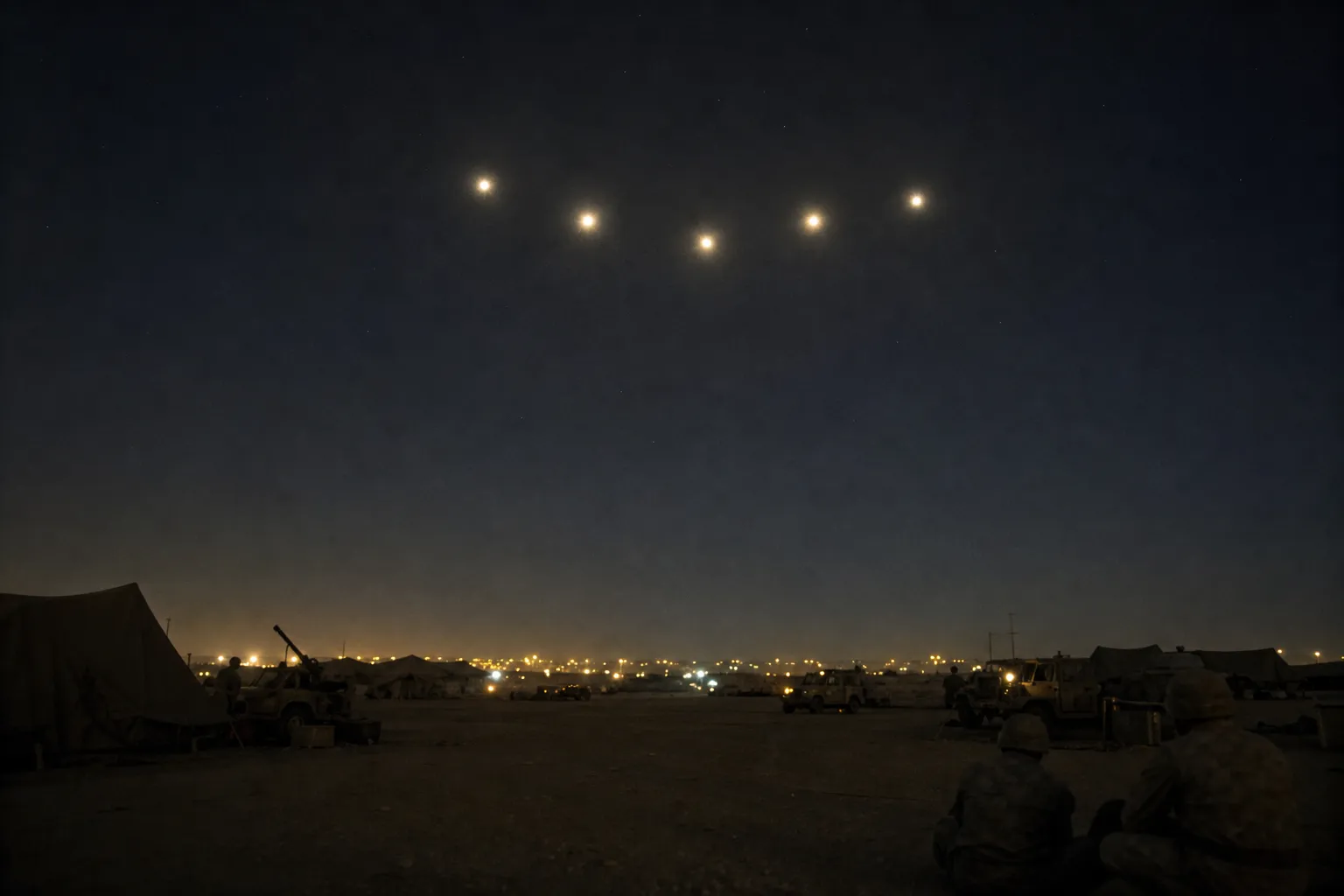
During the opening weeks of Operation Desert Storm — the US-led coalition campaign to expel Iraqi forces from Kuwait — coalition ground units were staged in the northern Saudi Arabian desert, roughly 50 miles south of the Iraqi border. The terrain was flat, remote, and under military occupation, with no civilian air traffic and tightly controlled airspace. In this environment, where any aerial object not broadcasting IFF (Identification Friend or Foe) signals would normally trigger immediate investigation, at least one US Army unit experienced repeated nighttime observations of a silent V-shaped aerial formation that could not be attributed to any known aircraft in the coalition or Iraqi inventory.
The witness, a serving US Army soldier who later recounted the incident (withholding his name given continued active service), was performing perimeter guard duty at his unit's position in the early morning hours when the sightings occurred. The incident was reported to multiple UFO research outlets and is notable for its military setting, the repeated nature of the observations over multiple nights, and the use of night-vision equipment that failed to reveal any structural form beyond the five lights.
The primary witness was an active-duty US Army soldier performing perimeter guard duty. He described himself as familiar with military aircraft identification and was equipped with standard-issue night-vision goggles on at least one of the observation occasions. Crucially, he reported that nearly every member of his section — suggesting a group of at least 8–12 soldiers — had independently observed the same or identical object passing over their position on at least one night during the deployment. The sightings occurred multiple times over the course of the late January to mid-February 1991 period, providing repeated observation opportunities rather than a single transient event. The multiple-witness nature of the sightings, spread across a unit of soldiers with professional aviation-identification training, significantly reduces the likelihood of individual misidentification.
The object first came to the primary witness's attention when, while scanning the desert perimeter, he had the sensation of something overhead. Looking back over his shoulder, he observed five lights of approximately stellar brightness arranged in a V formation, moving slowly and silently on a consistent heading over his unit's position. The lights were described as identical to each other in brightness — comparable to bright stars — and maintained their relative positions throughout the observation. The object made no sound; only a very faint rush of air, like a low wind, was noted as it passed directly overhead. The object crossed over the unit and moved out of sight over the far horizon. Within five minutes, it returned and made a second pass over the same position on the same heading. On a subsequent night of guard duty, the witness had night-vision goggles available. The object again traversed the position; through the goggles, only the five lights were visible — no structural outline, wings, or fuselage could be detected, which the witness found anomalous given the apparent proximity of the object.
Several characteristics distinguish this sighting from conventional aircraft. No sound was produced by the object at any stage, which rules out conventional rotary or jet-powered aircraft at low altitude. The five-light V formation maintained a completely stable arrangement with no relative movement between lights, inconsistent with a formation of individual aircraft (whose spacing would vary). The night-vision examination failed to reveal any structural outline, which the witness noted as anomalous — at the altitude he estimated, a man-made aircraft of the size implied by the light spread would have had a clearly visible airframe. The repeated passes over the same position on the same heading, at the same apparent altitude and speed, over multiple nights, suggest a programmed or autonomous behavior rather than random transit. No IFF signal would have been broadcast by any coalition aircraft passing over coalition positions at low altitude without warning; the absence of any reported interception by coalition air defense units suggests the object was either not detected by military radar or was treated as a known asset.
No radar confirmation data is available for this case. The use of military night-vision equipment — standard ANPVS-series night-vision goggles — produced only the five lights with no associated thermal or optical outline of a vehicle body. No physical traces were left at the position. The perimeter security structure of the unit would have constituted a basic real-time recording framework for the sightings, and the independent reports from multiple unit members constitute informal but meaningful corroboration.
No official response or investigation was conducted in connection with this sighting. The witness reported that discussion of the sighting among unit members was informal and that no report was filed through military channels, which was typical for the period — the witness explicitly noted that in 1991, reporting UFOs in a military context was socially stigmatized and could result in the witness being informally labeled unstable. Coalition military command had other priorities during the active combat phase of Desert Storm.
No active suppression is documented. The social stigma around military UFO reporting during this period is well-documented and constitutes an informal institutional disincentive to formal reporting. The witness did not come forward publicly until years after the event and withheld identifying information.
The Desert Storm V-formation sightings in Saudi Arabia are notable as part of a broader pattern of UAP activity documented over Gulf War positions. Multiple independent accounts from coalition soldiers in Saudi Arabia and Kuwait during this period describe luminous aerial objects exhibiting anomalous flight characteristics over military positions. The northern Saudi Arabian case is distinguished by its repeated nature, use of night-vision equipment, and the high proportion of unit members who independently reported the same sightings. The proximity to active combat operations, with their associated radar coverage and air-defense infrastructure, makes the absence of any official attribution to known coalition or adversary aircraft particularly significant. This case stands as evidence that unidentified aerial phenomena continued to be observed by military personnel in operational settings through the modern era, consistent with patterns documented by the US UAP Task Force and AARO in subsequent official reports.