
Credibility Audit
3 factors- Military Witness+3
- Multiple Witnesses+2
- Official Report+1
- 0–3
- 4–7
- 8–11
- 12–16
- 17+
DoD Observables
2 of 5- Instantaneous Acceleration
- Hypersonic Velocity
- Low Observability
- Trans-Medium Travel
- Anti-Gravity Lift
Event Description
Craft morphology
In 1952 — the same year the United States experienced its massive wave of UFO sightings culminating in the Washington, D.C. flap — Royal Air Force personnel operating over the eastern Mediterranean and Syrian coastal region filed one of the earliest documented military UAP reports from the Middle East. The area around Latakia, Syria's principal port city on the Mediterranean coast, was under regular British military overflight as the RAF maintained presence throughout the region during this period of active Cold War patrol operations. Syria had gained independence from France in 1946 and British forces continued operations across the eastern Mediterranean, making RAF aircrew the primary documentary source for aerial incidents over the Syrian coast.
The witnesses were RAF aircrew — trained military observers who had undergone formal instruction in aircraft recognition and atmospheric phenomena identification as part of standard RAF training doctrine of the period. British military pilots and observers of the early 1950s were explicitly trained to distinguish known aircraft types, meteorological phenomena, and balloons from anomalous objects. The sighting was made by at least two crew members simultaneously, providing independent corroboration from trained observers aboard the same aircraft. The report was filed through official RAF channels, meaning the witnesses were prepared to submit their account for official scrutiny and potential career consequences — a strong filter against frivolous or fabricated reports.
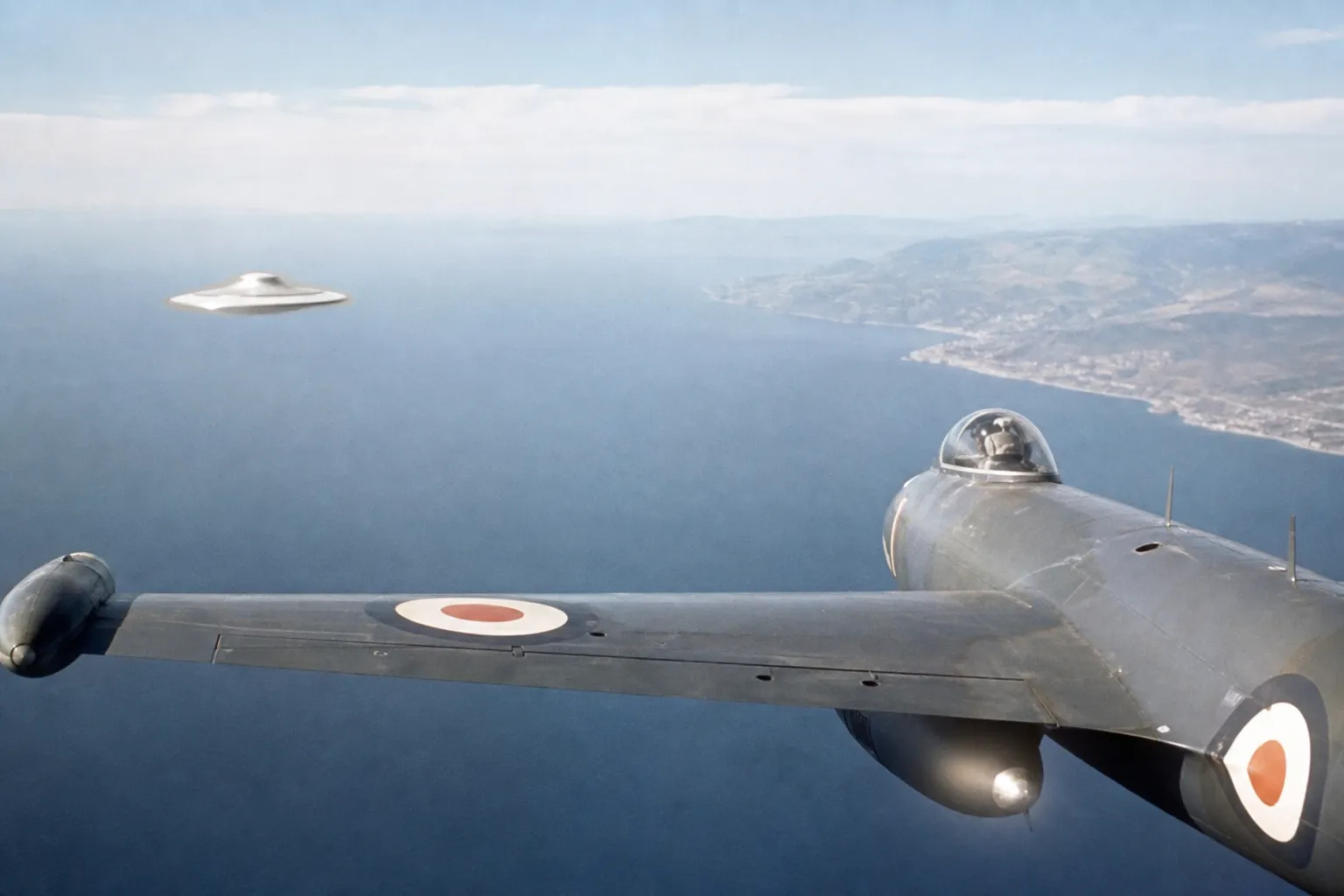
The crew reported a bright, disc-shaped or lenticular object that appeared in the airspace near Latakia on the Syrian coast. The object was described as luminous and considerably brighter than any known aircraft navigation lighting of the period. It initially appeared to be pacing the RAF aircraft — maintaining relative position — before executing a rapid acceleration and departure that was incompatible with any 1952 jet aircraft performance. The acceleration was described as near-instantaneous, with no visible engine exhaust, contrail, or propulsion signature. The object disappeared from visual range within seconds of its final maneuver.
The key anomaly is the terminal acceleration. In 1952, the most advanced aircraft in operational service — the F-86 Sabre and MiG-15 — had top speeds of approximately 685 mph. The object's departure was described in terms that placed it beyond any known aircraft capability. The absence of any propulsion signature — no jet exhaust, no contrail, no propeller wash — was noted explicitly by the crew. The object's ability to maintain station relative to the RAF aircraft (implying speed-matching followed by deliberate positioning) before executing a high-speed departure indicates controlled, purposeful flight rather than a natural phenomenon. No weather balloon of the period could pace a military aircraft or execute rapid directional acceleration.
The declassified report does not specify instrument effects beyond the visual observation. No radar track is documented in the surviving records for this specific event. The sighting was primarily a visual observation by trained aircrew, reported under the RAF's formal UFO reporting procedure that had been in development since the late 1940s following the Robertson Panel recommendations and the expansion of the Air Ministry's interest in the subject.
The report was submitted through official RAF channels to the Air Ministry in London, which maintained a UFO investigation file throughout the Cold War era. British Air Ministry UFO records were progressively declassified beginning in the 1990s and the bulk were transferred to the UK National Archives at Kew. The 1952 Syrian coast report falls within the period of the Air Ministry's systematic collection of aircrew sighting reports. The Ministry's response was consistent with its standard procedure of the period: acknowledgment, filing, and retention without public disclosure. No operational action was taken.
There is no evidence of active suppression specific to this report. British Air Ministry UFO files from 1952 were held under standard classification for decades before release to the National Archives. The release process, completed progressively from the 1990s through 2009, made available thousands of RAF and MoD UFO reports. This case is part of that broader declassification rather than a specifically targeted suppression effort. The standard classification of military aircrew reports as operationally sensitive was the primary reason for their non-public status.
This case represents the documented entry point for UAP reports from Syrian airspace in the official British military record. The RAF's systematic reporting culture of the early 1950s — driven by genuine concern about Soviet aircraft and unknown phenomena alike — means that aircrew reports from this period carry substantially more institutional credibility than civilian accounts. Syria in 1952 occupied a strategically important position in Cold War surveillance and patrol operations, and RAF overflights were routine. The documentation of a disc-shaped object with anomalous acceleration by trained RAF aircrew over this region establishes a baseline for the presence of anomalous aerial phenomena across the eastern Mediterranean during the peak of the early Cold War UAP wave.
Sources
- governmentUK National Archives — Air Ministry UFO files, early 1950s series (Kew, AIR 2 and DEFE series)
- mediaNick Pope, 'Open Skies, Closed Minds' (1996) — documents systematic RAF UFO reporting, 1952 wave
- mediaUFO Evidence — British RAF Middle East Command sighting reports 1950–1955