
Credibility Audit
3 factors- Multiple Witnesses+2
- Expert Witness+2
- Official Report+1
- 0–3
- 4–7
- 8–11
- 12–16
- 17+
DoD Observables
2 of 5- Instantaneous Acceleration
- Hypersonic Velocity
- Low Observability
- Trans-Medium Travel
- Anti-Gravity Lift
Event Description
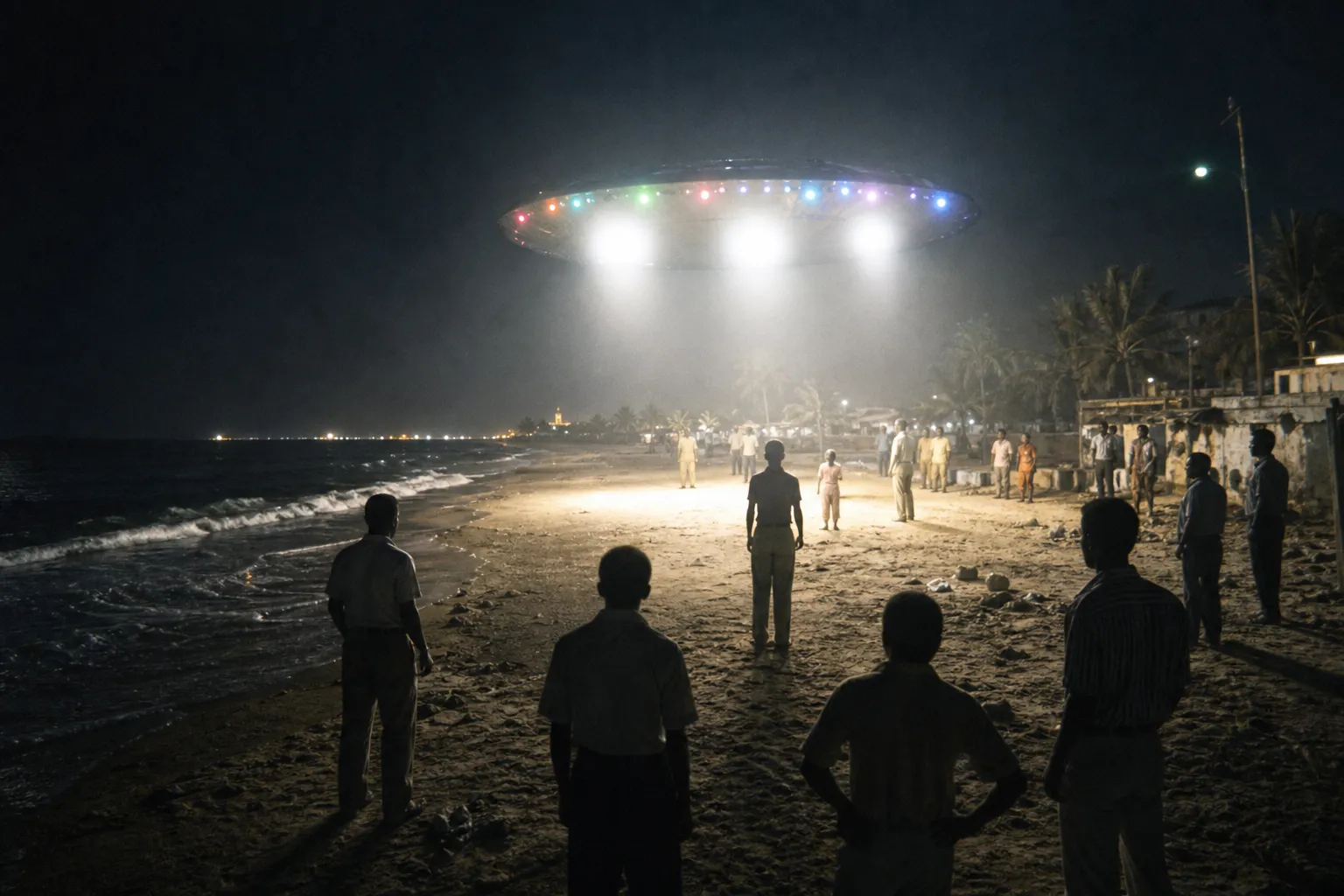
Shortly before 2 a.m. on March 29, 1974, two people walking on a beach along the Atlantic coast of Lomé, Togo, encountered an unidentified hovering craft that subjected them to intense directed light and apparent physiological effects for approximately 20 minutes. The incident occurred on the coast of one of West Africa's smallest nations, far from any major population center or military installation, but was investigated by French researcher Joel Mesnard and subsequently reported in the peer-reviewed UFO journal Phénomènes Spatiaux, making it one of the most formally documented UAP close encounters in francophone West Africa.
The primary informant was a French male worker, designated "AW" in the research report to protect his identity, who was in Lomé on holiday. He was described as a credible adult civilian with no prior interest in UAP phenomena. The second witness was a local Togolese woman whose identity and subsequent whereabouts are unknown. The two witnesses were together on the beach when the encounter began. The investigation was conducted by Joel Mesnard, a methodical French researcher associated with the Lumières dans la Nuit (LDLN) network and a contributor to Phénomènes Spatiaux — one of the most rigorous French-language UAP journals of the 1970s. Richard Hall, a senior NICAP researcher, separately corroborated the case in his reference catalogues.
At approximately 1:45 a.m., the two witnesses noticed a craft hovering over the Atlantic Ocean near the shoreline. The object carried three bright white lights that the witness described as "virtually blinding." From the sides and top of the craft, luminous rays emanated in multiple directions. The object also displayed colored flashes — yellow, blue, red, and green — in sequence. No structural details of the craft itself were discernible behind the intense illumination. The object hovered stationary for a period before beginning to move at what the witness described as "considerable pace" along the coastline. During the stationary phase, a depression appeared in the water surface beneath the craft, estimated at approximately 20 feet in depth — consistent with a downward pressure or field effect from directly below the object. The encounter lasted from approximately 1:45 to 2:05 a.m., a duration of 20 minutes, cross-checked against the witness's watch.
The craft's behavior included silent hovering over open water, colored light emissions in a non-standard pattern, and directed heat projection toward the witnesses. The departure trajectory is uncertain from the available record — the witness was unsure whether the craft continued at altitude, ascended further, or submerged — the last possibility suggested by the water depression and the Atlantic context. No conventional aviation or maritime craft produces this combination of blinding directional lights, multi-colored flashes, hovering silence, and downward water displacement.
Both witnesses experienced physical paralysis for the duration of the encounter — a condition described as being "held" by the lights, unable to move voluntarily despite remaining conscious. Both also reported intense heat that they felt was being "purposely projected" toward them rather than radiating passively. Following the encounter, the primary witness (AW) experienced significant physiological aftereffects: lightheadedness, difficulty hearing, and a severe headache in the immediate aftermath. Most significantly, AW reported prolonged psychological and physiological effects — anxiety and nervousness that he attributed directly to the encounter — lasting for at least two years after the incident. An anomalous large wave struck the beach despite calm seas, immediately following or during the encounter. No burns or lasting skin effects are documented. No instrument readings (magnetometer, radiation) were taken at the time.
No official investigation was conducted by Togolese authorities. Togo in 1974 was under the single-party rule of Gnassingbé Eyadéma's military government, with no civilian UAP reporting infrastructure and no mechanism for formally processing such accounts. The case entered the documented record exclusively through the efforts of civilian researchers: Mesnard's investigation and his publication in Phénomènes Spatiaux in March 1976, roughly two years after the event.
No active suppression is documented. The two-year gap between the encounter and publication likely reflects the difficulty of accessing witnesses in a West African country in the mid-1970s rather than deliberate concealment. The local woman's identity and whereabouts were never established, leaving the case with a single fully-interviewed witness.
The Lomé 1974 encounter is notable for the specificity and consistency of its physiological testimony. Paralysis and directed-heat effects at close range, combined with prolonged post-encounter neurological symptoms, place this case in a subcategory of close encounters that researchers including Mesnard and Hall considered qualitatively different from simple visual sightings. The water-surface depression beneath the hovering craft, if accurately reported, suggests a downward-directed force or field effect inconsistent with any conventional aircraft or natural phenomenon. The case's publication in Phénomènes Spatiaux — a journal that applied stricter evidentiary standards than most popular UFO publications of the era — and its independent notation by NICAP give it unusual archival durability for a West African incident from this period.
Sources
- academicPhénomènes Spatiaux — Joel Mesnard investigation report, March 1976 issue
- mediaUFO Insight — 'The Togo Beach UFO Incident – Paralysis, Blinding Lights, and Further Suggestions of Underwater Bases'
- mediaUFO Evidence — Africa Cases Directory (Richard Hall / NICAP reference)