
Credibility Audit
4 factors- Military Witness+3
- Govt. Acknowledgment+4
- Multiple Witnesses+2
- Official Report+1
- 0–3
- 4–7
- 8–11
- 12–16
- 17+
DoD Observables
0 of 5- Instantaneous Acceleration
- Hypersonic Velocity
- Low Observability
- Trans-Medium Travel
- Anti-Gravity Lift
Event Description
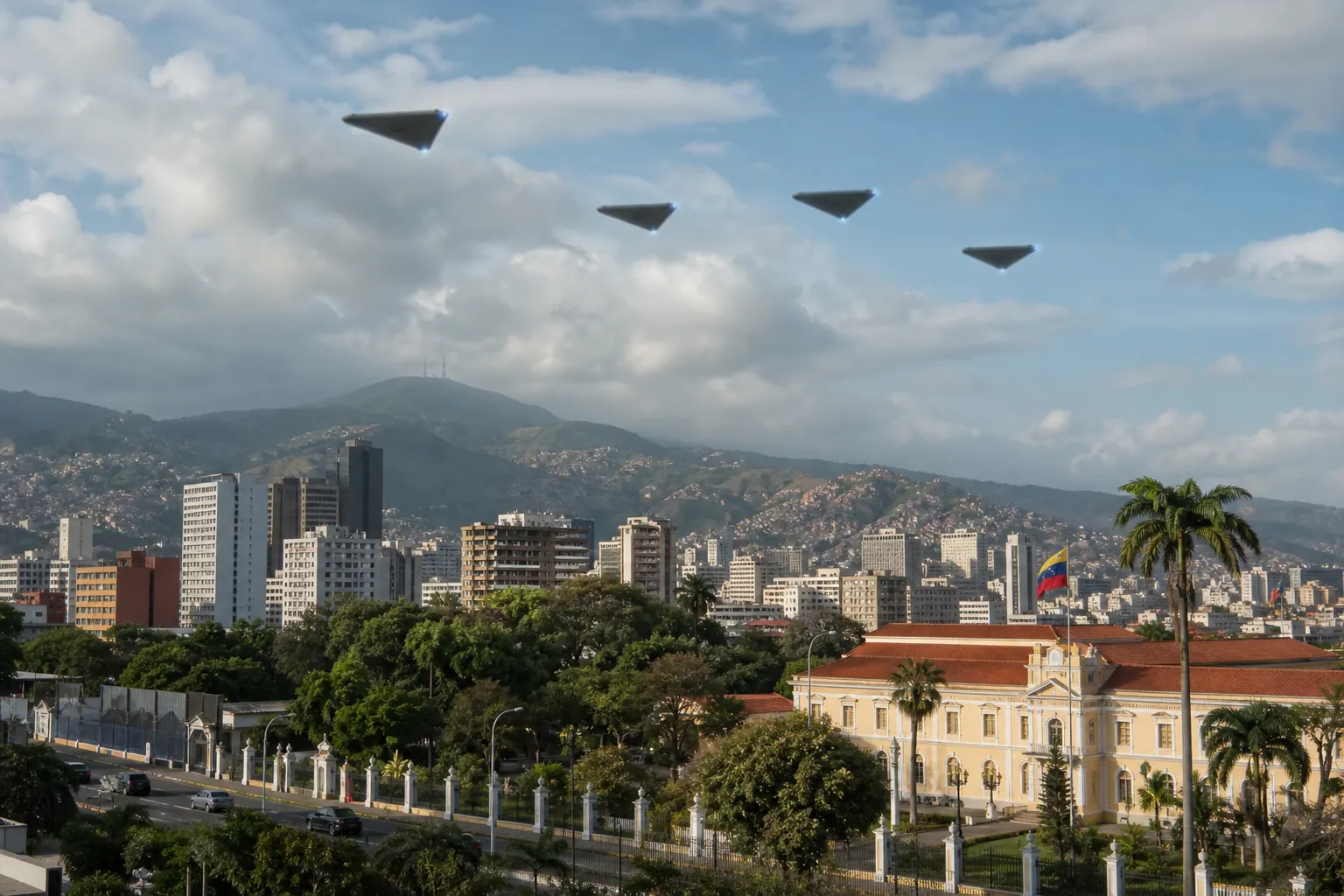
Craft morphology
On the afternoon of July 31, 1974, the Presidential Palace of Miraflores in Caracas became the epicenter of Venezuela's most consequential UAP event. President Carlos Andrés Pérez was presiding over a ministerial cabinet session when the meeting was interrupted by reports of unidentified objects visible in the sky over the capital. The President and his ministers stepped into the palace gardens, where they, along with waiting journalists and military security personnel, witnessed four dark objects moving silently over the city. Simultaneously, hundreds of other witnesses across the cities of Maracay (Aragua state) and Valencia (Carabobo state) reported identical observations, indicating a multi-city flyover covering Venezuela's densely populated central corridor.
The principal witnesses were among the most credible possible: a sitting head of state, members of the national cabinet, military security personnel, and credentialed journalists. Carlos Andrés Pérez had assumed the presidency in March 1974 and was one of the most prominent political figures in Latin American history. The assembled cabinet represented the full executive branch of the Venezuelan government. Beyond Miraflores, an unknown but substantial number of civilians — described in contemporary Venezuelan press coverage as "thousands" across three cities — independently reported the same phenomenon within the same time window. The political sensitivity of the sighting, occurring over the seat of government itself, made suppression or dismissal difficult for the Defense Ministry, which formally acknowledged the incident by requesting official reports.
The objects were described as dark in color and triangular in shape, each producing luminous effects visible against the afternoon sky. Four distinct craft were observed simultaneously over different locations spanning a distance of approximately 180 kilometers from Caracas to Valencia. The objects moved silently. No sonic signature consistent with conventional jet or propeller aircraft was reported. The duration of the sighting is not precisely recorded in available documentation, but witnesses reported the objects accelerated and disappeared at high speed following the initial observation from Miraflores. The multi-city, simultaneous nature of the event effectively eliminates localized balloon, flare, or atmospheric artifact hypotheses: the same phenomenon was independently described at roughly the same time by witnesses separated by over a hundred kilometers.
Three primary anomalies characterize this event. First, the triangular formation of four objects with self-luminous properties does not match any known Venezuelan Air Force or civil aviation asset deployed in the mid-1970s. Second, the Defense Ministry's subsequent radar investigation found that Maiquetía International Airport's radar systems, covering the capital's airspace, registered no returns corresponding to the observed objects — despite clear simultaneous visual confirmation from multiple ground locations including military installations. Third, the Defense Ministry confirmed that no commercial, private, or military flights had been authorized in the affected airspace that afternoon, ruling out misidentification of known air traffic.
No physical trace evidence or physiological effects were reported by witnesses. The radar null result at Maiquetía is the primary instrument anomaly: the Venezuelan defense radar system, covering the central corridor airspace, captured no targets during the period of visual observation. This radar null, while not a direct physical effect, is significant because it indicates either objects with a radar cross-section below the threshold of 1970s-era search radar, or objects capable of actively evading detection — both anomalous characteristics. Military bases in the central corridor that provided visual confirmation similarly reported no radar corroboration.
The Venezuelan Ministry of Defense formally requested investigation reports from military aviation command and from the Maiquetía radar facility. The resulting inquiry confirmed the mass of visual observations and the complete absence of radar returns or authorized flight activity. No official explanation was offered. The government did not deny the event — the President's direct observation made that impossible — but also issued no formal public conclusion. Venezuelan researcher Héctor Escalante, who documented the case over subsequent decades, noted that military personnel at affected bases were instructed not to speak to media about what they had observed. The presidential witness component prevented total suppression; the case remained in Venezuela's UFO research literature as the country's most politically high-profile incident.
The Defense Ministry's investigation results were not made fully public. Military witnesses at the bases in the central corridor were reportedly instructed to keep their accounts internal. However, the presidential nature of the sighting created an unusual accountability constraint: the head of state was himself a witness, making blanket denial politically untenable. Media coverage in the Venezuelan press in August 1974 documented the event and the official inquiry. No declassification of the military investigation file has been confirmed. The radar null result — a key finding — was leaked through ufology researcher channels rather than formally published by the Venezuelan government.
The Miraflores Palace flyover stands as the most politically significant UAP event in Venezuelan history and one of the most credible head-of-state witness cases in the global record. The combination of a sitting president, a cabinet of ministers, journalists, military personnel, and thousands of independent civilian witnesses across three cities constitutes an exceptionally large and high-credibility witness pool. The radar null result despite confirmed visual observation mirrors patterns seen in other benchmark cases including the 1976 Tehran intercept and the 1989 Belgium wave. The simultaneous multi-city nature of the event provides strong triangulation support for an actual physical phenomenon rather than a localized optical effect. Venezuela's failure to formally declassify or explain the Defense Ministry investigation file leaves the case open.