
Credibility Audit
2 factors- Multiple Witnesses+2
- Historical Document+1
- 0–3
- 4–7
- 8–11
- 12–16
- 17+
DoD Observables
0 of 5- Instantaneous Acceleration
- Hypersonic Velocity
- Low Observability
- Trans-Medium Travel
- Anti-Gravity Lift
Event Description
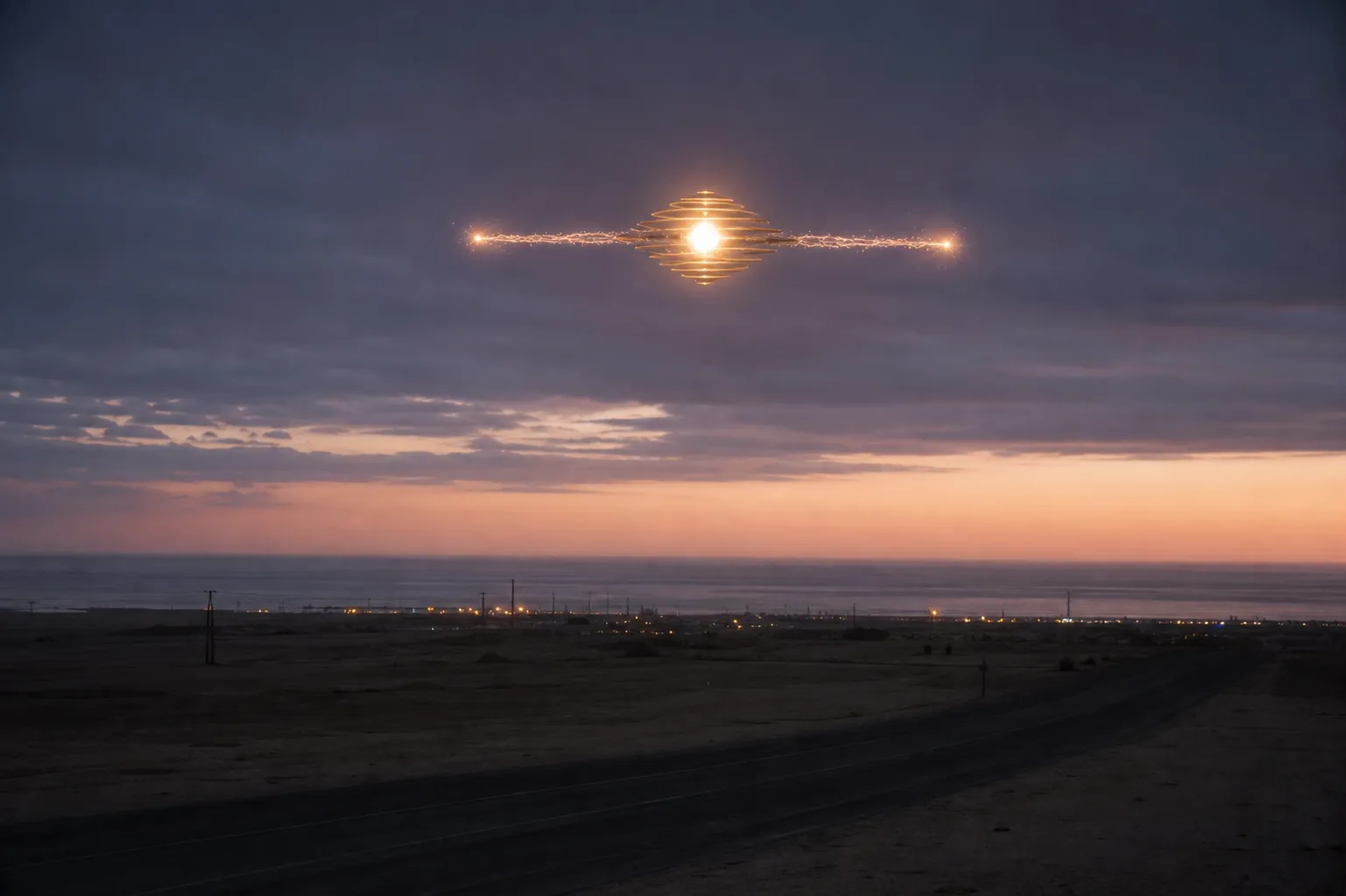
On August 16, 1976, residents of Walvis Bay — the port town on the Atlantic coast of what was then South West Africa, administered by South Africa under the South African Border War conditions — reported observing an unidentified aerial phenomenon over the desert wilderness surrounding the town. The event was significant enough to prompt coverage in the regional newspaper, The Namib Times, which published witness descriptions in its August 16 edition. Walvis Bay in 1976 was a strategic maritime and military location: the South African Defence Force (SADF) was actively operating in South West Africa as part of the broader Border War campaign, and the territory was under military administrative conditions. Multiple independent witnesses observed the same phenomenon from different positions within the town.
The witnesses were residents of Walvis Bay, a town whose population in 1976 consisted predominantly of fishing industry workers, harbour personnel, and South African military and administrative staff. No individual witness names are preserved in the available documentation — the Namib Times article reported the collective observations without attribution by name. The multi-witness nature of the observation — described as "several people" in the newspaper record — and the consistent descriptive detail across witnesses (spherical top, bright ball, luminous extensions with spark-like emissions) supports a genuine shared observation rather than individual misidentification. No known conventional military operation in the area at that time would account for the described phenomenon.
Witnesses described the object as having a layered structure: a spherical element on top, with a round ball positioned beneath that shone brilliantly, and two elongated luminous extensions. These extensions were described as shining and appearing to shoot off something resembling sparks. The phenomenon appeared at night or in pre-dawn hours and was associated with the surrounding darkness. Critically, the object did not abruptly terminate — it "faded" gradually as the sun rose, eventually disappearing completely as daylight arrived. This gradual sunrise-associated disappearance is unusual and distinguishes the phenomenon from conventional aircraft (which would not be affected by ambient light levels) while also being inconsistent with standard meteor or fireball behaviour (which produces instantaneous rather than gradual phenomena). Some observers characterised it colloquially as a "Space Monster" — a descriptor reflecting the unfamiliar appearance rather than a literal classification.
The sunrise-correlated gradual disappearance is the primary anomaly. No natural aerial phenomenon common to the Namibian coastal desert — atmospheric optical phenomena, ball lightning, meteorological apparatuses — would be expected to appear brightly at night and fade consistently with increasing solar illumination in the manner described. The structural description — a layered spherical-and-ball configuration with independently luminous extensions emitting particle-like emissions — does not correspond to known aircraft of the era. South Africa's 1976 aviation capabilities over Walvis Bay consisted of SADF conventional aircraft, and no SADF experimental platform matching this description is known to have been operational. The coastal desert location and the phenomenon's apparent static or slow movement (implied by the long observation period through pre-dawn hours) further constrain conventional explanations.
No electromagnetic, radar, or instrument effects are documented in the available sources. The Namib Times report is based solely on visual witness accounts. No physical residue, trace evidence, or photographic record is known to exist. The documentary significance is the contemporaneous newspaper record, which provides a fixed date and geographic anchor for an otherwise undocumented regional event.
No official response from South African Defence Force authorities, SADF South West Africa Command, or South West Africa Administration has been identified in available sources. Given the SADF's operational status in the territory during the Border War period, any unusual aerial phenomena over strategic maritime towns like Walvis Bay would theoretically have been of air-defence interest. The absence of documentation may reflect either that no formal report was made to military authorities, or that any military response documentation was classified and not subsequently released.
No evidence of active suppression is identified. South African military censorship during the Border War was primarily focused on counter-insurgency operations and SADF force activities; there is no known policy of systematic UAP suppression in South West Africa during this period comparable to US, Soviet, or British programmes. The case appears to have been simply a local newspaper report that did not attract subsequent formal investigation.
The Walvis Bay 1976 case is the best-documented historical UAP encounter available for the territory of Namibia. Its significance is primarily archival: it provides a contemporary newspaper record for an anomalous aerial observation in a strategically significant location during the South African Border War period. The SADF's operational presence in South West Africa during this period — with Soviet, Cuban, and UNITA forces also active in the broader regional conflict — means that the airspace over Walvis Bay in August 1976 was among the most closely monitored in sub-Saharan Africa. An unidentified luminous object that was observed by multiple residents over several hours without attracting documented military investigation constitutes an archivally notable gap in the SADF air-defence record of that period.