
Credibility Audit
3 factors- Military Witness+3
- Multiple Witnesses+2
- Official Report+1
- 0–3
- 4–7
- 8–11
- 12–16
- 17+
DoD Observables
2 of 5- Instantaneous Acceleration
- Hypersonic Velocity
- Low Observability
- Trans-Medium Travel
- Anti-Gravity Lift
Event Description
Craft morphology
Zambia gained independence in 1964 under Kenneth Kaunda's UNIP government, and by 1975 the Zambian Air Force (ZAF) had developed into a small but professional force with British-trained pilots and air traffic control personnel, supplemented by advisors from several nations. Lusaka International Airport served as the ZAF's primary base and the nation's main civilian airfield. The mid-1970s were a period of heightened aerial sensitivity in southern Africa: the ongoing wars of liberation in Rhodesia, Angola, and Mozambique meant that unidentified aircraft over Zambian airspace were a genuine security concern, and the ZAF maintained active interception procedures. This security context gave any anomalous aerial contact immediate operational significance.
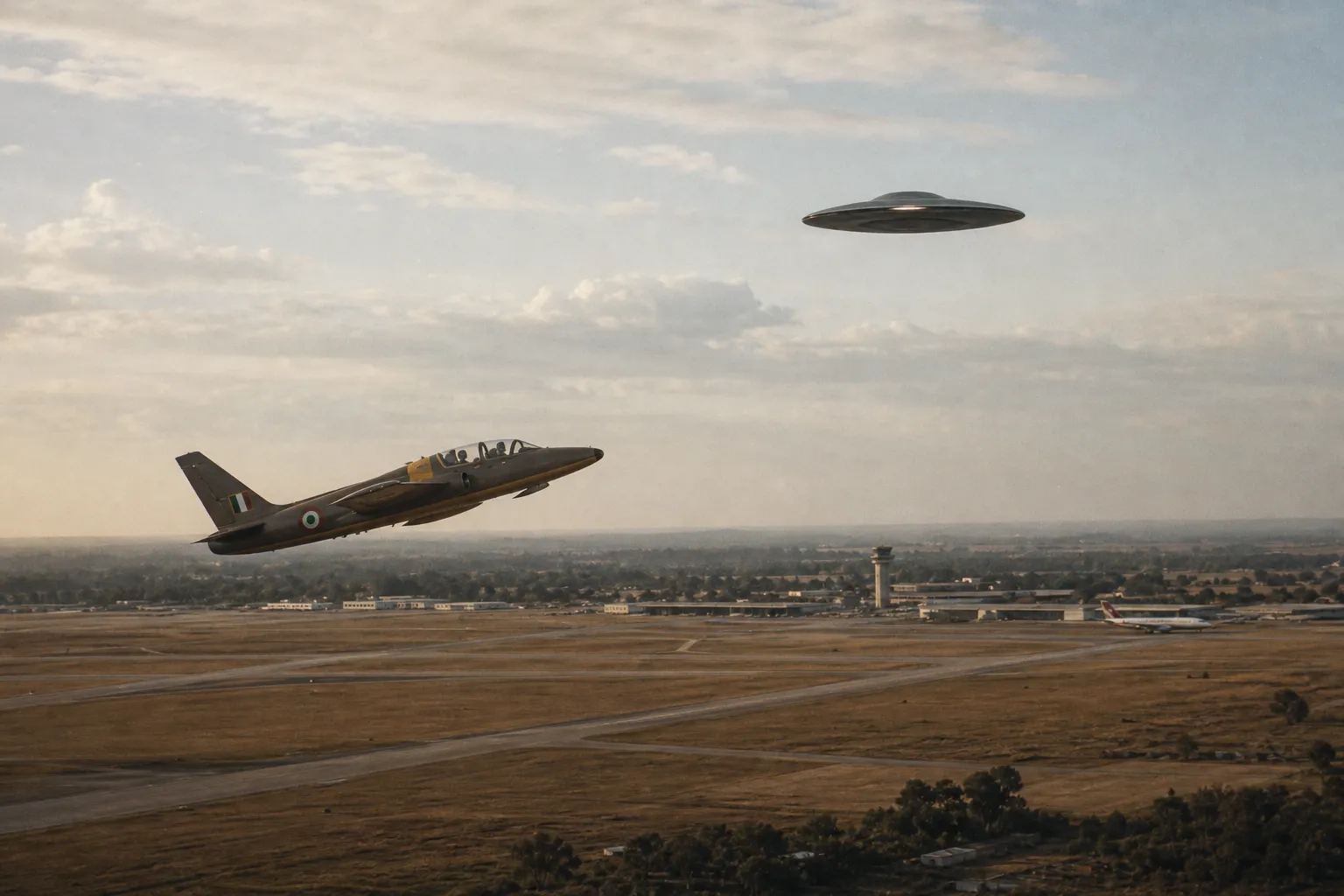
Zambian Air Force pilots — British-trained, operating to RAF-standard recognition protocols — were the primary witnesses. The object was first sighted by ground crew at the airfield, who alerted the duty officer. A ZAF jet trainer was dispatched for visual identification. The pilot in the intercepting aircraft visually confirmed the object and reported its characteristics by radio to the Lusaka tower, where the air traffic control officer also observed the object visually from the tower. The combination of airborne pilot, air traffic control officer, and ground crew as independent witnesses from three different positions provides strong multi-witness corroboration.
The object was described as a disc or lens shape, metallic in appearance under daylight, with no visible propulsion system. The ZAF jet trainer pilot closed to within identification range and confirmed the object's shape before it accelerated away. The acceleration was described as instantaneous — the object went from a relatively low speed (slow enough for the jet trainer to approach) to an extreme departure speed in a fraction of a second, leaving the ZAF aircraft far behind. The object departed toward the northeast and was lost from visual range within seconds.
The intercept provided a direct speed comparison: the ZAF jet trainer — with a top speed of approximately 350–500 mph depending on type — could approach the object initially, indicating it was flying at relatively low speed. The subsequent instantaneous acceleration to a speed that left the jet trainer behind definitively is the primary performance anomaly. No aircraft in the ZAF's adversaries' inventories — Rhodesian, South African, or Soviet-supplied Angolan or Mozambican forces — had this capability. The disc shape, metallic appearance, and silent operation were also inconsistent with any known aircraft.
No radar tracking data is documented in available sources. The primary evidence is the multi-witness visual observation, including the airborne pilot's close-range sighting and radio report to the tower. No physical trace was identified.
The incident was reported through ZAF channels and entered the official military record. Zambia's close relationship with British military advisors during this period meant the report was also communicated informally to British representatives in Lusaka. The Southern African UFO Research Society (SAUFORS), which maintained close contacts with military sources across the region, documented the case. Zambian newspapers reported the incident, providing contemporaneous press coverage.
Zambia under Kaunda's UNIP had a controlled press but not a totalitarian information system. Newspaper coverage of the ZAF incident reached the public within weeks. No active suppression campaign is documented. The ZAF did not publicly confirm the report but did not prevent newspaper coverage.
The Zambia 1975 case is notable for the direct interception attempt, which provides a performance benchmark unavailable in most UAP sightings: the ZAF pilot's ability to initially approach the object and then be left behind on acceleration provides a concrete, measurable demonstration of the object's performance characteristics. The case contributes to the documented pattern of UAP activity across southern Africa during the mid-1970s liberation wars, when military aviation activity was at its highest in the region's history. SAUFORS's documentation of this and related southern African cases provides a research baseline for the region that is often overlooked in primarily Anglo-American UAP research.
Sources
- mediaSouthern African UFO Research Society (SAUFORS) — Zambia military case files, 1975
- mediaThe Times of Zambia — contemporaneous newspaper coverage of ZAF UFO intercept, 1975
- mediaCynthia Hind, 'UFOs Over Africa' (1982) — documents Zambia ZAF case, chapter on Southern African military encounters