
Credibility Audit
5 factors- Multiple Witnesses+2
- Expert Witness+2
- Video Evidence+2
- Historical Document+1
- Official Report+1
- 0–3
- 4–7
- 8–11
- 12–16
- 17+
DoD Observables
0 of 5- Instantaneous Acceleration
- Hypersonic Velocity
- Low Observability
- Trans-Medium Travel
- Anti-Gravity Lift
Event Description
Craft morphology
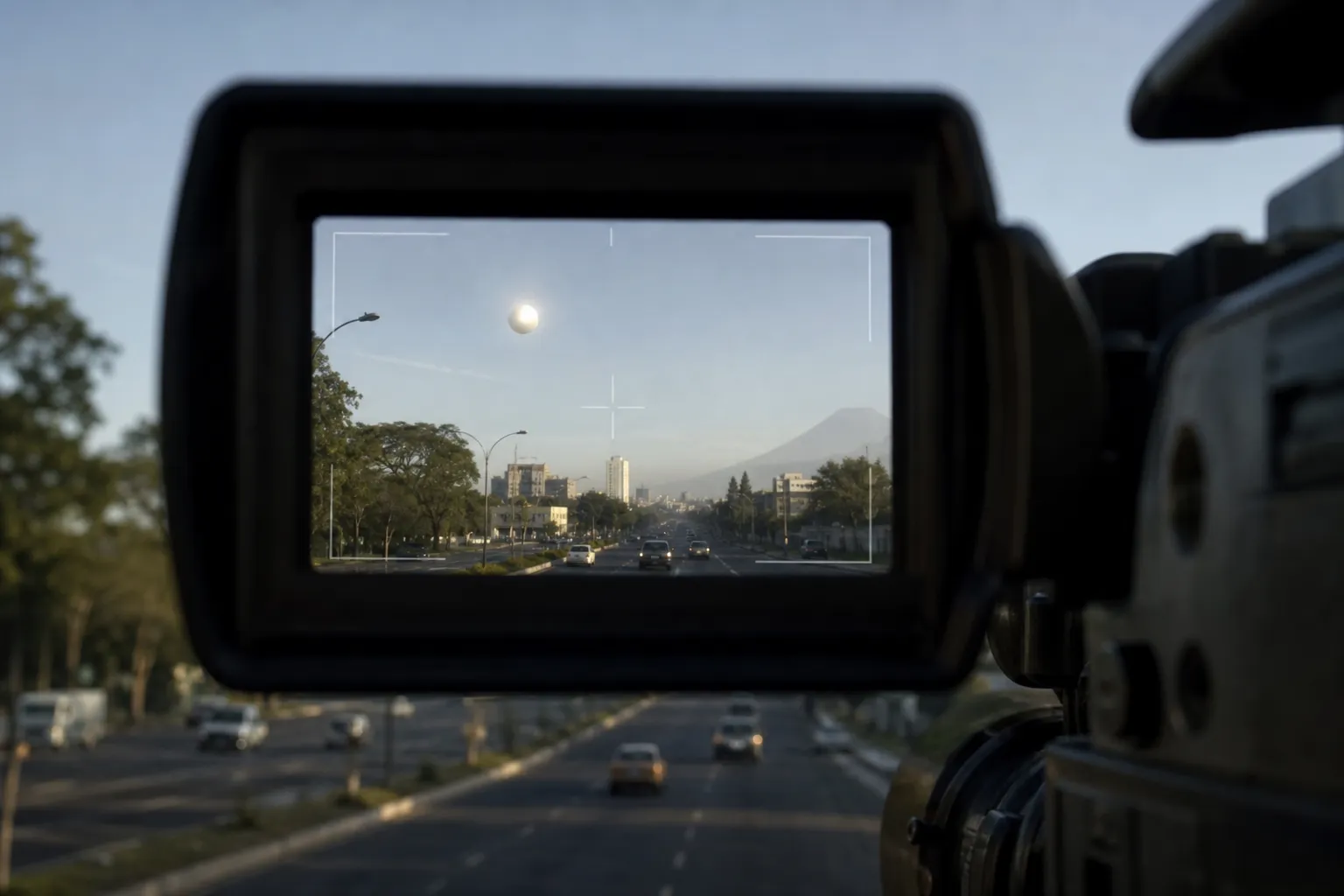
Shortly after 10 in the morning on October 6, 1976, a professional television film crew deployed on a routine commercial shoot in Guatemala City inadvertently became the producers of what researchers would later call one of the earliest credibly analyzed UAP video recordings. The crew from Canal 3 (Channel 3) Guatemala — among them cameraman Manuel Juárez — was set up in the parking lot of a fast-food establishment on Calzada Roosevelt, Zone 11, when a luminous spherical object appeared in the sky above, emerging from behind trees and traversing the frame in a measured north-to-south path before executing a sharp 90-degree ascent and vanishing. Juárez tracked the object for approximately 51 seconds of captured footage. The recording was made on professional-grade television camera equipment, providing higher image quality than the typical amateur photographs that dominated UAP evidence at the time. What followed — technical analysis by Channel 3's operations chief, review by the world's leading UAP scientist, and presentation before the United Nations — elevated this footage to international notice.
Cameraman Manuel Juárez was a professional television operator with training in focus, tracking, and film technique — skills that distinguish his capture from an untrained observer's attempt to film an aerial object. Oscar Tobar and other advertising agency and automobile distributor personnel present at the shoot provided independent corroboration of what the camera recorded. Eduardo Mendoza, operations chief at Channel 3, applied technical broadcast industry expertise to analyze the footage's content. Dr. J. Allen Hynek — Chairman of Astronomy at Northwestern University, former USAF scientific consultant on Project Blue Book, and founder of the Center for UFO Studies (CUFOS) — reviewed the footage and provided his formal scientific opinion. Hynek's involvement constitutes the highest level of expert analysis available in the civilian UAP research world in 1976. The subsequent presentation of the footage before a United Nations committee in November 1977 further institutionalized the record.
The object was spherical and self-luminous — brilliantly illuminated with no shadow visible on its underside despite the sun being at approximately 58 degrees of elevation, indicating an internal or surface light source rather than reflective illumination. It emerged from behind trees in the direction of north and traveled southward across the frame. Eduardo Mendoza's analysis established the following parameters: approximate initial altitude of 300 meters, rising to approximately 1,000 meters at the point of 90-degree course change; ground speed of approximately 35–40 km/h (against measured prevailing winds of 15 km/h, eliminating balloon drift as explanation); total observable flight path captured for 51 seconds before the abrupt vertical turn. The object then disappeared at the zenith — accelerating skyward in a manner inconsistent with any conventional or experimental aircraft known to operate in Guatemala in 1976.
Three anomalies emerge from the combined technical and visual analysis. First, the self-luminosity — the absence of a shadow despite direct overhead sunlight — indicates an object generating or emitting light rather than reflecting it, which is not characteristic of known aircraft, balloons, or meteorological objects. Second, the 90-degree vertical course change from horizontal north-to-south flight to direct skyward trajectory is physically demanding and was executed without any visible deceleration, turn radius, or banking typical of known aircraft. Third, the object's measured ground speed of 35–40 km/h in 15 km/h winds is inconsistent with a free balloon (which would move at wind speed) but too slow for a known powered aircraft to maintain controlled flight without stalling — placing the object in an unusual performance envelope.
No physical trace evidence or physiological effects were reported. The 51-second video footage constitutes the primary evidentiary record and was subjected to photographic and broadcast-technical analysis. Mendoza's measurement of the object's apparent size, speed, and altitude used the known field of view of the Channel 3 camera equipment and known landmark references within the frame to produce calibrated estimates. No anomalous electromagnetic effects on the camera equipment or nearby vehicles were documented. The footage was examined for signs of optical artifacts, lens flares, or film processing anomalies; no such artifacts were identified by either Mendoza or Dr. Hynek in their respective analyses.
The Guatemalan government did not initiate a formal national investigation into the incident. However, the footage achieved international official attention through the United Nations process: Grenadian Prime Minister Eric Gairy had taken up the cause of international UAP investigation at the UN, and the Guatemala Channel 3 footage was among the evidence materials presented to the UN special committee on November 14, 1977. Gairy had introduced the agenda item "Establishment of an agency or department of the United Nations for undertaking, co-ordinating and disseminating the results of research into unidentified flying objects and related phenomena" at the 32nd General Assembly session. The draft resolution was not pressed to a vote but the presentation of the Guatemala footage before the committee constitutes the highest formal international recognition the case received.
No active suppression of the Guatemala footage was documented. The Guatemalan government neither endorsed nor suppressed the Channel 3 recording. The footage circulated in international UFO research circles through the late 1970s and was published in the International UFO Reporter (IUR), the journal of the Center for UFO Studies, in Volume 2, Number 11. Dr. Hynek's endorsement of the footage as genuine provided it credibility in the research literature. The Grenadian Prime Minister Eric Gairy, who championed UAP investigation at the UN and used the Guatemala footage as evidence, was deposed in a coup in March 1979 while attending a UN session in New York — an event sometimes noted in the context of UAP disclosure politics, though no causal connection has been demonstrated.
The 1976 Guatemala City footage occupies a unique position in UAP documentation history as one of the earliest instances of professionally recorded video subjected to formal scientific analysis and presented to an international governmental body. Dr. Hynek's endorsement — from the scientist who served as the USAF's own UAP consultant for twenty years — carries particular weight: Hynek was not prone to easy attribution of genuineness and had publicly reclassified many ambiguous cases as conventional. The 51-second duration of the footage, the multiple professional witnesses, and the technical analysis grounded in known equipment parameters together produce a case that satisfies most serious evidentiary criteria. Guatemala's Channel 3 footage remains the single best-documented UAP event in Central American history.
Sources
- mediaDe Guatemala: El OVNI de 1976 en Guatemala
- mediaSiglo 30: Los casos más importantes de avistamientos OVNIS en Guatemala
- academicInternational UFO Reporter (CUFOS), Vol. 2 No. 11 — Guatemala case analysis by Eduardo Mendoza / J. Allen Hynek