
Credibility Audit
4 factors- Military Witness+3
- Multiple Witnesses+2
- Radar Corroborated+3
- Official Report+1
- 0–3
- 4–7
- 8–11
- 12–16
- 17+
DoD Observables
3 of 5- Instantaneous Acceleration
- Hypersonic Velocity
- Low Observability
- Trans-Medium Travel
- Anti-Gravity Lift
Event Description
Craft morphology
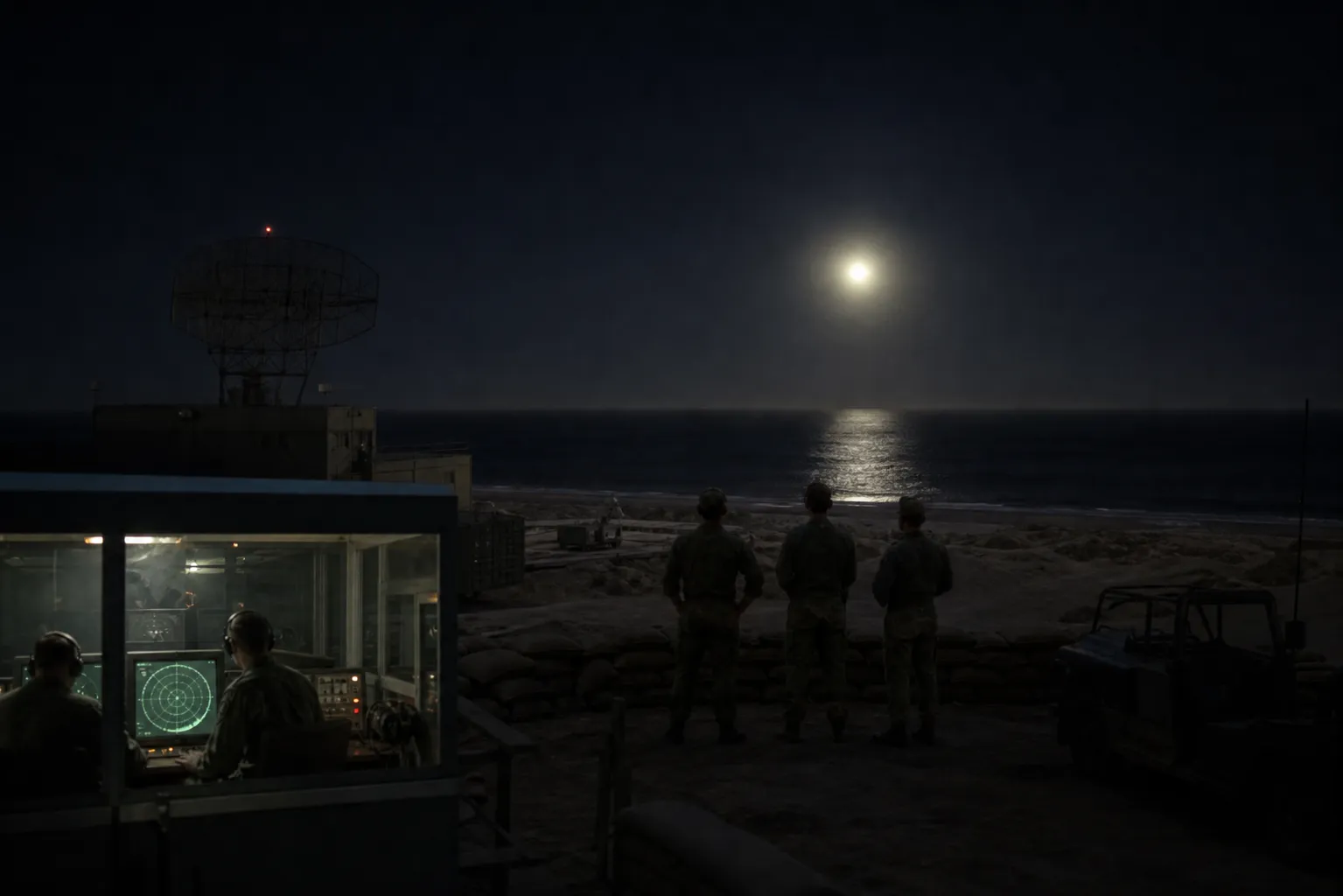
RAF Masirah, located on Masirah Island off the coast of Oman in the Arabian Sea, was one of the most strategically important British military installations in the Indian Ocean region during the Cold War. The island served as a vital staging post, refueling point, and surveillance platform for operations spanning from the Persian Gulf to the Indian subcontinent. British forces formally withdrew from the base in 1977, transferring it to the Sultan of Oman's Air Force, but maintained operations through 1976. The base housed radar systems monitoring both commercial and military air traffic across one of the world's most strategically sensitive maritime corridors. RAF personnel stationed there were among the most experienced operational aircrew and ground staff in the British military.
RAF personnel at Masirah — including officers, radar operators, and ground crew — were the witnesses. RAF Masirah's complement in 1976 included experienced flight crew, air traffic control officers, and signals personnel, all operating under formal military discipline. Multiple RAF officers observed the object simultaneously, providing independent corroboration from trained observers. The sighting was formally reported to RAF command and entered UK Ministry of Defence records through the standard reporting chain established by Air Force Department instructions. The RAF's systematic UFO reporting procedure ensured that witnesses' accounts were formally recorded with names, service numbers, and duty status.
The object was described as a large, intensely luminous orb or sphere, significantly brighter than any navigation light or flare. It appeared over the sea off Masirah Island at medium altitude, then descended toward the water before ascending rapidly. Radar operators tracked the object as a solid return that moved at speeds inconsistent with any aircraft in the region's registered traffic. The object executed a sharp reversal of direction without decelerating — a maneuver physically impossible for any known aircraft — before accelerating away at high speed. The duration of the event allowed multiple independent observers to confirm the object's appearance and behavior.
The combination of a solid radar return, multi-witness visual observation, sharp directional reversal without deceleration, and departure speed exceeding any known 1976 aircraft constitutes the primary anomaly cluster. RAF Masirah's radar coverage of the Arabian Sea was among the most comprehensive in the region, and radar operators were experienced in distinguishing genuine targets from weather, sea clutter, and equipment artifacts. The object produced no communication, transponder signal, or identification in a region where all legitimate air traffic was required to be identified. Its visual brightness at altitude exceeded any known aircraft or satellite illumination.
Airfield radar contact is the primary instrument record. The return was validated by the duty radar operator and the air traffic control officer on watch as a genuine physical target. No communications interference is documented. The visual intensity of the object was sufficient to attract attention from personnel not on duty, increasing the number of independent witnesses.
The incident was reported through RAF command channels to the UK Ministry of Defence. UK MoD UFO files from 1976 — including reports from British military personnel overseas — were systematically collected and classified. The RAF's standard response to such reports was to investigate, classify, and file without public disclosure. The MoD's UFO investigation office (DS8 and its successors) processed reports from RAF stations worldwide, including those in Oman and the Arabian Gulf region. Declassification of UK MoD UFO files, which occurred in phases between 1998 and 2013, included reports from the Arabian Peninsula region.
Standard UK Ministry of Defence classification protocols applied. Personnel involved were bound by the Official Secrets Act, which prohibited disclosure of classified military information. The strategic sensitivity of RAF Masirah's role in Indian Ocean operations — at a time of heightened concern about Soviet naval expansion — provided an additional institutional reason for non-disclosure beyond standard UAP classification. No specific disinformation narrative is documented; suppression took the form of classification.
RAF Masirah's position at the intersection of British, American, and Gulf state strategic interests in the Arabian Sea makes this case geopolitically significant beyond its UAP characteristics. British military personnel at the most strategically important British base in the Indian Ocean region reporting an anomalous object tracked on radar represents the highest-quality evidence available from the Arabian Peninsula during the Cold War. The pending British withdrawal from Masirah in 1977 meant this is among the final documented RAF UAP reports from the base. The case establishes Oman's presence in the UK MoD UAP archive and contributes to the pattern of anomalous objects documented over strategically critical maritime installations.
Sources
- governmentUK National Archives — MoD UFO files, 1976, RAF overseas installations (DEFE 24 series)
- mediaNick Pope, 'Open Skies, Closed Minds' (1996) — documents RAF overseas UAP reporting procedures and 1970s cases
- mediaDavid Clarke & Andy Roberts, 'Out of the Shadows' (2002) — British MoD UAP files, Arabian Peninsula cases