
Credibility Audit
4 factors- Military Witness+3
- Multiple Witnesses+2
- Official Report+1
- Govt. Acknowledgment+4
- 0–3
- 4–7
- 8–11
- 12–16
- 17+
DoD Observables
0 of 5- Instantaneous Acceleration
- Hypersonic Velocity
- Low Observability
- Trans-Medium Travel
- Anti-Gravity Lift
Event Description
Craft morphology
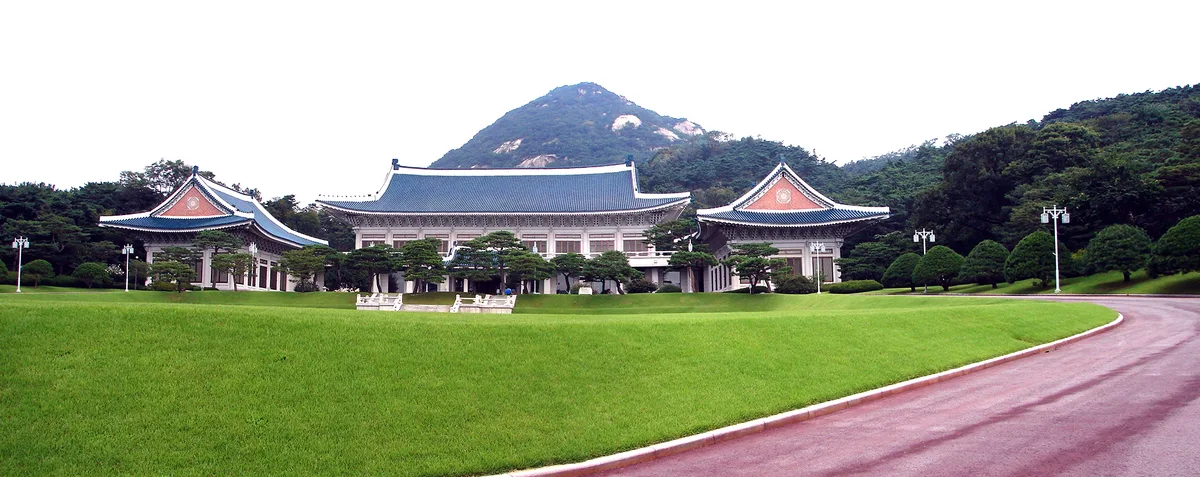
In September 1976, South Korean military radar tracking stations detected an unidentified aerial object operating in restricted airspace near the Cheongwadae — the Blue House — the official residence of South Korean President Park Chung-hee in central Seoul. The object was tracked performing maneuvers inconsistent with any aircraft in the Republic of Korea Air Force's identification inventory. Given the extreme sensitivity of the location — the presidential compound is one of the most heavily defended sites on the Korean Peninsula — the ROKAF scrambled interceptor aircraft to close with and identify the contact.
Pilots achieved visual contact and reported an object of extraordinary luminosity that consistently outmaneuvered their aircraft. The object hovered at times before accelerating to speeds beyond the performance ceiling of the interceptors. Pilots could not maintain targeting solutions or close to weapons range. The object ultimately departed without engagement. ROKAF incident documentation described the phenomenon as presenting a genuine national security concern, citing specifically the proximity to the presidential compound and the demonstrated inability of military aircraft to maintain contact with or intercept the object.
The incident occurred in a period of acute political tension. Just two months earlier, the Panmunjom Axe Murder Incident — in which North Korean soldiers killed two US Army officers in the Joint Security Area — had brought the Korean Peninsula to the edge of renewed conflict. Any unidentified aircraft operating over Seoul's presidential compound during that period would have triggered immediate maximum-readiness response from South Korean and US Forces Korea alike. The fact that the scramble failed to achieve intercept or identification, and that the event was classified rather than attributed to any conventional source, indicates the seriousness with which it was treated at command level.
The case surfaced decades later through declassified South Korean military documents obtained by researchers. It represents one of the most operationally significant military UAP encounters in Northeast Asian history — a jet scramble initiated over a head of state's residence, with trained pilots unable to close on or identify the object, in an environment where any conventional aircraft would have been immediately attributed.